The Winter That Made America: Valley Forge and the Forging of the Continental Army
By Library of History Editorial Staff
On the morning of December 19, 1777, Continental Army surgeon Albigence Waldo watched his fellow soldiers trudge up the frozen road toward a windswept plateau above the Schuylkill River in Pennsylvania. What he saw moved him to reach for his diary. "There comes a Soldier," he wrote, "his bare feet are seen thro' his worn-out Shoes, his legs nearly naked from the tatter'd remains of an only pair of stockings, his Breeches not sufficient to cover his nakedness, his Shirt hanging in Strings, his hair dishevel'd, his face meagre; his whole appearance pictures a person forsaken and discouraged." The army shuffling toward Valley Forge was approximately 12,000 strong, veterans of Brandywine and Germantown, survivors of two years of combat on the American continent's eastern seaboard. Washington's returns showed nearly 2,900 men unfit for duty from lack of clothing and shoes alone. Horses were dying. Commissary wagons were often empty. Twenty miles away in Philadelphia, British officers hosted balls and theatrical performances, confident that the American rebellion would dissolve in the coming months. They were watching the right army. They simply drew the wrong conclusion.
The six months the Continental Army spent at Valley Forge (December 19, 1777 to June 19, 1778) constitute one of the most mythologized episodes in American military history and also one of the most persistently misunderstood. The popular image emphasizes suffering: barefoot soldiers, frozen deaths, a commander on his knees in prayer in the snow. The suffering was genuine. The deaths were real, approximately 2,000 men, roughly one in eight who entered the camp, perished during the encampment, most from typhus, typhoid fever, dysentery, and pneumonia. What is less commonly remembered is that Valley Forge was not primarily a story of endurance. It was a story of transformation. The army that marched out of that plateau six months later was not the army that had shuffled in. It had been rebuilt from the inside out, reorganized, resupplied, politically defended, and, most consequentially, drilled into a professional fighting force by an unlikely Prussian volunteer who arrived in camp with an Italian greyhound, a letter from Benjamin Franklin, and the practical knowledge of how to make soldiers fight as soldiers rather than individuals. Valley Forge did not make the Revolution. But it made the Revolution winnable.
Starve, Dissolve, or Disperse: A Revolution at Its Low Ebb
The autumn of 1777 had been a season of compounded misfortune for Washington's army. On September 11, the Continental Army lost the Battle of Brandywine, the largest land engagement of the Revolutionary War, to General William Howe, opening the road to Philadelphia. On September 26, British forces occupied the American capital. Washington's counterattack at Germantown on October 4, conceived as a bold strike against the British garrison in Philadelphia's suburbs, dissolved in confusion when dense morning fog and poor coordination turned a promising tactical situation into a costly repulse. The contrast with the Northern Department was crushing: on October 17, General Horatio Gates accepted the surrender of British General John Burgoyne at Saratoga, New York, in the most decisive American victory of the war to that point. Gates was suddenly the hero of the hour, and Washington, with Philadelphia lost and two major defeats in six weeks, was the man who couldn't hold a city.
Washington chose Valley Forge for strategic reasons: the plateau offered a defensible position between Philadelphia and the Continental Congress's refuge in York, close enough to monitor British movements and threaten a response if Howe attempted a winter offensive. The choice was militarily sound. The army's condition on arrival was not. Washington's letter to Congress on December 23, 1777, written four days after the march into camp, became one of the most anguished dispatches in American military history. "I am now convinced, beyond a doubt," he wrote, "that unless some great and capital change suddenly takes place in that line, this Army must inevitably be reduced to one or other of these three things. Starve, dissolve, or disperse, in order to obtain subsistence in the best manner it can." The core crisis was not temperature. It was supply failure. The Continental Army's commissary and quartermaster systems had collapsed under the combined weight of wartime inflation, currency depreciation, contractor failures, and Congressional dysfunction. There were days when no meat reached the men at all. The cry that went up through the camp, "No meat! No meat!", became a kind of grim anthem of the encampment's early weeks.
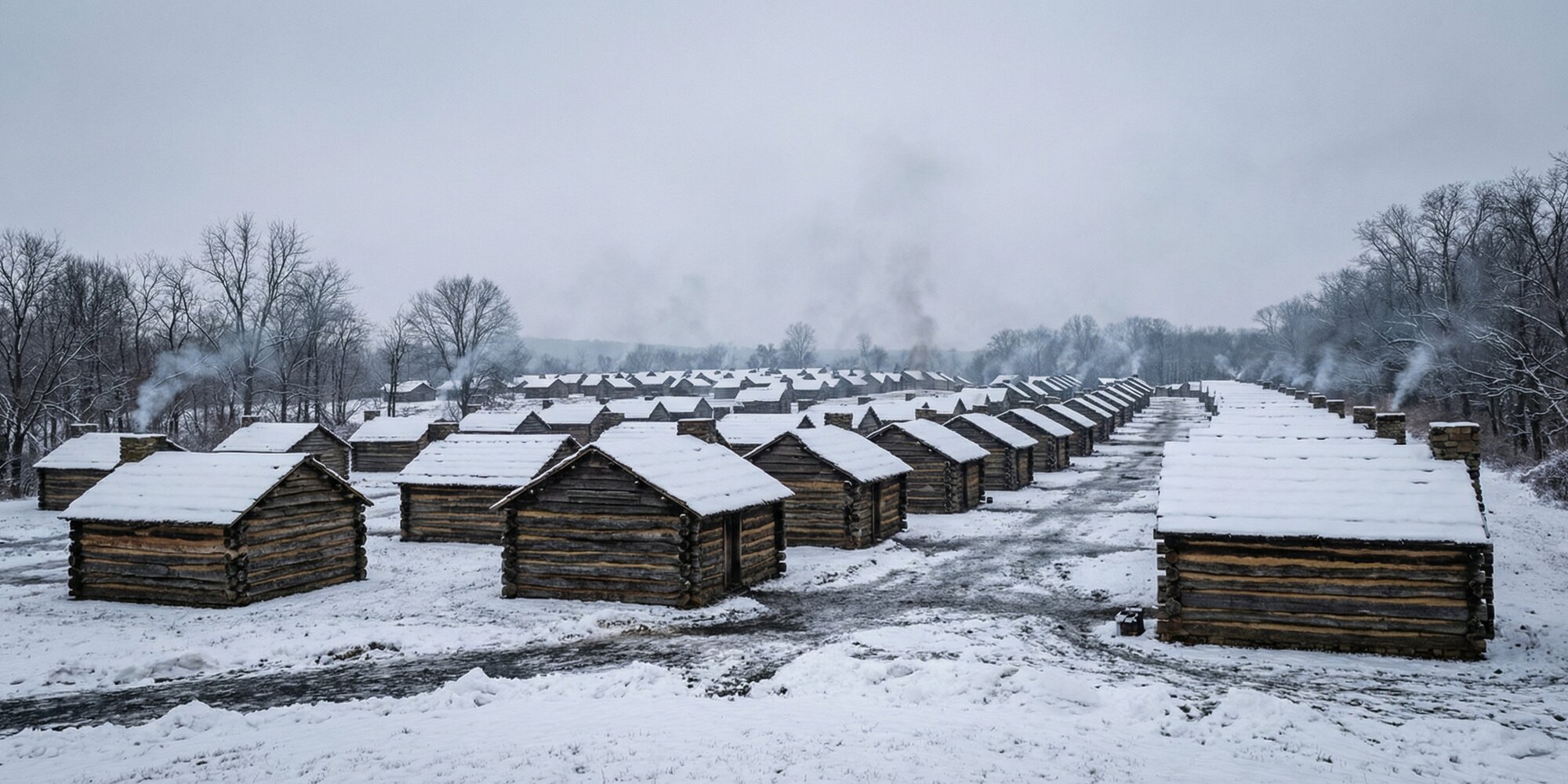
The men did not simply wait to die. Washington organized the construction of the camp with characteristic methodical energy. Each company was assigned to build a log hut according to standardized dimensions, fourteen feet wide by sixteen feet long by six and a half feet high, and Washington offered a cash prize of twelve dollars to the fastest-building company in each regiment. By late January, the frozen hillside had been transformed into a rough city of several hundred huts laid out in organized rows, housing an army that had arrived with almost no shelter. Washington himself refused to move into permanent headquarters until his men were housed; he spent the early weeks of the encampment in his marquee tent before transferring to the stone farmhouse owned by Isaac Potts. Disease, not cold, was the principal killer. Typhus, typhoid fever, dysentery, and pneumonia moved through the close-quartered huts and the improvised hospitals, houses and barns commandeered in the surrounding countryside, faster than Washington's overwhelmed medical officers could manage. Approximately 2,000 men died during the six-month encampment. The army, somehow, held together.
No One Remembers the Quartermaster: Greene and the Rebuilding of Supply
The army held together partly because Washington refused to allow it to fall apart, and partly because he possessed the political skill to identify and remove the obstacles most threatening to its survival. In late February 1778, he finally persuaded Major General Nathanael Greene to accept appointment as Quartermaster General, the officer responsible for moving supplies, equipment, and materiel to the army. Greene, a former Rhode Island iron anchor manufacturer turned military commander, was already one of Washington's most capable field officers. He accepted the appointment with what has become the most self-effacing line in American military administrative history: "No one," he told Washington, "remembers the Quartermaster."
It was true, and it was exactly why the job needed someone of Greene's caliber. His predecessor, Major General Thomas Mifflin, had run the Quartermaster Department into the ground through neglect and, some historians argue, deliberate sabotage born of his political opposition to Washington's command. Greene's reorganization was methodical and consequential. He instituted accountability systems, recruited capable deputies, renegotiated contracts with suppliers, and within months had dramatically improved the flow of provisions and equipment to the army. By spring, men who had wrapped their feet in rags were beginning to receive shoes. The horses had forage. The commissary wagons had something in them. The transformation was unglamorous, administrative, and essential. Without it, the military training that would shortly transform the Continental Army would have had nothing to work with. As the National Park Service's Valley Forge history records, Greene "greatly improved the operation of the Quartermaster department" during his tenure, an assessment that, in context, is a considerable understatement.
While Greene rebuilt the army's logistics, Washington navigated a political threat that ran in parallel with the supply crisis. A loose network of critics, including Brigadier General Thomas Conway, an Irish-born French officer frustrated by his stalled promotions; Major General Thomas Mifflin; and various Congressional allies skeptical of Washington's generalship, were circulating criticism of the Commander-in-Chief in the wake of Brandywine and Germantown. Conway had written a letter to General Gates containing a pointed criticism of Washington; a passage from that letter was disclosed to Washington through channels that remain historically murky, and Washington confronted Conway directly in a response of icy precision. Modern scholarship, including the work of Don Higginbotham in The War of American Independence, is skeptical that the "Conway Cabal" ever constituted an organized conspiracy to replace Washington with Gates. What it certainly represented was a real challenge to Washington's authority at the moment of the army's greatest weakness. Washington's response (careful, methodical, and more political than military) demonstrated a kind of leadership that raw battlefield courage cannot produce. He cultivated allies, exposed the faction's maneuvers through controlled disclosure, and relied on the loyalty of officers whose careers were bound to his command. The cabal effectively dissolved by spring; Conway resigned his commission in April 1778 after being wounded in a duel with a Washington loyalist, General John Cadwalader. Mifflin's reputation did not recover.
The most conspicuous defender of Washington's command during the winter was also the youngest general in the Continental Army. The Marquis de Lafayette, nineteen years old, a French aristocrat who had arrived in America in June 1777 consumed by idealism and the desire to prove himself in a just cause, refused to be separated from Washington despite considerable pressure. He learned of the birth of his daughter on December 19, 1777, the same day the army marched into Valley Forge; he marked the occasion by donating muskets and uniforms to men in his division out of his own funds. When Congress offered him command of a proposed Canadian expedition, an assignment he and Washington both suspected was designed to separate him from headquarters, Lafayette wrote to Congress expressing his concern and his attachment. The expedition was eventually cancelled. Lafayette remained. As the National Park Service's Valley Forge biography of Lafayette confirms, his loyalty during the winter of 1777–1778 was not merely sentimental; it was one of the more visible demonstrations that Washington's command retained the confidence of the officers who mattered most.
The Prussian Drillmaster: Von Steuben and the Army's Transformation
On February 23, 1778, an improbable figure arrived at Valley Forge. Friedrich Wilhelm August Heinrich Ferdinand von Steuben was a middle-aged Prussian who had served as a staff officer under Frederick the Great during the Seven Years' War. He had come to America with a letter of introduction from Benjamin Franklin in Paris and a set of credentials that were somewhat more impressive on paper than in fact (he had presented himself as a lieutenant general, a rank he did not hold) but his practical knowledge of European military drill and infantry tactics was entirely genuine. He arrived at the encampment accompanied by an Italian greyhound and several French-speaking aides, speaking almost no English, and immediately identified what was wrong with the Continental Army and exactly how to fix it.
The problem was fundamental. The Continental Army had been fighting a professional European military for two years without the training that made professional European armies effective. American soldiers were brave. Many were experienced in woodland combat and skirmishing. What they could not do reliably was march in formation, execute facing movements, load and fire in coordinated volleys, respond to cavalry threats by forming square, or conduct a bayonet charge. The bayonet, in particular, was almost entirely absent from the Continental Army's tactical repertoire, one of the primary reasons the army had repeatedly broken under British pressure in the pitched battles of 1776 and 1777. Von Steuben understood that drill (repetitive, standardized, exhaustively practiced formation maneuver) was not mere ceremony. It was the mechanism by which frightened men could be made to function as a unit under fire.
He faced an immediate practical challenge: Prussian drill commands were in German or French, which he could not deliver to American troops. His solution was characteristically direct. He personally demonstrated each drill movement to a selected model company of one hundred men, had his aide translate, and then ran the exercise himself, drilling the company in public view with the rest of the army watching. When translations failed and frustration mounted, he reportedly resorted to cursing fluently in French and German, a performance that, according to contemporary accounts, delighted his American audience and established an immediate rapport. The model company became the template: trained by von Steuben, they trained their regiments, who trained their companies. Within weeks, the entire camp was drilling. The system he created, adapted from Prussian methods but simplified for American conditions and American institutions, was codified in his Regulations for the Order and Discipline of the Troops of the United States, known to posterity as the "Blue Book," which became the standard U.S. Army drill manual for more than three decades.
The proof came in the field. On June 28, 1778, nine days after the army marched out of Valley Forge in pursuit of the British column evacuating Philadelphia for New York, the Continental Army engaged the British rear guard at Monmouth Courthouse in New Jersey. When the controversial General Charles Lee ordered an unauthorized retreat that threatened to collapse the American position, Washington rode to the front and halted the rout. The army then reformed under fire, held the British assault, and conducted an organized fighting withdrawal of the kind that required exactly the discipline von Steuben had spent six weeks drilling into them. The National Park Service's history of Valley Forge records that the army that emerged from the encampment showed "ordered ranks, martial appearance, revived spirit, and fighting skill", and that the Battle of Monmouth demonstrated what that transformation had made possible.
Who Was Actually There: The Army Beyond the Myth
The popular image of the Valley Forge army is populated almost exclusively by Anglo-American yeoman farmers from the original colonies, ragged, white, and stoic. The historical army was considerably more varied. Free Black soldiers served in integrated units throughout the Continental ranks; several Northern states had incorporated Black men into their Continental regiments, and Rhode Island would formally organize the 1st Rhode Island Regiment, largely composed of freed Black men, in February 1778, while the army was still at Valley Forge. Historians estimate that several hundred Black soldiers were present at the encampment, a figure that is difficult to document precisely because the surviving muster rolls are incomplete. The Continental Army at Valley Forge also included significant numbers of Pennsylvania Germans, for whom von Steuben's German-language demonstrations were not entirely foreign, and a remarkable cohort of European volunteers whose expertise was central to the army's development, among them not only von Steuben but the Polish engineer Thaddeus Kosciuszko, and, most visibly, Lafayette himself.
Women were present throughout the encampment, and their roles were more than decorative. Martha Washington arrived at Valley Forge in early 1778, as she did at most of Washington's winter encampments during the war, and spent months there coordinating with other officers' wives to support the hospital system and maintain morale at headquarters. Washington's aide James McHenry wrote of her contributions with genuine admiration. Camp women (the wives and partners of enlisted men, as well as officers' wives) served as nurses, laundresses, and cooks in a system that relied on their labor to function. They are largely absent from the mythologized Valley Forge, but they were there in the snow alongside everyone else.
The strategic picture shifted dramatically in late April and early May 1778, when news reached Valley Forge of the formal Franco-American alliance signed February 6, a direct consequence of the Saratoga victory the previous October. The alliance transformed the calculus of the war: Britain now faced not merely a colonial rebellion but a conflict with France that threatened its global position. The new British commander in America, General Henry Clinton, was ordered to consolidate forces and evacuate Philadelphia, marching overland to New York. On June 19, 1778, six months to the day after arriving, Washington's army marched out of Valley Forge to pursue him. The winter that had nearly broken the Revolution had instead made it something new.
The Revolution That Learned to Win
Valley Forge does not fit neatly into the heroic American narrative, and that is part of what makes it genuinely important. It was not a battle. There was no dramatic victory, no turning point that can be located in a single afternoon's fighting. What happened on that frost-hardened Pennsylvania plateau over six months was more consequential and less cinematic: an army nearly destroyed by its own government's failure to supply it was rebuilt from the inside out by the combination of Washington's moral authority, Greene's administrative genius, von Steuben's professional knowledge, and the stubborn endurance of the men in the huts.
The story of that endurance resists simplification in other ways, too. The men at Valley Forge were not a homogeneous band of patriots marching toward a predetermined destiny. They were farmers and tradesmen, free Black men and Pennsylvania Germans, officers' wives and camp followers, European volunteers and American teenagers. They were there because they had chosen to be, in conditions that gave them every reason to leave, and they stayed for reasons as varied as the men themselves: patriotism, habit, fear, loyalty to the man next to them, belief in a cause whose ultimate success, in December 1777, looked far from certain.
The Founders Online archives at the National Archives preserve Washington's letter to Congress from Valley Forge in full, the dispatches of a man watching his army die and refusing to let it happen. Read alongside the Library of Congress's primary source overview of the American Revolution, they constitute one of the most revealing windows into what the Revolution actually cost and what it actually required. The army that emerged from Valley Forge on June 19, 1778, would fight for another three and a half years, through Monmouth and Yorktown, until Cornwallis finally surrendered on October 19, 1781. The winter that made the most famous prayer-in-the-snow story in American memory was not about prayer. It was about logistics, training, political survival, and the cold, systematic work of making an army that could win. Valley Forge was where that work got done.