The Governor and the Rebel: Bacon's Rebellion and the First Crisis of Colonial America
By Library of History Editorial Staff
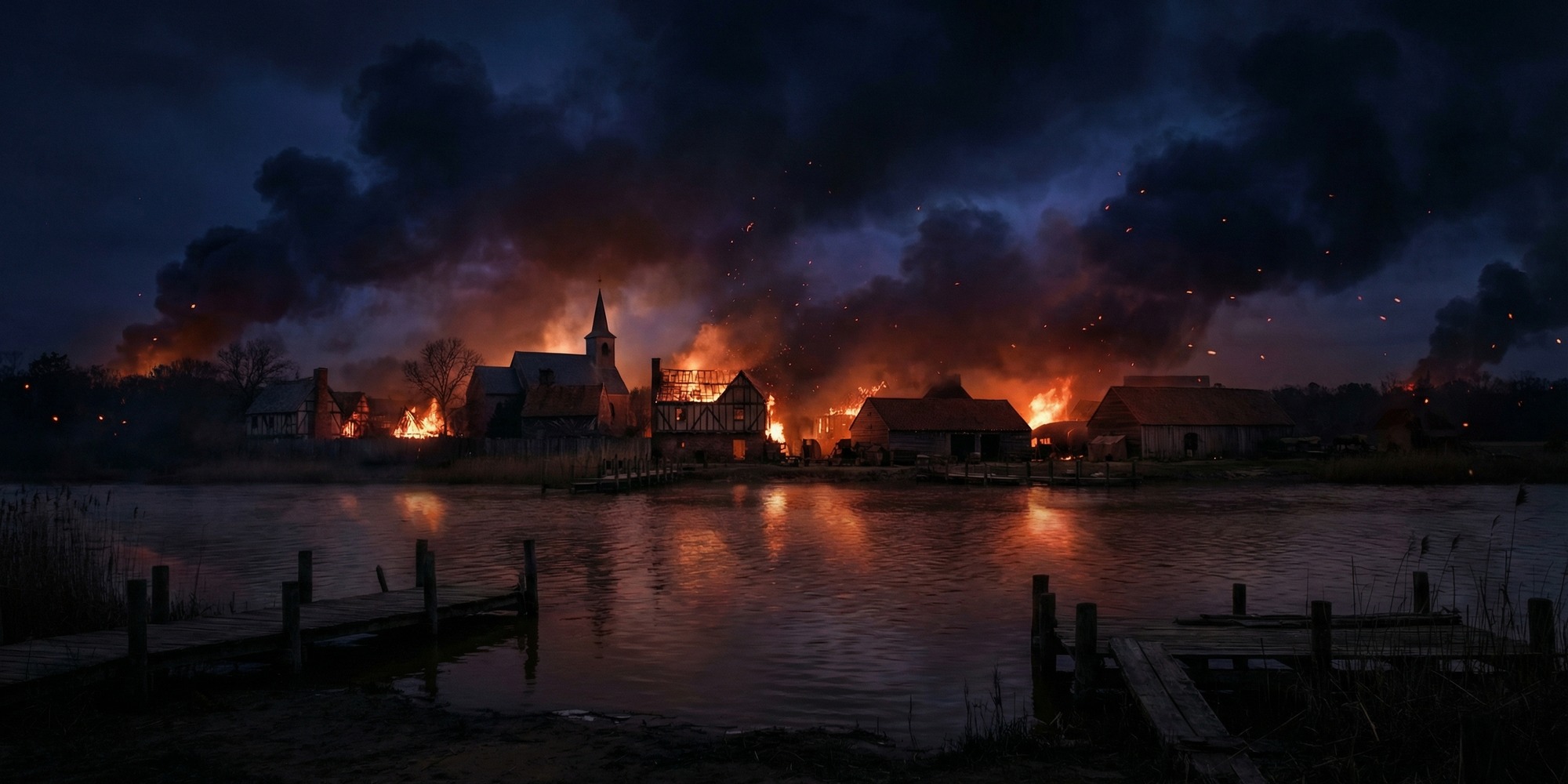
On the night of September 19, 1676, Governor Sir William Berkeley stood on the deck of a ship anchored in the James River and watched the capital of his colony burn. The church. The statehouse. The warehouses and taverns that had stood since the earliest desperate years of English America. Jamestown (England's first permanent foothold in the New World, seventy years old, hard-won through starvation and disease and three brutal Indian wars) was going up in torchlight flames set by its own people.
The man who ordered it burned was somewhere in the darkness onshore: a twenty-nine-year-old Virginia planter named Nathaniel Bacon, who had arrived in the colony barely three years earlier and who had spent the summer leading an unauthorized military campaign, threatening the colonial government, and issuing pamphlets that accused Berkeley of corruption, favoritism, and betrayal of the very people he was sworn to protect. In the weeks since Bacon's army had seized Jamestown, Berkeley had fled twice to the Eastern Shore. Now he watched his capital burn from the deck of a ship, a fugitive in his own colony.
Bacon's Rebellion lasted less than two years from its first sparks in 1675 to its violent suppression in early 1677. It is remembered, when it is remembered at all, as a footnote, a chaotic power struggle between two difficult men on a tobacco-farming frontier. That reputation does the rebellion a significant disservice. What exploded in Virginia in 1676 was the first major armed uprising in England's American colonies, driven by a volatile mixture of economic misery, racial anxiety, class resentment, frontier violence, and political corruption. Its suppression would reshape the architecture of Virginia society in ways that echo across American history to this day.
A Colony at Breaking Point
To understand what happened in 1676, you have to understand what Virginia had become in the decades before it, and what it was doing to the people at the bottom of it.
By the 1670s, Virginia's tobacco economy was under serious strain. Tobacco prices had fallen steadily since the 1650s, the result of overproduction, disruptions from Anglo-Dutch wars, and English mercantile policies that restricted Virginia's access to foreign markets. Taxes remained high. And the colony's primary labor system, white indentured servitude, was producing a growing crisis that its architects had never quite anticipated.
Indentured servitude worked, in theory, as a transaction: men and women from England and elsewhere signed contracts binding them to several years of labor in exchange for passage to the New World. At the end of their indenture, typically four to seven years, they received freedom dues: a small allotment of land, tools, and corn. In practice, by the 1670s, the best tidewater land was already held by established planter families, and freed servants found themselves landless and impoverished, pushed toward the dangerous Virginia frontier, where they scratched at marginal soil and lived in proximity to Native communities whose territory they were steadily encroaching upon.
The result, by the early 1670s, was an estimated six to seven thousand freed indentured servants in Virginia, a restless, armed, landless, and resentful underclass pressed against the colony's western edge. Governor Berkeley himself described the situation with alarming candor: "How miserable that man is that Governes a People where six parts of seaven at least are Poore Endebted Discontented and Armed." His diagnosis was accurate. He had no cure ready.
The colony's political structure sharpened the resentment. Berkeley and a small circle of wealthy planter families controlled the governor's council, dominated the General Assembly, and held valuable monopolies on the Indian trade. The governor had not called elections in fourteen years. His inner circle grew rich; the frontier struggled. It was not an arrangement designed to survive a crisis.
The Wrong Indians, The Wrong War
The crisis arrived in the summer of 1675, and it began, like so many catastrophes, with a misunderstanding.
In July, a trading dispute erupted between the Doeg Indians and a planter named Thomas Mathew on the Northern Neck near the Potomac River. Mathew had apparently failed to pay for goods he had obtained from the Doegs; the Doegs raided his plantation and killed one of his herdsmen. Virginia militia retaliated, and in a catastrophic case of mistaken identity, attacked not only the Doegs but also a group of Susquehannock Indians who happened to be camped nearby. The Susquehannocks, an Iroquoian-speaking people who had already been displaced from their home territory in Maryland, were pushed into the Virginia piedmont and began raiding frontier settlements in force.
The escalation accelerated in the autumn of 1675. Virginia and Maryland militia surrounded a Susquehannock fort near the Potomac and called the chiefs out for negotiation. Instead of parleying, the militia murdered five Susquehannock chiefs during the meeting, an act of treachery that transformed a manageable border conflict into an open war. Through the winter of 1675–76, Susquehannock raids on frontier settlements intensified, and settlers were killed. Fear and fury spread along every county road west of the tidewater.
Berkeley's response deepened the rift. In March 1676, his "Long Assembly" declared war on hostile Indians but attempted to distinguish between hostile and peaceful tribes, an approach that was strategically sound and politically disastrous. Frontier settlers, terrified and furious, did not want careful distinctions. They wanted campaigns of extermination. Berkeley's plan to build a chain of forts along the frontier struck them as expensive, useless, and transparently designed to protect the planter elite's lucrative Indian trade monopolies rather than their scalps.
Into this atmosphere walked Nathaniel Bacon, Jr., twenty-eight years old, well-educated, eloquent, and personally aggrieved (his overseer had been killed in a raid). He was, by accident of marriage, Berkeley's cousin; the governor had welcomed him onto the Council of State. Bacon demanded a military commission to lead volunteer forces against the Indians. Berkeley refused. Fearing, correctly, that Bacon would use any commission to wage unlimited war against all Native peoples regardless of their relationship with Virginia, the governor withheld authorization. Bacon went anyway.
What Bacon did with his unauthorized commission was not a defense of the frontier. It was an extermination campaign. He persuaded the Occaneechi nation, Virginia's long-standing allies, to capture a group of Susquehannocks on his behalf. When the Occaneechis returned with prisoners, Bacon turned on his allies without warning, killing Occaneechi men, women, and children and looting their town. This was not a war against hostile Indians. It was a war against any Native people within reach.
The Governor and the Rebel
The confrontation between Berkeley and Bacon came to its most dramatic moment on June 23, 1676, at the Jamestown statehouse.
Berkeley had declared Bacon a rebel and stripped him of his council seat. Bacon had been elected as a burgess by supporters in Henrico County and arrived at the June Assembly session, where he was captured and brought before Berkeley. He knelt, begged forgiveness, and was pardoned, then was refused the commission he sought once again. He left, and returned two weeks later with five hundred armed men.
What followed was the defining scene of the rebellion. Bacon's force surrounded the statehouse while the burgesses crowded to the windows and watched. Berkeley strode out, reportedly baring his chest and daring Bacon to shoot him. The standoff held for hours, outside in the summer heat, armed men facing the colonial government through the walls of a building that was, by all appearances, entirely powerless. Eventually the burgesses, fearing for their lives, forced Berkeley's hand. The governor reluctantly granted Bacon his commission, naming him "commander in chief of the force raised, and to be raised during this Indian war."
Berkeley voided the commission almost immediately upon Bacon's departure and again declared him a rebel. Bacon responded in July by marching to Middle Plantation, issuing his "Declaration of the People", a document that catalogued Berkeley's corruption, his favoritism toward the wealthy, and his betrayal of ordinary Virginians. Berkeley fled to the Eastern Shore. Bacon issued oaths, threatened Berkeley's loyalists, and attacked the Pamunkey Indians, Virginia's most faithful Native allies since the 1640s, who had committed no hostility against the colony and who now found themselves fleeing into swamps and marshes as their queen, Cockacoeske, led her people in desperate evasion of Bacon's forces. Forty-five Pamunkeys were eventually captured; others were killed.
Berkeley retook Jamestown in September, his naval forces having reasserted control of the Chesapeake. Six days later, Bacon arrived and laid siege. On September 18, Berkeley abandoned the capital again. The following evening, Bacon's men ran through Jamestown with torches, burning it building by building, the church, the statehouse, the warehouses that had served the colony since its earliest decades. Berkeley watched the glow of the fire from his anchored ships downstream, unable to stop it.
Six weeks later, the rebellion collapsed without a climactic defeat. Nathaniel Bacon died on October 26, 1676, not in battle, but of typhus and dysentery at a farmhouse in Gloucester County. He was twenty-nine years old. His body was buried in secret to prevent Berkeley from exhuming it and mounting it on a gibbet. Without him, the rebellion fractured quickly. Its final commanders surrendered in pieces through the winter.
The Solution That Outlasted the Problem
Berkeley's reckoning was swift and severe. He ordered the execution of twenty-three rebels, a toll that alarmed even King Charles II in London, who, according to a widely-cited account in the historical scholarship, reportedly remarked that the old governor had "hanged more men in that naked country than I have done for the murder of my father." A royal commission of three commissioners arrived in early 1677, took control of the government, and recalled Berkeley to England. He died there in July 1677, before he could defend himself before the king, the colonial career that had spanned four decades ending in disgrace.
Cockacoeske, the Pamunkey queen whose people had been attacked despite their alliance with Virginia, proved herself the most able political figure to emerge from the crisis. In May 1677, she negotiated the Treaty of Middle Plantation with the royal commissioners, securing legally recognized land rights for surviving Virginia Native peoples and establishing a framework of relationships between the colony and its neighboring tribes that would govern the next generation. She was one of the most sophisticated Indigenous political leaders of seventeenth-century North America, and her people's survival through the rebellion's violence was due in no small part to her leadership.
But the rebellion's most consequential legacy was not what it destroyed. It was what it built.
The spectacle of Bacon's army had profoundly alarmed Virginia's planter class, and not merely because of the property burned or the authority challenged. Approximately twenty percent of Bacon's rebel force had been African, comprising both enslaved people who had been promised freedom for their service and free Black men who joined voluntarily. Poor white servants, landless freedmen, and Black Virginians had fought side by side against the colonial establishment. This inter-racial coalition of the dispossessed, however fragile and however driven by different individual grievances, represented a potential threat to the planter elite that transcended any individual leader. What would happen the next time a Bacon appeared, if the same coalition reformed?
Virginia's legislature answered that question over the following decades through a deliberate transformation of the colony's labor system. New statutes in the 1680s and 1690s hardened the legal definition of slavery as a condition permanently and exclusively attached to African ancestry. Restrictions on free Black Virginians were dramatically tightened. The importation of enslaved Africans increased substantially as indentured servitude declined. By the early eighteenth century, the dangerous, restless class of armed, landless white freedmen who had provided the foot soldiers of Bacon's army had been steadily replaced by an enslaved African workforce bound by law and marked by race, a labor force that, by its nature, could not produce the same dangerous coalition of discontented free men.
The historian Edmund Morgan, in his landmark 1975 work American Slavery, American Freedom, made this the central argument of the most influential interpretation of Bacon's Rebellion in modern scholarship: that Virginia's planter elite, in the aftermath of 1676, made a calculated decision to build the ideology of white freedom on the foundation of Black slavery, that the two were not opposites but complements, each enabling the other. The colony that had nearly torn itself apart because it had too many poor, resentful, armed white men solved the problem by creating a permanent underclass of enslaved Africans, bound in ways that white servants were not and could never legally be. The fire that burned Jamestown illuminated, with terrible clarity, the transaction at the heart of the colonial enterprise, and the terms of that transaction would shape American society for the next three and a half centuries.
Bacon's Rebellion is not the story of a proto-revolutionary fighting for democratic principles. Nathaniel Bacon was an anti-Indian exterminationist who used the rhetoric of popular grievance to pursue his personal ambitions for land and power. Berkeley was an aged autocrat whose moderate Indian policy was sound in conception and catastrophic in execution. Neither man was a hero. The real story is the pressure built into the colony's bones (in its labor system, its land distribution, its political structure) and the way those pressures, when they finally exploded, drove the men who survived them to construct something new and far more durable in the ruins. What they built in the rubble of Jamestown was not a more just Virginia. It was the architecture of American slavery. And it lasted a very long time.