The Cold War & Postwar America in brief
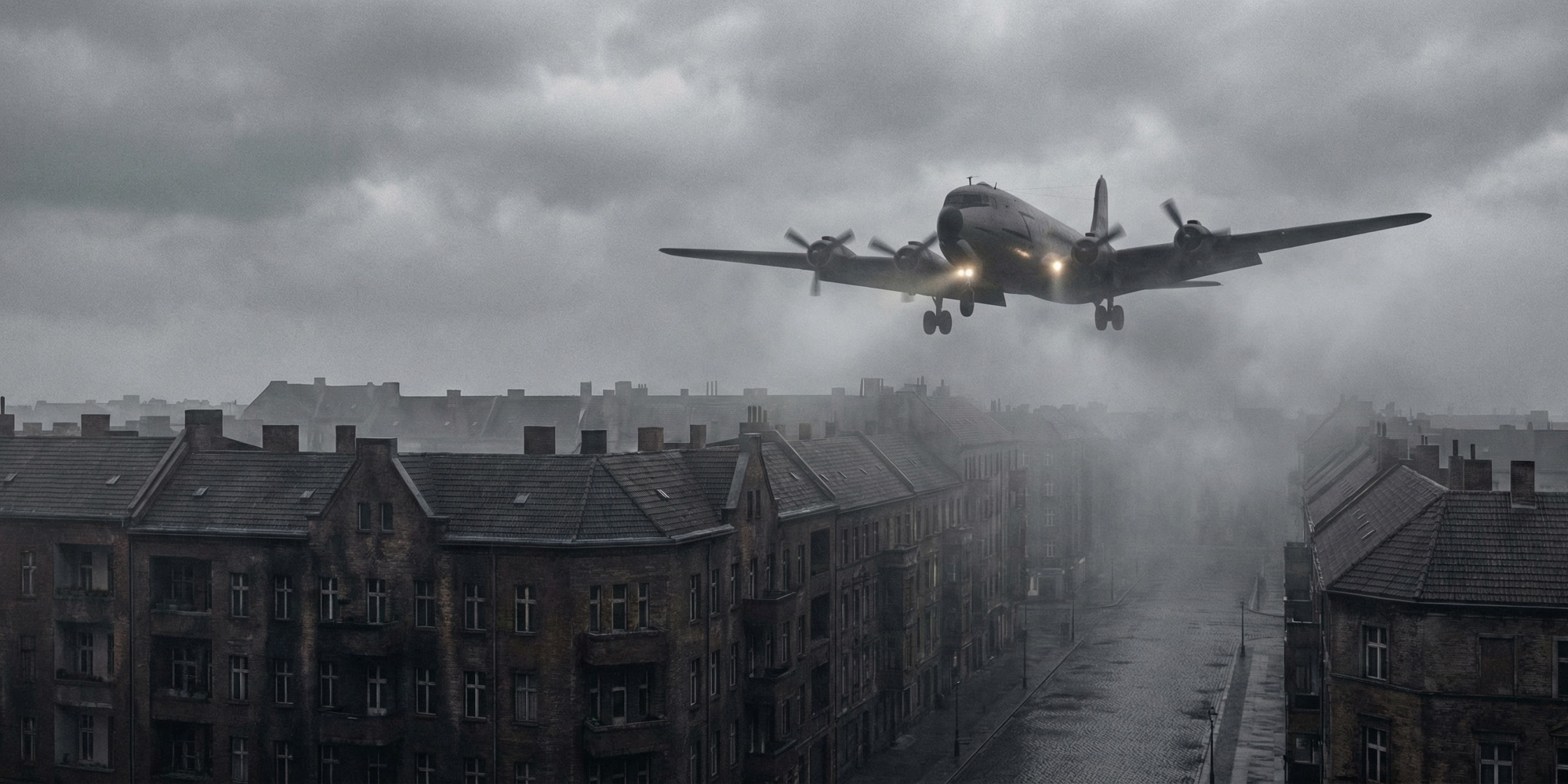
The Cold War and postwar America run 1945 to 1964. The Truman Doctrine came in 1947, the Marshall Plan right behind it. The Berlin Airlift flew 277,804 sorties over 324 days starting June 1948. NATO formed in 1949. Korea ran 1950 to 1953. McCarthyism peaked in the early 1950s and wrecked careers on thin evidence. Sputnik launched in 1957. The Cuban Missile Crisis lasted 13 days in October 1962. Kennedy was assassinated in 1963.
Two superpowers divide the world. The Iron Curtain descends across Europe as the wartime alliance between the United States and the Soviet Union collapses into mutual suspicion. Nuclear weapons cast a shadow over everything, schoolchildren practice duck-and-cover drills, families build fallout shelters, and the Doomsday Clock ticks toward midnight.
At home, America transforms in ways both exhilarating and unsettling. Suburbs sprawl outward from every major city as Levittowns and their imitators promise affordable homeownership to millions of returning veterans. The baby boom reshapes demographics, television enters every living room, and a consumer culture of unprecedented abundance takes hold. Rock and roll electrifies the young and horrifies the old.
Korea tests the containment doctrine when communist North Korea invades the South in 1950, drawing American troops into a brutal three-year conflict that ends in stalemate. McCarthy's witch hunt poisons public life, destroying careers and reputations with reckless accusations of communist infiltration. The Space Race captures the nation's imagination as Sputnik shocks America into action and Kennedy promises to put a man on the Moon.
Then Dallas, and everything changes. On November 22, 1963, President John F. Kennedy is assassinated, shattering the optimism of Camelot and ushering in a turbulent new chapter. Lyndon Johnson inherits a nation on the brink of profound transformation, carrying forward Kennedy's unfinished agenda while escalating American involvement in Vietnam.
Key Events
President Truman declares that the United States will support free peoples resisting subjugation, establishing the containment policy that will define American foreign policy for decades. The Marshall Plan commits billions to rebuilding war-ravaged Europe.
When the Soviet Union blockades West Berlin, the United States and its allies respond with a massive airlift, flying supplies into the besieged city for nearly a year. The operation becomes a powerful symbol of Western resolve against Soviet aggression.
North Korean forces invade South Korea, and the United States leads a United Nations coalition to defend the South. The conflict becomes a bloody test of containment, ending in a 1953 armistice that leaves the peninsula divided along roughly the same line where it began.
Senator Joseph McCarthy's anti-communist crusade reaches its peak during the Army-McCarthy hearings, which ultimately expose his tactics and lead to his censure. Meanwhile, the Supreme Court's unanimous Brown v. Board decision declares school segregation unconstitutional.
The Soviet Union launches Sputnik, the first artificial satellite, sparking fears of American technological inferiority and igniting the Space Race. In Arkansas, nine Black students integrate Central High School under the protection of federal troops ordered by President Eisenhower.
A CIA-backed invasion of Cuba at the Bay of Pigs ends in humiliating failure for the Kennedy administration. Months later, East Germany erects the Berlin Wall, turning the divided city into the Cold War's most potent symbol of oppression.
The discovery of Soviet nuclear missiles in Cuba brings the world to the brink of nuclear war. For thirteen harrowing days, Kennedy and Khrushchev negotiate a resolution, and the missiles are withdrawn, the closest the Cold War ever comes to turning hot.
On November 22, President John F. Kennedy is shot and killed while riding in a motorcade through Dealey Plaza in Dallas, Texas. The assassination stuns the nation and the world, ending the brief era of Camelot and elevating Lyndon Johnson to the presidency.
Congress passes the Gulf of Tonkin Resolution, giving President Johnson broad authority to escalate military involvement in Vietnam. The same year, the landmark Civil Rights Act outlaws discrimination based on race, color, religion, sex, or national origin.
Key Figures
President who launched the containment strategy and the Marshall Plan. His decisive leadership in the early Cold War, from the Berlin Airlift to the Korean War, shaped America's role as leader of the free world.
President who navigated the early Cold War and built the Interstate Highway System. The former Supreme Allied Commander brought a steady hand to the presidency, warning in his farewell address of the growing military-industrial complex.
President whose brief tenure included the Cuban Missile Crisis and the Space Race. His call to "ask what you can do for your country" inspired a generation, and his assassination in Dallas became a defining moment of the twentieth century.
President who escalated Vietnam and passed landmark civil rights legislation. A master legislator, Johnson used his political skill to push through the Civil Rights Act and the Great Society, even as the war in Southeast Asia consumed his presidency.
Senator whose anti-communist crusade became a cautionary tale. His reckless accusations of communist infiltration in the government ruined lives and careers before his tactics were finally exposed during the Army-McCarthy hearings.
Astronaut who became the first human to walk on the Moon. On July 20, 1969, Armstrong's "one small step" fulfilled Kennedy's bold promise and marked the greatest achievement of the Space Race.