Era 10 of 14
1939–1945
World War II in brief
World War II runs 1939 to 1945, and 1941 to 1945 for the United States. Japan attacked Pearl Harbor on December 7, 1941. The Doolittle Raid hit Tokyo on April 18, 1942, more for morale than damage. Midway turned the Pacific war that June. The D-Day landings came June 6, 1944. Germany surrendered May 8, 1945. The Manhattan Project's Trinity device went off July 16, 1945, and Japan surrendered in September. Roughly 405,000 Americans died.
Pearl Harbor jolts America into the most devastating conflict in human history. On the morning of December 7, 1941, Japanese aircraft sweep across the Hawaiian sky and shatter the illusion of American neutrality. Within days, the United States declares war on Japan, Germany, and Italy, plunging the nation into a global struggle that will demand sacrifice on an unprecedented scale.
The nation mobilizes every resource, factories retool overnight, women flood the workforce, sixteen million Americans put on uniforms. Rosie the Riveter becomes the symbol of a home front that produces an arsenal of democracy: tanks, planes, ships, and ammunition in quantities that stagger the imagination. Rationing, war bonds, and victory gardens reshape daily life as the entire country bends toward a single purpose.
On two fronts across two oceans, American forces fight their way from North Africa to Normandy, from Guadalcanal to Iwo Jima. D-Day, June 6, 1944, becomes the defining moment of the European theater, the largest amphibious invasion in history, a desperate gamble on the beaches of France that cracks open Hitler's Fortress Europe. In the Pacific, island-hopping campaigns claim territory one blood-soaked atoll at a time.
The atomic bomb ends the war and opens a terrifying new chapter. The mushroom clouds over Hiroshima and Nagasaki force Japan's surrender but raise moral questions that will haunt the world for generations. The Greatest Generation emerges from the fire, scarred, victorious, and determined to build a better future from the ruins of the old world.
Key Events
Adolf Hitler's blitzkrieg assault on Poland triggers declarations of war from Britain and France, plunging Europe into the most destructive conflict the continent has ever seen. America watches with growing unease as democracy retreats across the Atlantic.
France falls in just six weeks, stunning the world. Britain stands alone as the Luftwaffe pounds London and other cities in a relentless bombing campaign. The Royal Air Force holds, and Hitler's invasion plans stall, but the threat remains grave.
Japanese carrier-based aircraft launch a devastating surprise attack on the U.S. Pacific Fleet at Pearl Harbor, Hawaii, killing over 2,400 Americans. President Roosevelt calls it "a date which will live in infamy," and Congress declares war the next day.
The Battle of Midway turns the tide in the Pacific as American dive bombers destroy four Japanese carriers. On the home front, Executive Order 9066 authorizes the forced internment of over 120,000 Japanese Americans, one of the gravest civil liberties violations in American history.
Roosevelt and Churchill meet at Casablanca and demand unconditional surrender from the Axis powers. Allied forces invade Sicily and push into mainland Italy, opening a grinding campaign up the Italian peninsula that will last until war's end.
On June 6, over 156,000 Allied troops storm the beaches of Normandy in the largest amphibious invasion in history. By December, Hitler launches a desperate counteroffensive in the Ardennes, the Battle of the Bulge, which ultimately fails. At home, the GI Bill promises education and housing benefits to returning veterans.
The war reaches its climax and conclusion. Marines raise the flag on Iwo Jima. Roosevelt dies in April and Truman takes command. Germany surrenders on May 8. Atomic bombs devastate Hiroshima and Nagasaki, and Japan surrenders on September 2. The United Nations is chartered to prevent future global conflicts.
Key Figures
Commander-in-chief who led America through most of the war. His fireside chats rallied the nation, and his diplomatic skill held the Allied coalition together through years of brutal conflict.
President who made the decision to use the atomic bomb. Thrust into office by Roosevelt's death, Truman faced the war's most consequential choice and guided the nation through victory.
Supreme Allied Commander who planned the D-Day invasion. His organizational genius and ability to manage fractious Allied personalities made the liberation of Europe possible.
Commander of the Pacific Theater who accepted Japan's surrender. His island-hopping strategy bypassed heavily fortified Japanese positions and brought the war to Tokyo's doorstep.
Aggressive tank commander who led the Third Army across Europe. Known for his flamboyant personality and relentless pursuit of the enemy, Patton became one of the war's most celebrated generals.
Admiral who commanded the Pacific Fleet and oversaw the island-hopping campaign. His steady leadership at Midway, Iwo Jima, and Okinawa helped turn the tide against Japan.
Articles
From hidden factory towns to the Trinity test in New Mexico, the Manhattan Project fused science, industry, and wartime urgency into a weapon that transformed history.
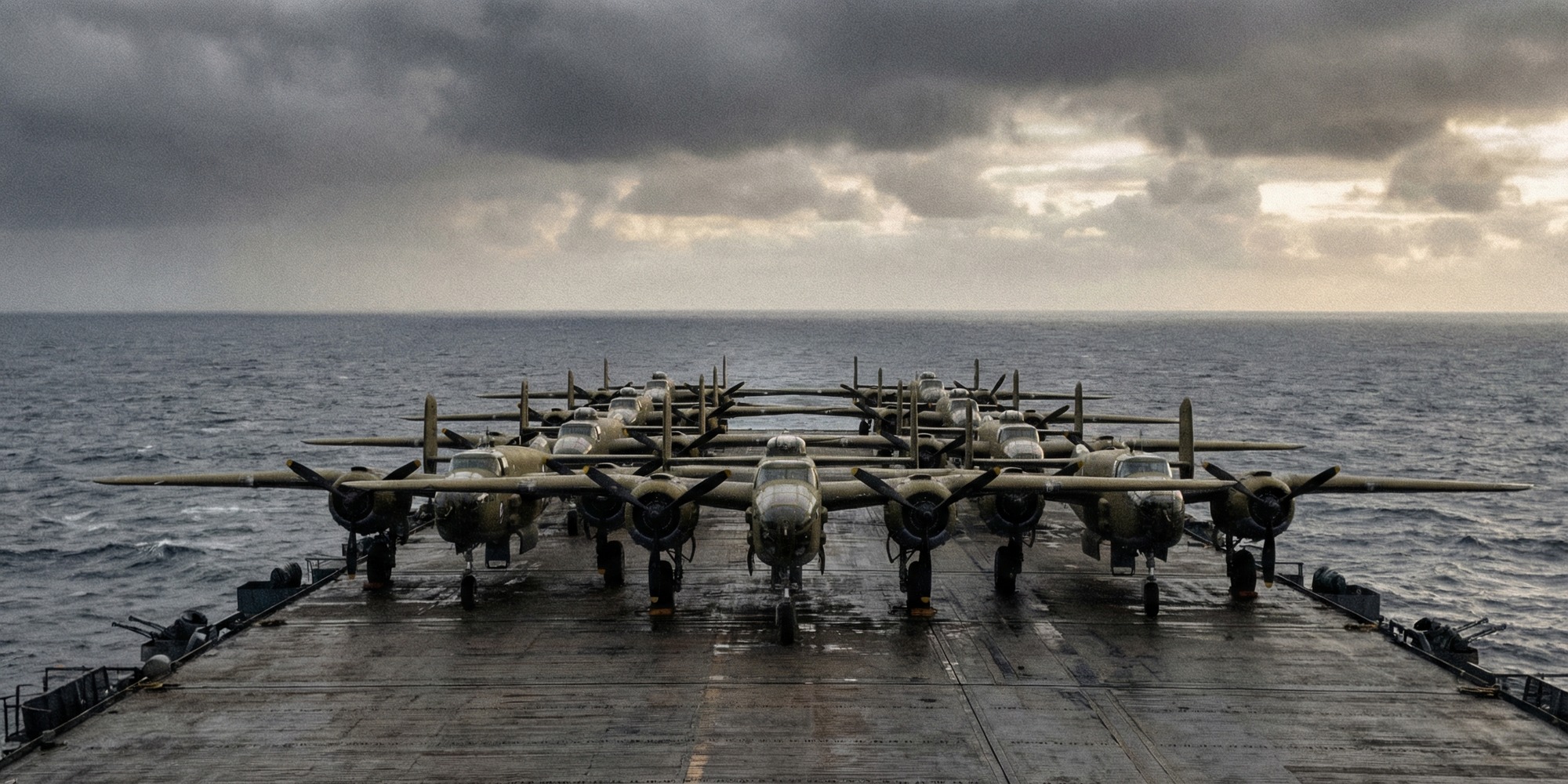
On April 18, 1942, sixteen B-25 bombers launched from USS Hornet in a desperate gamble that struck Tokyo, electrified a shattered nation, and set in motion the chain of events that turned the Pacific War.