381 Days on Foot: The Montgomery Bus Boycott and the Birth of a Movement
By Library of History Editorial Staff
Shortly after midnight on December 2, 1955, Jo Ann Robinson was alone in the basement print room of Alabama State College, feeding paper into a mimeograph machine. The building was dark and quiet. If an administrator found her there (using state equipment, on state time, for this) she would lose her job. She had been an English professor at the college for nine years. She kept feeding paper into the machine.
By morning, Robinson and her network of volunteers had distributed 52,500 leaflets across Black Montgomery: to churches, beauty parlors, barbershops, community centers, and schools. The leaflets described what had happened the previous evening, a 42-year-old seamstress named Rosa Parks had refused to give up her bus seat to a white passenger and had been arrested, and they asked one thing of the Black community: stay off the buses on Monday, December 5.
What followed was not a spontaneous eruption of rage. It was the disciplined, organized, sustained collective action of a community that had been preparing, consciously or not, for this exact moment for years. Over the next 381 days, nearly every Black resident of Montgomery, Alabama stopped riding city buses. They walked. They carpooled. They endured bombings, arrests, and legal persecution. And on December 20, 1956, they returned to integrated buses, having forced the United States Supreme Court to declare racial segregation on public transit unconstitutional.
The Montgomery Bus Boycott was the first major nonviolent mass protest of the modern Civil Rights Movement. It launched an unknown 26-year-old Baptist minister onto the national stage. And it proved, in a way that no speech or lawsuit alone could, that sustained collective action could crack the foundations of Jim Crow.
Twenty-Five Organizations Are Talking About a Boycott
To understand the boycott, you have to understand the buses. Montgomery's city buses were a daily theater of humiliation enforced by both Alabama state law and city ordinance. The front ten seats were permanently reserved for white passengers. Black passengers paid their fare at the front of the bus, then stepped off and re-entered through the rear door. Bus drivers, all of them white, had legal authority to re-seat passengers in the ambiguous middle rows if the front section filled up. If a white passenger needed a seat, a Black passenger could be ordered to stand, even if no equivalent seat was available elsewhere. Drivers routinely addressed Black riders with racial slurs and, on occasion, drove away before passengers who had paid at the front could re-board from the rear.
Approximately 75 percent of Montgomery's bus riders were African American. They had no practical alternative for most of the routes that connected their neighborhoods to downtown jobs and shops. The indignity was not occasional; it was daily, systematic, and backed by the force of law.
The Women's Political Council, founded in 1946 by Mary Fair Burks, had spent years working to change this. By 1955 its president was Jo Ann Robinson, a meticulous organizer and Alabama State College English professor who had already experienced the humiliation firsthand, a bus driver had screamed at her for accidentally sitting in the white section while distracted by grief. Robinson and the WPC had lobbied Montgomery's mayor repeatedly, seeking modest reforms: courteous treatment, guaranteed seating on a first-come basis, and Black drivers on predominantly Black routes. The mayor had offered nothing. In May 1954, Robinson had written to him directly, with a warning that contained both threat and prophecy: "There has been talk from twenty-five or more local organizations of planning a city-wide boycott of buses."
The community had been waiting for the right catalyst, and the right person. In March 1955, a 15-year-old named Claudette Colvin was arrested for refusing to vacate her seat on a Montgomery bus. She was brave and her cause was just, but civil rights organizers made a painful calculation: Colvin was young, unmarried, and pregnant. In the court of public opinion, particularly the white press, her case would be made about her personal circumstances rather than the system she had challenged. The community kept waiting.
Rosa Parks was not, as popular legend sometimes simplifies, simply a tired old woman who refused to move. She was 42, physically healthy, and a trained activist, secretary of the Montgomery chapter of the NAACP, a veteran of workshops at the Highlander Folk School in Tennessee. When bus driver James Blake ordered Parks and three other Black passengers to vacate their row on the evening of December 1, 1955, and three of them stood, Parks did not. Blake called the police. Officers Day and Mixon arrived and arrested her on a charge of "refusing to obey orders of a bus driver." At the jail, her mother's first question when Parks called was: "Did they beat you?"
E.D. Nixon, president of the Montgomery NAACP chapter, secured her bail that evening. He and attorney Fred Gray recognized immediately what Robinson already knew: this was the case they had been waiting for. By midnight, Robinson was at the mimeograph machine.
We Are Not Wrong
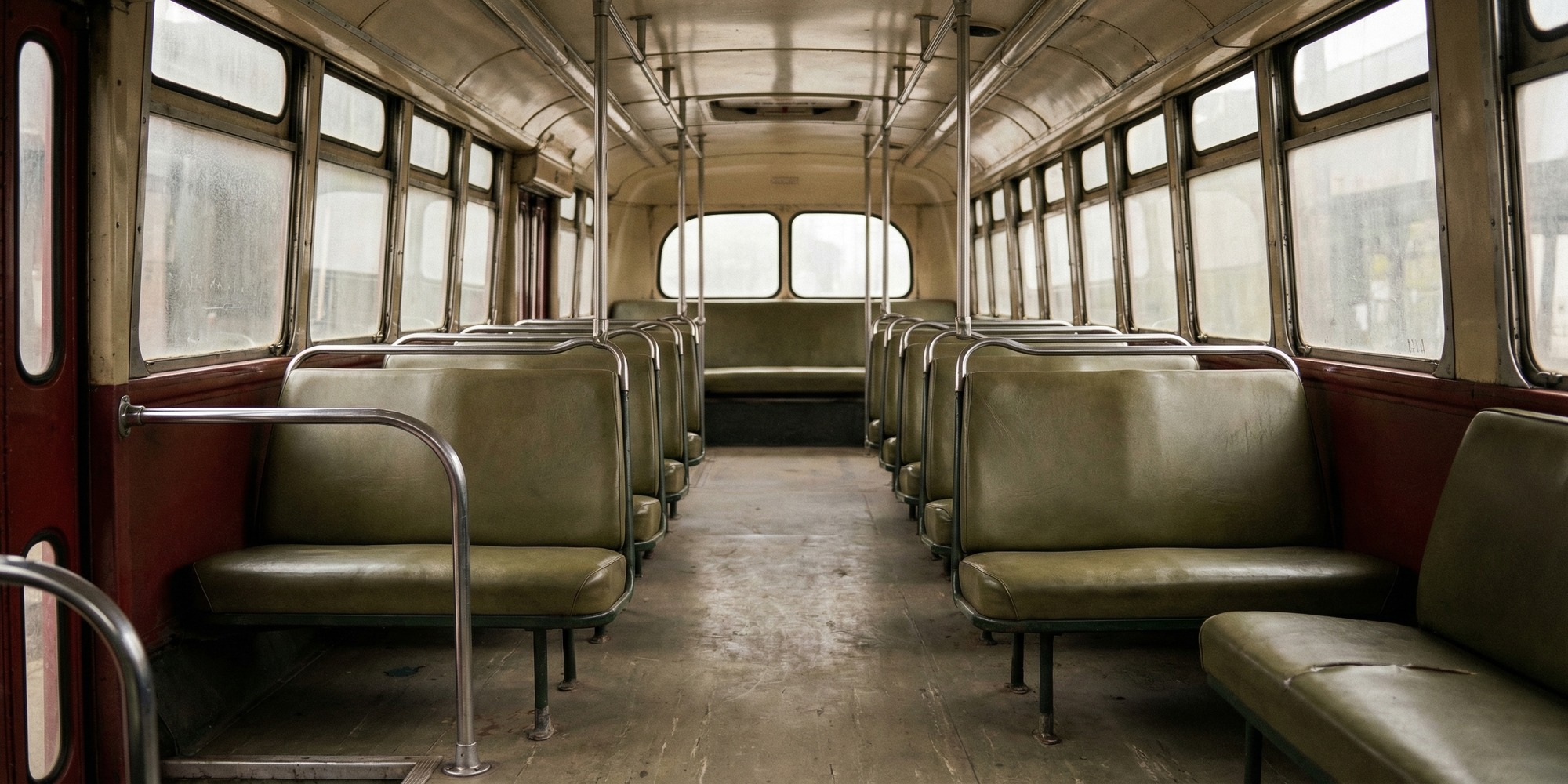
The morning of Monday, December 5, 1955, was cold and gray. Montgomery's Black community held its breath. The boycott organizers had hoped for 60 percent participation, enough to make a visible dent in the bus company's revenue. What they got was a miracle: approximately 90 percent of Black Montgomerians stayed off the buses. Buses that normally ran full rolled through Black neighborhoods nearly empty. Some carried a single passenger; many carried none.
That afternoon, Black community leaders gathered at the Dexter Avenue Baptist Church and formed the Montgomery Improvement Association to coordinate what they had decided, with stunning unanimity, to extend indefinitely. They needed a president. Someone respected, articulate, and ideally someone without enough local history to have accumulated political enemies. A name was proposed: Martin Luther King Jr., pastor of Dexter Avenue Baptist Church, who had arrived in Montgomery just fifteen months earlier. He was 26 years old. He accepted before he fully understood what he was accepting.
That evening, King addressed a mass meeting at Holt Street Baptist Church. Thousands packed the sanctuary; thousands more stood outside in the cold, listening through loudspeakers. King had been given less than twenty minutes to prepare a speech that would set the moral terms for the entire struggle. What he delivered was one of the most consequential extemporaneous addresses in American history.
"I want it to be known that we're going to work with grim and bold determination to gain justice on the buses in this city," he told the crowd. "And we are not wrong in what we are doing. If we are wrong, the Supreme Court of this nation is wrong. If we are wrong, the Constitution of the United States is wrong. If we are wrong, God Almighty is wrong."
The crowd voted to continue the boycott. The vote was unanimous.
The MIA presented three demands to city officials and the bus company: courteous treatment by drivers, first-come-first-served seating (Black passengers from the rear, white from the front, with no forced displacement), and Black drivers on predominantly Black routes. The demands did not even challenge the principle of segregated seating. They were the most minimal of reforms. City officials and bus company executives refused all three.
Thirty Thousand Rides a Day
The question before the MIA was not whether to fight. It was how to keep 50,000 people off the buses for an indefinite period in a city that had designed itself around those buses. The answer was an organizational achievement that deserves to stand alongside any logistical feat in American history.
The MIA built a carpool system from nothing. At its peak, the operation coordinated approximately 300 private vehicles dispatched from more than 40 pickup stations across Black Montgomery, handling an estimated 30,000 rides per day. Drivers volunteered their own cars and fuel. Dispatchers worked from handwritten schedules. Church basements served as coordination centers. Monday-night mass meetings, rotating among the city's Black churches, provided the communal fuel that kept morale intact through each week: part religious revival, part democratic town hall, part collective act of defiance.
Many participants simply walked. Some walked four miles each way; some walked twelve. An elderly woman who was offered a ride reportedly declined: "My feet is tired, but my soul is rested." Whether the precise words were hers or a later embellishment, the sentiment was not. Every empty bus was a small victory visible to everyone who saw it pass.
The city of Montgomery responded with escalation. In January 1956, Mayor W.A. Gayle announced a "get tough" policy and joined the White Citizens' Council. Police officers began following and harassing carpool drivers, citing them for trivial or invented violations. On January 30, while King was at a mass meeting, a bomb exploded on the front porch of his home on South Jackson Street. His wife Coretta and their infant daughter were inside; neither was physically injured. King rushed home to find an armed crowd of hundreds gathered in the street. He stood on the damaged porch and told them to go home. "Be calm as I and my family are," he said. "We are not hurt, and remember that if anything happens to me, there will be others to take my place." The crowd, many of them armed, dispersed.
E.D. Nixon's home was bombed two days later.
In February, a grand jury indicted 89 boycott leaders, including King, under a dormant 1921 anti-boycott statute. King was tried, convicted, and ordered to pay $500 or serve 386 days in jail. He chose to pay and appeal. The indictments backfired: they generated national press coverage and transformed local organizers into national figures. Donations poured into the MIA from across the country.
Meanwhile, attorney Fred Gray had filed a federal lawsuit that would prove decisive. Browder v. Gayle, named for plaintiff Aurelia Browder and brought on behalf of four Black women who had been mistreated on Montgomery buses, including the young Claudette Colvin, argued not merely that the bus company had acted badly, but that the legal framework of bus segregation itself violated the Fourteenth Amendment's equal protection guarantee. The case bypassed the city courts entirely and went directly to federal judges.
When the Supreme Court Came to Montgomery
On June 4, 1956, a three-judge federal panel ruled in Browder v. Gayle that racial segregation of public buses was unconstitutional under the Fourteenth Amendment. One of the three judges was Frank M. Johnson Jr., an Alabama-born federal jurist who would become one of the most consequential figures in civil rights law. Montgomery's city government appealed immediately to the U.S. Supreme Court.
The boycott continued through the summer and fall of 1956, through the Alabama heat, through continued harassment, through the grinding uncertainty of waiting. In late October, city officials obtained a state court injunction against the MIA's carpool operation, calling it a "private enterprise operating without a license." The MIA was ordered to appear in court to answer the injunction on the morning of November 13.
On the morning of November 13, 1956, King and other MIA leaders sat in the Montgomery courtroom, facing the likely end of their transportation system. Then a reporter leaned over and handed King a wire service dispatch. The United States Supreme Court had that morning affirmed the Browder v. Gayle ruling: racial segregation of public buses was unconstitutional under federal law. The carpool injunction was moot. The boycott had won before the city could kill it.
It took five more weeks for the Supreme Court's formal order to arrive in Montgomery. On the evening of December 19, word came that it would be delivered the next morning. On December 20, 1956, 381 days after the boycott began, the order was served on Montgomery city officials. That morning, Martin Luther King Jr., Ralph Abernathy, E.D. Nixon, and Rosa Parks boarded the first integrated bus. A white minister sat beside King near the front. It was, King would later recall, "a time of quiet dignity."
The victory was not without aftermath. White supremacists sniped at integrated buses in the days that followed; churches and the homes of ministers were bombed in January 1957. Violence is often the last resort of a losing cause. But the legal architecture of bus segregation in Montgomery, and by extension across the South, was finished.
The Movement That a Boycott Built
The Montgomery Bus Boycott mattered for what it won: integrated bus seating in one Southern city. It matters more for what it proved and what it built. It demonstrated that sustained, organized, nonviolent collective action, conducted not by professional agitators but by working people walking to their jobs, could compel legal change that decades of lobbying and individual protest had not. It established the blueprint: the mass meeting as democratic institution, the church as operational hub, the carpool as logistical backbone, the economic pressure of withdrawal as the central lever.
In January 1957, King and other Southern ministers founded the Southern Christian Leadership Conference, the direct institutional descendant of the MIA, to carry the boycott model across the South. Within a decade, it would help organize the Birmingham campaign, the March on Washington, and the Selma marches that produced the Voting Rights Act of 1965. The Library of Congress's exhibition on the Civil Rights Act of 1964 describes it as "the most significant piece of civil rights legislation since Reconstruction", legislation whose political possibility was opened, in part, by what happened on Montgomery's buses and sidewalks between December 1955 and December 1956.
It is worth pausing on the people the popular narrative sometimes obscures. Jo Ann Robinson ran the mimeograph machine at midnight; without her organizational foresight, there might have been no December 5 protest at all. E.D. Nixon made the judgment calls (that Parks was the right plaintiff, that the moment was right) that shaped the entire episode. Fred Gray filed the lawsuit that won in federal court. Claudette Colvin, nine months before Parks, had already refused and paid for it, and then served as a plaintiff in the case that ended segregation. They were all part of a community that had been organizing, petitioning, and waiting for years.
Martin Luther King Jr. became, as a result of the boycott, the moral voice of a generation. He was not yet that when he stood on the Holt Street stage in December 1955. He was a young minister who had been in town barely more than a year, handed a responsibility that would define the rest of his life. The boycott did not find a leader who then built a movement. A community built a movement, and in doing so, found its leader.
For 381 days, nearly 50,000 people made a choice every morning: to walk, to carpool, to endure, to refuse. That collective choice, made without smartphones, without social media, coordinated through church bulletins and word of mouth and the sheer human weight of community, is the story. The empty buses rolling through Black Montgomery were not merely a tactic. They were a daily declaration, repeated 381 times, that dignity was not negotiable.