The Deadliest Afternoon in New York: The Triangle Shirtwaist Fire and the Birth of the Modern Workplace
By Library of History Editorial Staff
It was a Saturday afternoon in late March, and the girls on the ninth floor of the Asch Building in Greenwich Village were thinking about the weekend. Pay envelopes had just been distributed. Women in their teens and early twenties, most of them Jewish and Italian immigrants who spoke little English outside the rhythms of the factory floor, were reaching for their coats, tucking their wages into apron pockets, chatting over the rattle of the last machines being stilled. The winter light was still pale through the tall loft windows. In a few minutes, they would be on the sidewalks of Washington Place, free until Monday morning.
At approximately 4:40 p.m. on March 25, 1911, someone on the eighth floor shouted: "Fire!"
Eighteen minutes later, 146 of those workers were dead, burned, suffocated, or broken on the pavement below after leaping from windows nine stories above Greene Street. The exits were locked. The fire escape collapsed under the weight of desperate bodies. The fire hoses had no water pressure. The ladder trucks couldn't reach past the sixth floor. What the Triangle Waist Company fire exposed in one terrible Saturday afternoon was not merely the negligence of two employers, but the entire moral architecture of the American sweatshop economy, and it lit a fuse beneath the Progressive Era that would burn all the way to the New Deal.
The World Behind the Windows: Immigrant Labor and the Sweatshop Economy
By 1911, the garment industry was the engine of working-class immigrant New York. The needle trades employed hundreds of thousands of men and women crowded into the loft buildings of Lower Manhattan and Greenwich Village, and shirtwaists, the blouse-like women's garments that had become a fashion staple, were among the city's most profitable exports. At the top of that industry sat the Triangle Waist Company, run by two partners: Max Blanck and Isaac Harris, both Jewish immigrants from Eastern Europe who had arrived in America penniless and built, through relentless ambition, one of the largest shirtwaist manufacturers in the city. They employed approximately 500 workers across the eighth, ninth, and tenth floors of the ten-story Asch Building at 23–29 Washington Place.
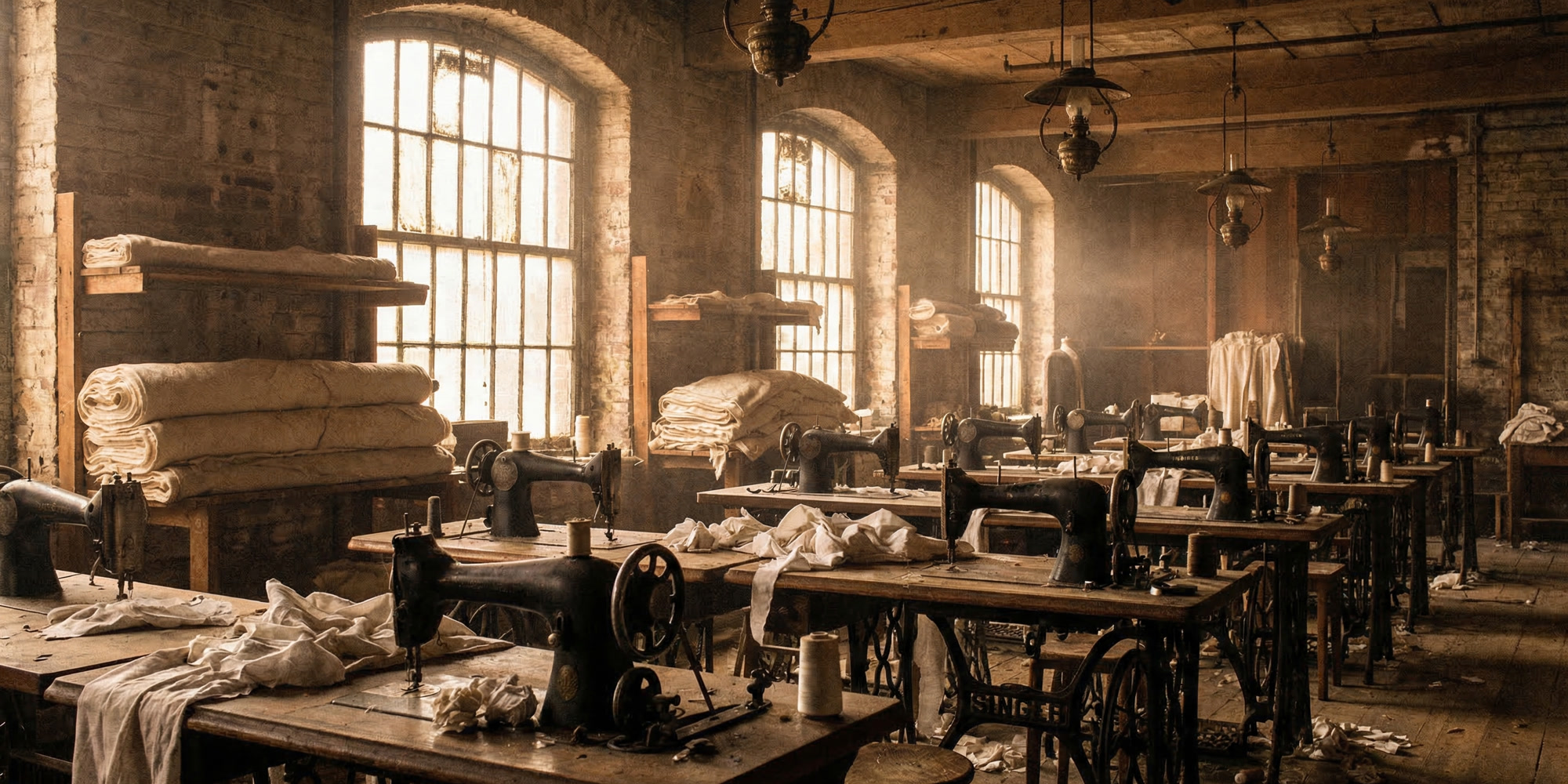
Their workforce was overwhelmingly female and overwhelmingly young, girls as young as fourteen worked alongside women in their twenties, most of them from Jewish and Italian immigrant families who had arrived in the great waves of Southern and Eastern European immigration that had crested in the 1900s. They earned between $3.50 and $6.50 per week for a schedule of nine-hour weekdays and seven-hour Saturdays, a fifty-two hour workweek, bent over treadle sewing machines in rooms thick with the floating lint of cut fabric. Scrap bins overflowed with fabric cuttings that accumulated through the week, dry as kindling, beneath the cutting tables.
Blanck and Harris had survived a major labor challenge just two years earlier. In November 1909, tens of thousands of garment workers, Triangle's employees among them, walked off the job in what became known as the "Uprising of the 20,000," the largest strike by women workers in American history to that point. After three months on the picket line, many workers won wage increases. But they did not win union recognition, and they did not win fire safety improvements. It was a half-victory with lethal consequences. By the spring of 1911, Triangle had returned to its old practices. The scrap bins were full. The Washington Place exit on the ninth floor, one of the building's two stairwell doors, was kept locked during working hours. The owners said it was to prevent theft and unauthorized breaks. It was also, labor organizers suspected, to keep union organizers out. Whatever the reason, the lock was there. And on March 25th, it would hold.
Eighteen Minutes: The Fire
The fire began quietly, as catastrophes often do. A spark, most likely from a discarded match or a cigarette, fell into one of the scrap bins beneath cutting table No. 2 on the eighth floor's Greene Street side. The accumulated lint and fabric scraps caught instantly. Within seconds, the flames were climbing a curtain of hanging shirtwaist material. A worker named Dinah Lifschitz grabbed the telephone and rang the tenth floor with the alarm. She could not reach the ninth. The building's switchboard had no signal for the middle floor where most of the workers sat.
The eighth floor had a fighting chance. Many workers made it down the Greene Street stairway or crowded into the two small elevators, operated by Joseph Zito and Gaspar Mortillaro, who made repeated runs into the smoke-thickened floors, saving an estimated 150 people before the heat made further trips impossible. Workers on the tenth floor, where the company's managers and some cutters worked, received a direct warning. Professor Frank Sommer's NYU Law School class, assembled in an adjacent building, extended painters' ladders across the gap between the rooftops and helped haul workers to safety. Of approximately seventy people on the tenth floor, all but one survived.
The ninth floor had no warning at all. By the time the flames arrived, both stairways were compromised and the Washington Place door was locked. Workers rushed the fire escape, a narrow, inadequate iron ladder that twisted away from the building's exterior. It buckled and collapsed under the weight of desperate women, hurling them into the courtyard below. Others broke the windows and looked down at Greene Street, nine stories beneath their feet, where a crowd was already gathering. They looked behind them at the fire. They looked down again. And they jumped.
William Gunn Shepard, a journalist who happened to be passing, stood on the sidewalk and watched. "I learned a new sound that day," he wrote afterward, "a sound more horrible than description can picture, the thud of a speeding living body on a stone sidewalk." The Fire Department's ladder trucks, the tallest available, could not reach above the sixth floor. The life nets the firefighters stretched below snapped under the impact of bodies falling from that height. One fire chief, Edward Croker, described finding, when the smoke finally cleared, "skeletons bending over sewing machines."
From the first alarm to the moment the fire was brought under control: approximately eighteen minutes. Final death toll: 146, 123 women and 23 men. Six victims remained unidentified for nearly a century, until researcher Michael Hirsch finally named them in 2011. The bodies were taken to a makeshift morgue on a covered pier at East 26th Street, where tens of thousands of New Yorkers came to walk the rows, searching for daughters and sisters and wives.
The Trial and the Fury
District Attorney Charles Whitman moved quickly. Within weeks of the fire, Max Blanck and Isaac Harris were charged with manslaughter. The central question was deceptively simple: had the owners known the Washington Place door was locked at the time the fire broke out? If they had knowingly locked their workers in, they were criminally responsible for those deaths.
The trial began December 4, 1911. More than a hundred witnesses testified over three weeks. Survivor after survivor described reaching the Washington Place door and finding it immovable. The prosecution believed its strongest witness was Kate Alterman, a young worker who had seen the locked door with her own eyes and escaped through another route. Defense attorney Max Steuer, one of the most formidable trial lawyers in New York, deployed a tactic that would long be remembered in legal circles: he asked Alterman to repeat her account verbatim, once, twice, three times. Her recitation, almost word for word each time, allowed Steuer to argue to the jury that she had been coached by prosecutors, that her testimony was performance rather than memory. It was a masterpiece of cross-examination and a destruction of an honest witness.
On December 27, 1911, after one hour and forty-five minutes of deliberation, the jury returned a verdict of not guilty on all counts. Blanck and Harris walked free. A civil court later fined them $75 per death, a total civil penalty that their fire insurance settlement more than covered. By some calculations, the owners came out of the disaster financially ahead. Within two years, Blanck was fined again for locking the exits in a new factory he had opened.
The city's reaction to the acquittal was a howl of outrage. At a memorial meeting at the Metropolitan Opera House, attended by some of the wealthiest families in New York, people who had come to offer condolences and perhaps feel that something had been done, a small, red-haired labor organizer named Rose Schneiderman took the stage. Schneiderman had been organizing garment workers for years. She had marched in the 1909 strike. She had tried to warn anyone who would listen about what the locked doors and the scrap bins and the overcrowding would one day produce. Now she looked out at the velvet seats and the evening clothes and said what she thought:
"I would be a traitor to these poor burned bodies if I came here to talk good fellowship. Too much blood has been spilled. I know from my experience it is up to the working people to save themselves. The only way they can save themselves is by a strong working-class movement."
The speech was met with silence, then applause. It became one of the most famous addresses in the history of American labor.
The World That Rose From the Ashes
Among the crowd on Washington Place the afternoon of the fire was a thirty-year-old social reformer named Frances Perkins. She was having tea nearby when she heard the fire alarms and ran toward the smoke. She arrived in time to watch women fall from the windows. She stood on the sidewalk and could do nothing. In the years that followed, she would describe March 25, 1911 as the day that defined her life's work, "the day the New Deal was born," she called it, in her own mind.
The New York State Factory Investigating Commission, established in the fire's immediate aftermath and chaired by Assemblyman Al Smith and State Senator Robert F. Wagner, became one of the most consequential legislative bodies in American history. Over the next four years, the commission conducted 22 public hearings, heard testimony from 222 witnesses, and physically inspected 1,836 factories across the state. Frances Perkins served as a staff investigator, and she made sure that the legislators who sat on the commission saw what she had seen. She dragged them into cramped factory spaces, required them to crawl through narrow exits, forced them to watch children at work past midnight in canneries and textile mills. She believed, correctly, that no amount of testimony would move a man as surely as the evidence of his own eyes.
The results were sweeping. New York passed between 36 and 38 new state laws governing factory safety, including mandatory sprinkler systems, minimum standards for fire exits, limits on working hours for women and children, requirements for mandatory rest days, and vastly improved sanitation codes. It was the most comprehensive legislative response to an industrial accident in American history to that point. And it was only the beginning.
Al Smith and Robert Wagner, both products of the Tammany Hall political machine, were permanently transformed by what they had witnessed. Smith went on to become a four-term governor of New York and a major force for urban liberalism in the Democratic Party. Wagner went to the United States Senate, where he authored the Social Security Act and, in 1935, the National Labor Relations Act, the Wagner Act, which finally guaranteed American workers the legal right to organize without employer retaliation. The fire that had killed 146 workers in eighteen minutes had, in a generation, reshaped the entire relationship between the federal government and the American workforce.
The garment workers' union, the International Ladies' Garment Workers' Union, grew from a small organization into one of the country's most powerful labor bodies in the years following Triangle. In 1913, Congress created the Department of Labor, partly in response to the sustained public pressure that the Triangle fire had helped generate. Frances Perkins, whom FDR appointed Secretary of Labor in 1933, the first woman ever to serve in a presidential cabinet, never stopped crediting that March afternoon in Greenwich Village as the source of everything she had fought for.
The Asch Building itself was renamed the Brown Building. It still stands at 23–29 Washington Place, now part of New York University. On October 11, 2023, a permanent memorial (inscribed in English, Yiddish, and Italian, the three languages of the women who died there) was finally dedicated at the corner of Washington Place and Greene Street.
A Contract Written in Fire
The 146 people who died on that Saturday afternoon did not die to make history. They died because no one with power had cared enough to make their survival worth the cost of a sprinkler system, an unlocked door, a fire drill. They died because the logic of the sweatshop, which valued efficiency over exits and profit over the lives of interchangeable workers, had been allowed to operate without meaningful check for decades, and because every warning, every strike, every petition had been dismissed or defeated.
What came after was not inevitable. It required Rose Schneiderman's fury, and Frances Perkins's tenacity, and Al Smith's willingness to be changed by what he saw, and Robert Wagner's legislative genius. It required the sustained outrage of a city that refused, this time, to simply grieve and move on.
Out of the Triangle fire came something that has protected workers ever since: the idea that government has not merely the right but the obligation to step between an employer and his employees and say, not like this. It is an idea so embedded in modern American life that most people never think about where it came from. It came from the ninth floor of the Asch Building, from the locked door on the Washington Place side, from eighteen minutes that changed everything.