A Nation Uprooted: The Trail of Tears and the Cherokee Removal
By Library of History Editorial Staff
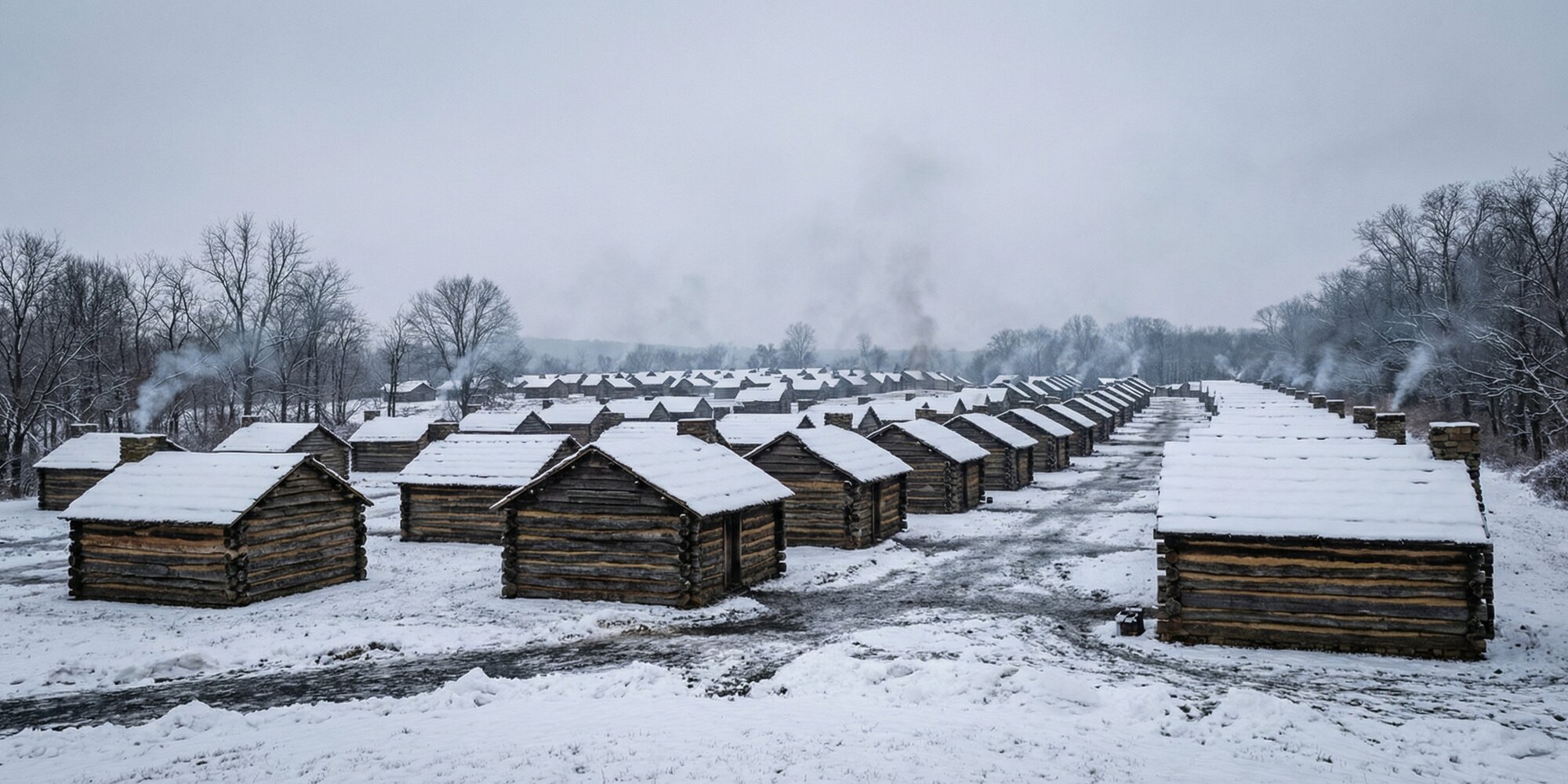
In late May 1838, soldiers of the United States Army fanned out across the foothills of the Appalachian Mountains in Georgia, Alabama, Tennessee, and North Carolina. Their orders were precise: round up the Cherokee people (every man, woman, and child) and march them to holding camps along the Tennessee River. In the villages they swept through, families were given minutes to gather what they could carry. Behind them, white settlers moved in to claim the farms, the orchards, and the livestock. Houses were set alight. Graves were looted. The smoke rose for miles.
Among the thousands herded into stockade camps that summer was a woman named Quatie, Mary Brian Stapler Ross, the wife of Principal Chief John Ross. She would not survive the journey west. According to accounts that circulated among the Cherokee, she gave her blanket to a sick child during the brutal crossing of the ice-locked Ohio River in January 1839, and died of pneumonia days later. She was in her late twenties. The army's records noted her death only as the loss of "John Ross's wife."
Her story, and the story of the approximately 4,000 Cherokees who perished on what became known as Nunna daul Tsuny, "The Trail Where They Cried", is not simply a story of dispossession. It is a story of a civilization that did everything a democratic republic said it valued: it built constitutional government, achieved mass literacy, pursued legal redress, and won a landmark victory in the United States Supreme Court. And it still lost. The Trail of Tears stands as one of the most searching indictments in American history, not because a nation acted against its principles, but because, in this case, its principles were not strong enough to stop it.
A Civilization in the Crosshairs
By the early decades of the nineteenth century, the Cherokee Nation occupied a substantial swath of the southeastern United States, millions of acres in present-day Georgia, Alabama, Tennessee, and North Carolina. To call it "wilderness," as federal officials often did, was a deliberate fiction. The Cherokee had long maintained towns, farms, trade networks, and complex governance. But in the 1820s, their civilization underwent a period of extraordinary transformation that set them apart even among Indigenous peoples who had adapted to American expansion.
In 1821, a man named Sequoyah, also known as George Guess, completed one of the most remarkable intellectual achievements of the era: a syllabary of eighty-six characters capable of representing every sound in the Cherokee language. He had worked on it for over a decade, often in secret, ridiculed by neighbors who called his project witchcraft. Within months of its dissemination, thousands of Cherokees could read and write in their own language. By 1828, the Cherokee Phoenix, the first Native American newspaper, printed in both English and Cherokee, was publishing from New Echota, Georgia, with Elias Boudinot as its editor. In 1827, the Cherokee adopted a written constitutional government modeled in part on the U.S. Constitution, declaring themselves a sovereign nation with defined territory and a bicameral legislature.
The Cherokee leadership was not naive about why they pursued this "civilization strategy." Principal Chief John Ross understood that demonstrating political and cultural compatibility with American norms might provide legal and diplomatic protection against removal. It was a calculated gamble. And for a time, it seemed to be working, until it made things worse. A prosperous Cherokee population holding fertile farmland, and gold discovered on Cherokee territory in Georgia in 1829, turned the region's appetite for removal into something closer to frenzy. Georgia's legislature responded to the Cherokee constitution with fury: it passed laws annexing Cherokee lands, abolishing their government and courts, and distributing Cherokee property in state lotteries to white Georgians. The rule of law, it seemed, applied only when it was convenient.
It is important to situate this moment in its political context without sanitizing it. The appetite for Cherokee land was not an Jacksonian aberration. Thomas Jefferson had advocated removal; James Monroe and John Quincy Adams had pursued voluntary removal treaties. The policy had broad support across the South and was popular enough nationally to survive significant opposition. What Andrew Jackson brought, upon taking office in March 1829, was not a new idea. It was aggressive political will and executive ruthlessness in service of a very old one.
The Law and the Defiance
Jackson moved quickly. Within months of his inauguration, removing the eastern Indian nations became his signature legislative priority. On May 28, 1830, he signed the Indian Removal Act into law, a bill that had passed the Senate by 28 to 19 and the House by an uncomfortably narrow 102 to 97, numbers that reflected genuine national ambivalence. The Act itself did not explicitly authorize force; it called for "negotiations" and land exchanges west of the Mississippi River. In practice, it became the legal scaffolding for coercion.
The opposition was fierce and, by the standards of the age, broad. Senator Theodore Frelinghuysen of New Jersey argued on the Senate floor for three days that removal violated the honor of the United States and its solemn treaty obligations, a speech that made him nationally famous. Catharine Beecher organized women's petition campaigns against the Act, one of the first large-scale exercises of women's political voice in American history. Jeremiah Evarts, a missionary writing under the pen name "William Penn," published powerful essays arguing that removal violated the principles of Christian civilization that the nation claimed to profess. None of it was enough.
The Cherokee, rather than accepting removal, turned to the courts. Their two Supreme Court cases became landmarks of American constitutional law. In Cherokee Nation v. Georgia (1831), Chief Justice John Marshall held that the Court lacked jurisdiction because the Cherokee were a "domestic dependent nation" rather than a foreign one, a ruling that denied them immediate relief while expressing deep sympathy for their cause. But the following year came Worcester v. Georgia (1832), the case that should have saved them. Georgia had arrested Samuel Worcester, a missionary living on Cherokee land, for failing to obtain a state license, a license that was itself part of Georgia's effort to extend its authority over Cherokee territory. Marshall's ruling was sweeping: Georgia's laws over Cherokee territory were unconstitutional. The Cherokee Nation was a distinct community with an inherent right to self-governance. Only the federal government, bound by existing treaties, could exercise authority over Cherokee lands.
Jackson reportedly dismissed the ruling. The oft-quoted line ("John Marshall has made his decision, now let him enforce it") is of uncertain direct provenance; historians note that its sentiment, if not its precise phrasing, accurately reflects his documented position. He declined to enforce the ruling. Georgia remained defiant. The federal government did nothing. The Supreme Court of the United States had spoken in the Cherokee's favor, and the republic had shrugged. The message was unmistakable: the law had limits, and those limits ended where political will began.
The Betrayal at New Echota
After Worcester, John Ross continued to lead the overwhelming majority of the Cherokee people in refusing removal. But the defeat in the political arena, and the creeping reality that Jackson intended to proceed with or without legal cover, fractured the Nation. A minority faction calling itself the Treaty Party concluded that resistance was futile and that negotiating from a position of some strength was preferable to being expelled with nothing.
Led by Major Ridge, his son John Ridge, and Elias Boudinot, the same man who had edited the Cherokee Phoenix, the Treaty Party met with Jackson's agents at the Cherokee capital of New Echota, Georgia, in December 1835. On December 29, approximately 500 people out of a Cherokee Nation of some 17,000 signed the Treaty of New Echota, ceding all Cherokee land east of the Mississippi in exchange for $5 million and territory in present-day Oklahoma. John Ross and the vast majority of the Cherokee people immediately repudiated it.
Ross traveled to Washington with a petition bearing more than 15,000 Cherokee signatures, nearly the entire population, opposing ratification. Congress set it aside. In May 1836, the Senate ratified the Treaty of New Echota by exactly 31 to 15: one vote over the required two-thirds. Daniel Webster and Henry Clay had argued against it. It made no difference. The Ridges and Boudinot understood what they had done; under Cherokee law, unilaterally signing away tribal land was a capital offense. They had, in effect, signed their own death warrants. All three would be assassinated by Cherokee opponents in 1839, shortly after arriving in Indian Territory.
The two-year window for voluntary departure under the treaty came and went with most Cherokees still on their land, refusing to recognize an agreement they had never sanctioned. By the spring of 1838, President Martin Van Buren, Jackson had left office in March 1837, ordered the forced removal to proceed. General Winfield Scott arrived in the Cherokee country with approximately 7,000 federal soldiers and state militia. The roundup began.
The Trail Where They Cried
The soldiers moved through Cherokee communities with terrifying speed. Families were pulled from their homes at gunpoint, given minutes, sometimes less, to gather belongings before being marched to a network of stockade camps. Livestock was stolen. Houses were burned. White settlers followed the soldiers at a close distance, rifling through abandoned property and digging up graves in search of silver ornaments. The Cherokees watched their world disappear behind them as they walked.
More than 16,000 Cherokees were packed into the stockades through the summer of 1838. The camps were overcrowded, sweltering, and disease-ridden. Measles, dysentery, whooping cough, and fever moved through the population with terrible efficiency. An estimated 2,000 people died in the camps before the westward march even began. Three initial detachments were sent west by water (by flatboat and steamboat along the Tennessee, Ohio, Mississippi, and Arkansas rivers) but heat and illness made those journeys catastrophic as well.
After negotiations with John Ross, General Scott agreed to allow Ross to organize and lead the overland removal himself. Ross divided his people into thirteen detachments of roughly a thousand each, and the great overland migration began in late August and September 1838. The route was approximately 800 miles (through Tennessee, Kentucky, Illinois, Missouri, and Arkansas) and the marchers were inadequately clothed, fed, and supplied for what lay ahead. The winter of 1838–1839 was brutal. Temperatures in some areas plunged to thirty degrees below zero. The marchers traveled on foot, in wagons, and on horseback, their path marked by the graves of those who could not go on.
It was at the crossing of the Ohio River in January 1839 that Quatie, John Ross's wife, died. She was among thousands who succumbed to cold, hunger, and illness along the route. The last of the thirteen detachments arrived in Indian Territory in late March 1839, after seven months on the road. The Library of Congress cites an overall death toll of approximately 4,000; other historians' estimates, accounting for deaths in the camps, on the march, and in the immediate aftermath of arrival, range higher. The National Endowment for the Humanities notes that some 2,000 died in detention and 2,000 to 3,000 more perished on the trail itself. Whatever the precise figure, the scale of loss was catastrophic for a nation of fewer than 20,000 people.
The Cherokee were not alone in this ordeal. The Indian Removal Act affected Indigenous peoples across the eastern United States. The Choctaw, Creek, Chickasaw, and Seminole nations also faced forced removal, the Seminole fighting two bloody wars of resistance in Florida before a negotiated end. Northern nations, often overlooked in popular memory, were similarly dispossessed. The Trail of Tears has become the most widely remembered name for this era of forced migration, but it represents only the most vivid chapter in a longer and broader catastrophe.
The World Built in Exile
The survivors who arrived in Indian Territory found themselves in a fractured, devastated community. The assassination of the Ridge family and Elias Boudinot in 1839 threatened to rip the Nation apart entirely. But John Ross, displaying the same tenacity that had characterized his years of legal resistance, gradually unified the Cherokee people again. In September 1839, a new constitution was adopted in Indian Territory, and the Cherokee Nation began the slow, painful work of rebuilding.
They would succeed, in remarkable ways. Towns, schools, and newspapers rose again. The Cherokee Nation established one of the highest literacy rates in North America. A small group of Cherokees (estimated at 800 to 1,000) had hidden in the mountains of North Carolina during the roundup, refusing removal and eventually prevailing in their right to remain. Their descendants constitute the Eastern Band of Cherokee Indians today, still holding a portion of their ancestral land in the Great Smoky Mountains.
The legal legacy of Worcester v. Georgia, ignored when it mattered most, proved remarkably durable. Though the ruling could not save the Cherokee in 1832, it became the cornerstone of twentieth-century Native American sovereignty law. The Supreme Court repeatedly invoked Marshall's reasoning in later decades to affirm the inherent right of tribal self-governance, a posthumous vindication that came far too late for those who died on the march, but that continues to shape federal Indian law to this day.
The political consequences of removal were, in a grim sense, precisely what its advocates had intended. The southeastern homelands of the Five Civilized Tribes were rapidly converted to plantation agriculture after their expulsion, deepening and extending the slave-cotton economy that would bring the country to civil war within a generation. The land taken from the Cherokee helped fuel the very contradictions that tore the republic apart thirty years later.
What endures about the Trail of Tears is not simply the scale of the suffering, though the suffering was immense. It is the particular cruelty of how it happened. The Cherokee had played by every rule the United States claimed to believe in. They had built democratic institutions, exercised free speech, pursued legal remedies, and won. The republic looked at what they had built and took it anyway. That is not the story of a nation that failed to live up to its ideals through ignorance or neglect. It is the story of a nation that knew exactly what it was doing and chose to do it regardless. Two centuries later, that choice still demands reckoning.