"Fort Frick": The Battle of Homestead and the War for the Soul of American Labor
By Library of History Editorial Staff
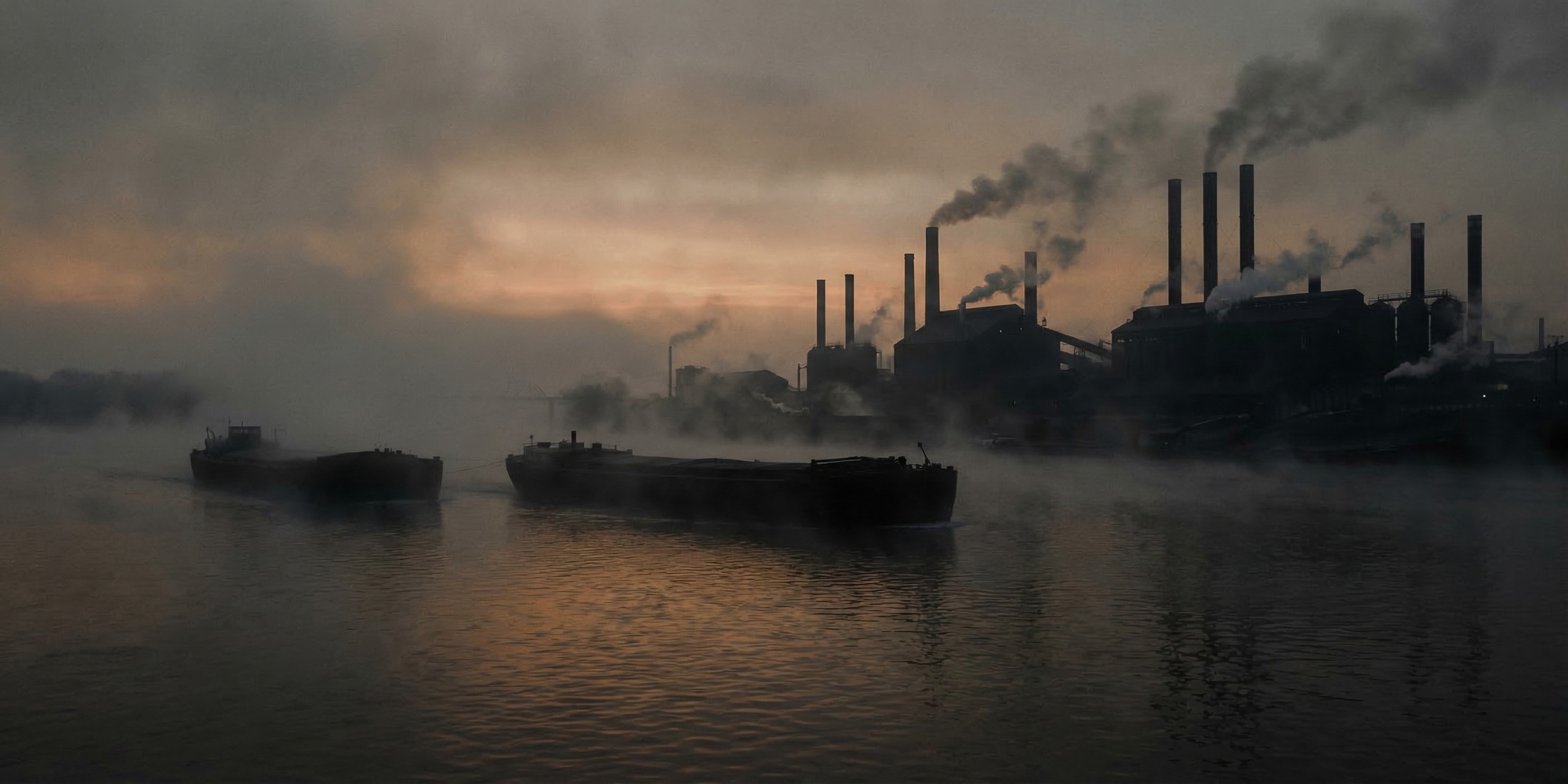
In the hours before dawn on July 6, 1892, two converted coal barges moved silently up the Monongahela River toward the Carnegie Steel Company's Homestead Works. Aboard them were approximately 300 Pinkerton National Detective Agency agents, recruited from New York, Chicago, and Philadelphia, armed with Winchester rifles and told they were being deployed to protect company property. The plan was simple: arrive under cover of darkness, land inside the mill fence before the workers learned of their approach, and establish control of the grounds so that Carnegie's chairman, Henry Clay Frick, could reopen with a non-union workforce.
The plan failed within minutes of reaching shore. More than ten thousand workers and townspeople had been waiting for them since three in the morning.
What unfolded over the next thirteen hours on the banks of the Monongahela was not merely a labor dispute that turned violent. It was a collision between two irreconcilable visions of what industrial America was supposed to be, and who it was supposed to serve. The Homestead Strike of 1892 left at least sixteen people dead, shattered the nation's most powerful steelworkers' union, triggered one of the most dramatic political crises of the Gilded Age, and cast a long shadow over the relationship between American capital and labor that would endure for decades.
The Steel King and His Enforcer
To understand what happened at Homestead, it is necessary to understand the two men who made it inevitable: Andrew Carnegie and Henry Clay Frick, a partnership that was always more combustible than it appeared.
Carnegie was born in Dunfermline, Scotland, in 1835, the son of a handloom weaver whose livelihood had been destroyed by industrial machinery, a biographical irony Carnegie would spend his life quietly avoiding. He came to America as a child, rose from telegraph messenger boy to railroad manager to investor, and by the 1870s had concentrated his formidable energies on steel. By 1892, Carnegie Steel was the largest steel producer in the world. Carnegie himself was one of the wealthiest men alive. He had recently published his famous essay "The Gospel of Wealth" in the North American Review, arguing that great fortunes carried an obligation to improve society, that "the man who dies thus rich dies disgraced." He gave money to libraries, universities, and concert halls. He cultivated a public image as a friend to the working man, a fellow immigrant who had made good and wished to help others do the same.
The workers at Homestead might have found that image harder to square with their daily reality. They worked twelve-hour shifts, seven days a week. Their wages were tied to a complex sliding scale linked to the price of steel, which had climbed sharply in recent years, meaning Carnegie's profits had soared while the company argued the scale's structure meant wages need not rise proportionally. The skilled workers in the Amalgamated Association of Iron and Steel Workers, the largest and best-organized craft union in the American iron and steel industry, were among the highest-paid industrial workers in the country. But high wages in absolute terms did not mean the relationship between employer and employee was one of equals.
Henry Clay Frick had been born in 1849 in West Overton, Pennsylvania, and had built his own fortune in coke, the coal derivative used to fuel steel furnaces, before becoming indispensable to Carnegie. In 1891, Carnegie appointed Frick chairman of Carnegie Steel. Frick was brilliant, cold, and possessed of a ruthlessness that even Carnegie, no sentimentalist himself, sometimes found startling. Frick made no pretense of sympathy for organized labor. He had broken strikes before. He believed the Amalgamated Association was a fundamental obstacle to efficient industrial management, that its work rules, its control over who could operate which machines, its insistence on negotiating every change to the production process amounted to an intolerable constraint on the company's ability to run its own mills. He was determined to settle the question permanently.
Carnegie (who had written publicly that workers had the right to organize, that lockouts were unjust, that arbitration was preferable to confrontation) arranged to be in Scotland when the confrontation came. Whether he gave Frick explicit authorization for what followed, or simply created the conditions and looked away, remains one of the central questions of the episode. What is clear is that when Frick moved, Carnegie did not stop him.
"Fort Frick", The Lockout and the Community That Refused to Yield
The showdown at Homestead had been building for months. The workers' contract with Carnegie Steel expired on June 30, 1892. In February, Frick had opened negotiations with a set of demands: wage cuts of approximately 18 to 26 percent for the skilled workers covered by the Amalgamated's contract, and a reduction in the number of positions covered by union wage scales. The Amalgamated countered that Carnegie's profits, which had grown substantially as steel prices rose, more than justified maintaining existing rates. Frick was unmoved. He set a hard deadline of June 24, warning that if no agreement was reached, the company would deal with workers individually rather than through the union.
As negotiations stalled, Frick began preparing for a confrontation. The company stockpiled steel inventory to weather an extended stoppage. Most visibly, most provocatively, Frick ordered the construction of a new fence around the entire perimeter of the Homestead Works: eight feet of wooden planking topped with barbed wire, with holes cut at intervals that workers immediately recognized as rifle ports. The community had a name for it before it was finished. They called it "Fort Frick."
On June 28 and 29, Carnegie Steel began locking workers out of sections of the plant. On June 30, as the contract expired, the lockout became total. The Amalgamated's response was immediate and remarkable in its organization. Union leaders Hugh O'Donnell and William Weihe did not simply call a strike and post pickets. They mobilized the entire community (the 3,800 union members, the 5,000 additional workers and townspeople who depended on the mill, the women and children of Homestead) into something closer to a town militia. Workers were organized into military-style companies assigned to patrol the river, the rail lines, every road into town. They established a telegraph network to track news from Pittsburgh and beyond. They set up a committee of safety that functioned as a shadow government for the town. They would know, they promised, the moment Carnegie Steel tried to bring in strikebreakers, or worse.
Their intelligence was better than Frick's secrecy.
The Battle of the Barges, July 6, 1892
Frick had engaged the Pinkerton National Detective Agency in late June, contracting for 300 agents to be transported to Homestead by barge and landed inside the mill fence under cover of darkness. The operation was meant to be swift and quiet. The barges, the Iron Mountain and the Tide, converted coal vessels fitted with makeshift sleeping quarters and weapons, departed from Pittsburgh after midnight on July 5. By three in the morning on July 6, the Amalgamated's network had already sent word to Homestead. Church bells rang through the town. Steam whistles sounded at the mill. By the time the barges approached the landing at four in the morning, a crowd of over ten thousand workers and townspeople stood waiting on the riverbank.
Who fired the first shot has been disputed ever since. Congressional investigators, newspaper reporters, and participants gave contradictory accounts. What is not disputed is that within minutes of the first barge attempting to land, both sides were firing. The Pinkertons, still aboard their barges and unable to establish a defensible position on shore, were pinned down. The workers had improvised: they brought a small cannon loaded with scrap metal to the riverbank; they attempted to set the river surface alight with burning oil barrels rolled into the water; at one point they launched a small dynamite torpedo (which failed to detonate with any effect). The barges were riddled with bullets.
The battle lasted thirteen hours. Nine workers were killed and dozens wounded. Seven Pinkerton agents died and many more were injured. By late afternoon, the Pinkertons raised a white flag. Hugh O'Donnell of the Amalgamated accepted their surrender and promised safe passage to the town's opera house, which would serve as a temporary detention facility. He could not keep that promise. As the Pinkertons marched through Homestead's streets, an enraged crowd fell upon them, women beat the men with umbrellas and bare hands; workers clubbed them with sticks and pieces of lumber. The Pinkertons arrived at the opera house bloodied and traumatized. The Homestead Sheriff, who had watched from a distance, made no serious effort to intervene.
The workers had won the battle. They controlled the mill. But the victory was already turning against them in ways they could not yet see.
The Long Siege, Berkman, the Militia, and the Collapse of the Strike
Frick refused to negotiate. He had never intended to negotiate. When news of the battle reached him in Pittsburgh, he reportedly remained composed, continued working, and began preparing the next move. He petitioned Pennsylvania Governor Robert Pattison to deploy the state militia. The governor, a Democrat who owed something to labor voters, hesitated for nearly a week, but on July 12, he ordered 8,500 National Guard troops under Major General George Snowden to march into Homestead. Snowden's message to the Amalgamated's committee of safety was brief and final: "I don't recognize your union or any other union."
With the militia in control, Frick began reopening the mills with strikebreakers brought in from out of state. The Amalgamated's pickets, unable to block the gates against armed soldiers, could only watch. The community that had organized so effectively to hold the riverbank found itself increasingly powerless against the full weight of the state's coercive apparatus.
On July 23, a young Russian-born anarchist named Alexander Berkman, who had no connection to the Homestead workers but believed the strike represented the revolutionary moment he had been waiting for, gained entry to Frick's private office in Pittsburgh and shot him twice, then stabbed him in the leg. Frick, remarkably, survived. He finished his day's work, refused hospitalization until late that evening, and released a statement saying he did not expect to die and that the company's affairs were in good hands. The assassination attempt had precisely the opposite effect from what Berkman intended. Public sympathy, which had been running strongly toward the workers after the battle of the barges, shifted sharply. Editorialists who had condemned the Pinkertons now condemned the strike. The workers at Homestead publicly disavowed Berkman and his act, but the damage was done. The narrative had changed.
By November, with the mills running on non-union labor, with leaders of the Amalgamated facing criminal charges, and with their funds exhausted, the union voted to end the strike and accept Carnegie's terms. The legal aftermath was ferocious and one-sided. Thirty-three workers were charged with treason under Pennsylvania law, a charge eventually dismissed as the courts found it could not be sustained. Eight leaders faced murder charges arising from deaths during the battle; none was convicted. Dozens more faced conspiracy charges. Not a single Pinkerton agent was prosecuted for any of the deaths that occurred during the battle, despite coroner's inquests that established some of the workers' deaths had been caused by gunfire from the barges.
The Amalgamated Association did not recover. Its national membership fell from approximately 24,000 in 1891 to roughly 10,000 by 1894. Carnegie Steel and the industry that followed its example operated effectively free of union organization for the next four decades. It was not until 1937, when the Congress of Industrial Organizations mounted a sustained organizing campaign, that steelworkers won collective bargaining rights again.
Carnegie returned from Scotland. He expressed private regret, to friends, in letters, eventually in his autobiography, where he wrote that "no pangs remain of any wound received in my business career save that of Homestead." His partnership with Frick dissolved bitterly in 1900 in a dispute over company shares; the two men did not reconcile. Carnegie spent the last decades of his life giving away hundreds of millions of dollars to libraries and universities and peace foundations. He did not, historians have noted, share any of that wealth with the men and women of Homestead.
What the River Remembered
The Homestead Strike illustrated something the Gilded Age was demonstrating again and again, in factory towns and mining camps and rail yards across America: that in a direct confrontation between organized capital, a sympathetic state government, and an organized community (even a well-organized, determined, and righteous community) capital held structural advantages that mere solidarity could not overcome. The Amalgamated had intelligence networks, community organization, and genuine public sympathy. Frick had the Pinkertons, the governor, and the National Guard. The outcome was not surprising in retrospect, however heroic the resistance.
What made Homestead different was the scale and visibility of the confrontation, and the particular moral resonance of Andrew Carnegie's position. Here was a man who had published, in a major national journal, a theory of stewardship, who had argued that great wealth carried great obligation, that the successful industrialist owed something to the society that had made his success possible. And here was what that theory looked like when tested: eight-foot fences with rifle ports, Pinkerton agents on barges in the dark, strikebreakers behind militia bayonets, treason charges for union men who had done nothing more than defend the community they had built.
The workers who held the Monongahela riverbank on the morning of July 6, 1892, lost the war even as they won that battle. But what they did on that riverbank (the organization, the defiance, the willingness to stand against something larger than themselves) did not disappear. It went underground, into the memory of industrial communities across America, into the organizing traditions that would resurface forty-five years later in the CIO campaigns of the 1930s. The men who built the modern American labor movement knew Homestead's story. They had grown up hearing it. It told them something they needed to know: that it was possible to fight, even when, especially when, the odds were assembled against you.
The Monongahela still runs through Pittsburgh. The Carnegie Steel works at Homestead are gone now, replaced in time by a shopping mall. Andrew Carnegie's libraries still stand in hundreds of American towns. The workers who died on that riverbank on July 6 have a small historical marker. It is, in the accounting of the Gilded Age, about what they received.