The Sky Bridge to Berlin: How the Great Airlift Saved a City and Defined the Cold War
By Library of History Editorial Staff
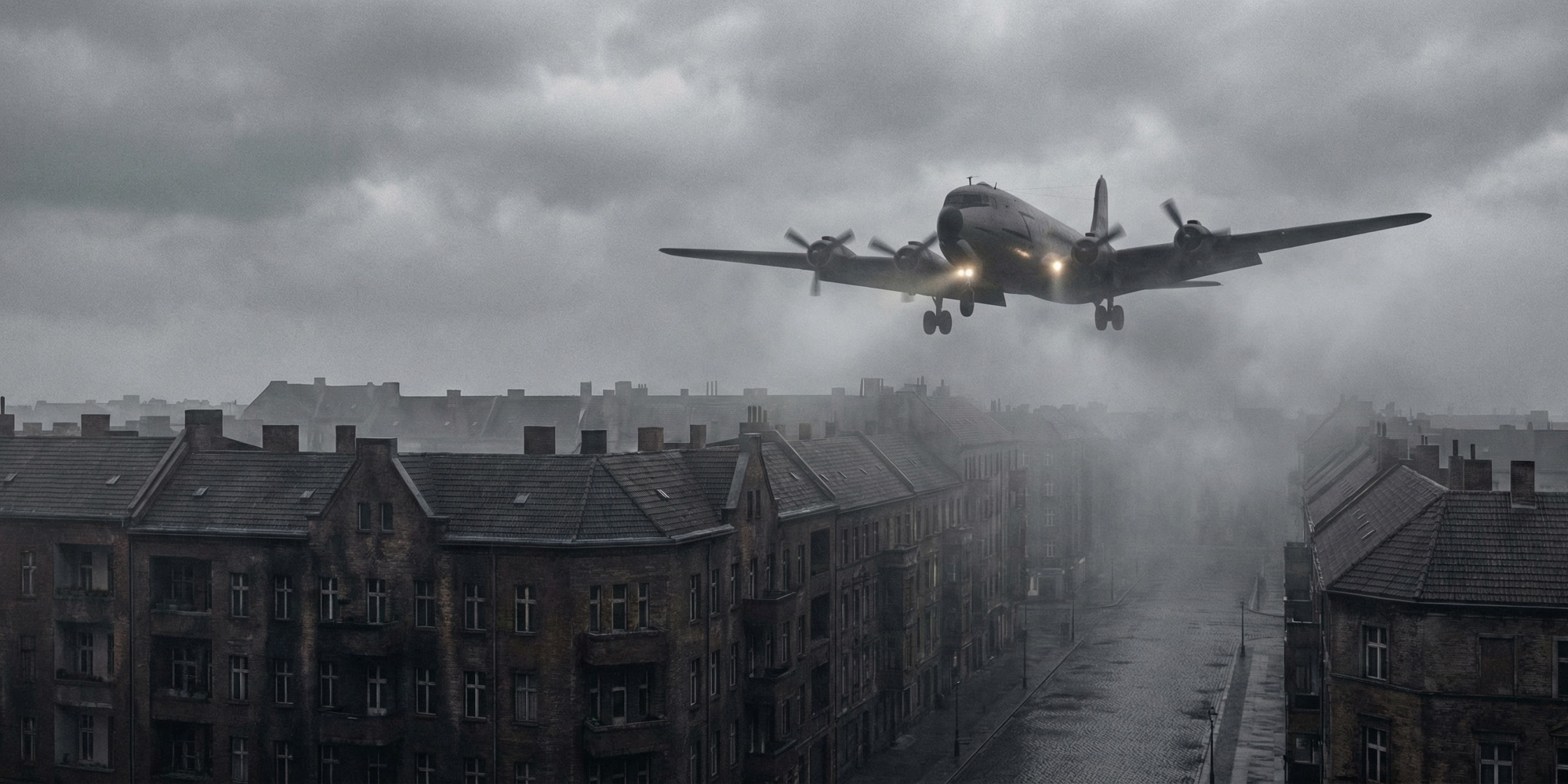
The clock at Tempelhof Airport read a few minutes past three in the morning on a raw November night in 1948 when the C-54 Skymaster began its descent. Fog pressed in from the east, thick and low, shrouding the rooftops of a city still half in rubble. The runway lights burned faint below. The approach corridor was barely twenty miles wide, dictated by wartime treaty, and on either side of the glide path, the apartment buildings of a shattered German city rose like dark cliffs. The pilot had exactly one shot at the landing. If he missed, he would not circle. Protocol was absolute: there was no room in the pattern for a go-around. He either put the plane down or he flew back to West Germany with a load of coal that 2.2 million people urgently needed.
He put it down. Ground crews in coal-dusted coveralls were at the hatch before the propellers stopped, unloading ten tons of soft brown coal in under twenty minutes. Then the plane refueled and was gone. Three minutes later, another C-54 touched the runway behind it. Then another. Every ninety seconds, around the clock, every day, for fifteen months, because the Soviet Union had decided that this isolated outpost a hundred miles inside its occupation zone was not worth the Western Allies' trouble, and the Western Allies had decided to prove it very, very wrong.
An Island in the Wrong Ocean
To understand the Berlin Airlift, you have to understand the peculiar geography of defeat. When Germany surrendered in May 1945, the victorious Allies carved the country into four occupation zones: American, British, French, and Soviet. Berlin itself (the capital, the prize, the symbolic heart of everything the war had been about) was similarly divided among the four powers. The problem was that Berlin sat deep inside the Soviet zone, a hundred and ten miles from the nearest Western territory. The city was a Western island in a Soviet sea, connected to the outside world only by rail lines, roads, and canals that ran entirely through Soviet-controlled territory.
For three years, this arrangement held, uncomfortable but functional. Then, in early 1948, the Western Allies began moving toward consolidating their three zones into a single economic unit, the embryo of what would become West Germany. The Soviets, led by Marshal Vassily Sokolovsky, watched this consolidation with alarm. On March 20, 1948, Sokolovsky walked out of the Allied Control Council, the four-power body governing occupied Germany, and it never met again. The wartime alliance that had defeated Hitler was, for practical purposes, over.
The immediate trigger came in June. On June 18, the Western Allies introduced a new currency, the Deutsche Mark, to stabilize their zones' shattered economies. The Soviets responded by introducing their own Ostmark and, on June 23, attempting to impose it on all of Berlin. The West refused. The next morning, June 24, 1948, Soviet forces lowered barriers across every road, railway, and canal connecting West Berlin to the outside world. They also cut off the electrical supply from East Berlin's generators. West Berlin had approximately 36 days of food reserves and 45 days of coal. Stalin was betting that starvation and cold would do what armies could not.
When Berlin Falls, Western Germany Will Be Next
In Frankfurt, General Lucius D. Clay received the news and immediately began drafting cables to Washington. Clay was a Georgia-born West Point engineer, a man of fierce conviction and a volcanic temper, who had spent three years as the de facto proconsul of American-occupied Germany. He understood what Berlin meant in a way that Washington sometimes did not. "When Berlin falls, western Germany will be next," he wrote. "If we mean to hold Europe against communism, we must not budge."
Clay initially proposed sending an armored convoy down the autobahn to force the Soviets' hand. The Truman administration recoiled: an armed convoy risked a firefight that could escalate into a third world war within four years of the second ending. But doing nothing (abandoning the city, accepting Soviet dominance) was equally unthinkable. It would signal to every nation in Europe that American commitment was conditional, that the United States would retreat when the pressure rose.
President Harry Truman, a man not given to elaborate strategic deliberation when the moral choice seemed clear, made up his mind quickly. "We are going to stay, period," he told his advisers. The question was how. Clay had mentioned an alternative in one of his cables, almost as an afterthought: an airlift. The Soviets, by wartime agreement, could not legally interfere with aircraft flying through the three designated air corridors (the northern lane from Hamburg, the central from Hanover, the southern from Frankfurt) each twenty miles wide. Clay doubted it could work. But it was the only option that didn't risk a shooting war.
On June 26, 1948, Operation Vittles began. American C-47 Skytrains (twin-engine aircraft from the previous war, carrying only two and a half tons each) began flying from Rhein-Main and Wiesbaden Air Bases. The British launched their own operation, called Plainfare, the same day. In those first chaotic days, the combined airlift delivered perhaps 80 tons of supplies to West Berlin. The city needed 4,500 tons per day to survive.
The Conveyor Belt in the Sky
The airlift's salvation came in the form of General William H. Tunner, a logistics officer of extraordinary gifts who had previously organized the legendary "Hump" operation flying supplies over the Himalayas into China during the war. Tunner arrived in late July 1948 to find a sprawling, improvisational mess. Pilots were making decisions on the ground about loads and routes. Radio channels buzzed with chatter. Aircraft circled over Tempelhof waiting for landing slots, sometimes for hours. One particularly bad day, August 13, saw rain, a mid-air collision, and three aircraft crashing at Tempelhof in a single afternoon, blocking the runway for hours while Tunner himself circled overhead in his command plane, unable to land, listening to his entire operation grind to a halt.
He restructured everything from the ground up. The "conveyor belt" system that emerged was a masterpiece of industrial logic. Aircraft flew scheduled routes at fixed altitudes and fixed intervals: three minutes apart in good weather, four in bad. There was no circling. A pilot had one approach; if he could not land, he returned to base with his load. Engines were never shut down on the ground. The moment a plane touched down, crews rushed to unload it, fuel it, and turn it around within thirty minutes. Pilots ate their meals in the aircraft, handed out through the windows by ground staff. New four-engine C-54 Skymasters, carrying ten tons versus the C-47's two and a half, replaced the older planes as fast as the USAF could reassign them.
The operation's physical plant expanded to match. Tempelhof Airport, originally a Nazi-era showpiece with an iconic curved terminal, became the American hub. Its approach corridor threading between apartment buildings so close that pilots could see laundry on the lines. Gatow Airport served the British. And in October 1948, the French sector added Tegel Airport, a runway carved out of rubble and sandy soil in just 61 days, its construction carried out around the clock by West Berliners and French engineers working in candlelight and winter cold. Tegel opened on December 5, 1948, and added critical capacity just as the winter deepened.
On Easter Sunday, April 16, 1949, a date Tunner had chosen for maximum symbolic impact, he launched what became known as the Easter Parade: a coordinated 24-hour maximum-effort push that delivered 12,940 tons of supplies in 1,398 flights. It was a demonstration of pure industrial might, a message to Moscow written in airplane engines and coal dust. One day. Twelve thousand tons. The Soviets had wanted to starve Berlin into submission. America had responded by building the largest aerial supply chain in history.
And threaded through the logistics was something altogether more human. In the summer of 1948, a young Air Force lieutenant named Gail Halvorsen noticed children watching his C-54 approach Tempelhof through the perimeter fence. He stopped, talked to them through the wire, and on impulse tied his two sticks of chewing gum to a handkerchief parachute and dropped them from his plane on the next pass. Within days, letters began arriving at Tempelhof addressed simply "To the Chocolate Uncle" or "To the Candy Bomber." Halvorsen's improvised gesture became Operation Little Vittles, eventually distributing over three tons of candy and chocolate to Berlin's children, a symbol of what the airlift meant beyond coal and flour and powdered milk.
A City Holds
West Berliners endured conditions that would have broken a population with less reason to hold. In the depths of the winter blockade, coal rations fell to four pounds per person per day. Electricity ran for only two to four hours in most neighborhoods. Bakeries rationed carefully to stretch flour deliveries. Factories cut shifts. The black market thrived, but ordinary Berliners mostly accepted their rations with a dignity born of the knowledge that whatever the hardship, the alternative was worse.
Their mayor understood this. Ernst Reuter, the Governing Mayor of West Berlin, was a former communist turned Social Democrat who had spent the Nazi years in exile and returned to a city half in ashes. On September 9, 1948, he stood before approximately 300,000 West Berliners gathered at the bombed ruins of the Reichstag and delivered the speech of his life. "Peoples of the world," Reuter declared, his voice carrying over the crowd, "look upon this city!" The crowd roared. They were not victims awaiting rescue; they were a people who had chosen a side and intended to hold it. That choice transformed the moral calculus of the airlift. American and British aircrews were not occupiers dispensing charity to a defeated enemy. They were partners in something larger, a joint assertion that free people would not be coerced into submission by a cutting of their supply lines.
The toll of the operation was real. Over fifteen months, 101 people died in airlift-related accidents: 31 Americans, 39 British, 13 German civilian workers on the ground, and others. They died in crashes caused by mechanical failure, bad weather, disorientation in fog. Not one death came from Soviet action, Moscow never formally violated the air corridors, but the corridors were narrow, the weather was unforgiving, and the operational pace was relentless. Those 101 names are the human cost written in the ledger behind every ton of coal delivered.
The Morning the Barriers Came Down
Behind the scenes, the blockade was failing on its own terms. The Western Allies imposed a counter-blockade on East Germany, cutting off industrial exports from the western zones to the east. East German factories, dependent on Ruhr steel and western machine parts, felt the pinch in ways Moscow had not anticipated. Meanwhile, the airlift's success made Soviet diplomacy look increasingly foolish. Month by month, the tonnage numbers climbed; month by month, the prediction that the West would quit proved wrong.
Negotiations through back channels in the spring of 1949 finally produced agreement. At midnight on May 12, 1949, Soviet forces lifted the barriers. Roads, railways, and canals connecting West Berlin to the west reopened. The first Western vehicles drove through in the early morning hours to cheering crowds. The airlift continued, deliberately, through September 30, 1949, stockpiling a reserve buffer that would deter any future coercion. By the time the last supply flight landed, the operation had delivered 2,323,738 tons of food, coal, medicine, and supplies in 277,804 flights over fifteen months. The cost came to approximately $224 million, divided between American, British, and other Allied contributions.
The consequences reordered the postwar world. NATO, whose founding treaty had been signed on April 4, 1949, while the airlift was still running, was born directly out of the Berlin crisis, which demonstrated more vividly than any diplomatic document the necessity of a formal Western military alliance. West Germany, proclaimed as the Federal Republic of Germany on May 23, 1949, was the political result of the same struggle: the Western zones, having held together through the blockade, now became a sovereign state aligned with the democratic world. And the psychological transformation in Berlin itself may have mattered most of all. A population that had begun the postwar years as a defeated enemy, under occupation, emerged from the airlift as something the Truman administration had not entirely planned for: allies. The men and women who had built Tegel Airport by candlelight, who had subsisted on four pounds of coal in January and waited at the Tempelhof fence for candy parachutes, now understood what the Western alliance was defending, and had chosen to be part of it.
Stalin had presented Harry Truman with two options: accept the loss of Berlin, or risk a third world war. Truman had refused both and found a third option that his adversary had never anticipated. The Berlin Airlift did not fire a shot. It did not cross a single Soviet barrier. It flew over all of them, ninety seconds at a time, and in doing so wrote the opening chapter of how the Cold War would actually be fought, not with armies on the march, but with will, endurance, and the willingness to sustain something difficult long past the moment an adversary expects you to quit.