The City That America Forgot: Hurricane Katrina and the Drowning of New Orleans
By Library of History Editorial Staff
The morning of August 28, 2005, was the last ordinary morning New Orleans would know for years. By sunrise, Mayor Ray Nagin had already issued the city's first mandatory evacuation order in its three-century history. The Superdome's doors were opening as a "shelter of last resort" for those who had nowhere else to go. Along the interstates leading out of Louisiana, transportation officials had reversed the lanes, a procedure called contraflow, so that all outbound traffic moved in a single relentless column away from the Gulf. And yet tens of thousands of people were not moving. Some had elderly parents who could not travel. Some had no car, no money for a hotel room, no family in a dry county. Some simply refused to leave what they had spent lifetimes building. In Washington, Max Mayfield, director of the National Hurricane Center, had spent the previous night on the phone with the governors of Louisiana and Mississippi and the mayor of New Orleans. He had described, in the careful language of meteorology, what he had watched building over the warm waters of the Gulf: a storm unlike most of what the city had survived before. He wanted them to understand what was coming. He did not know whether they did.
A Hole Below the Waterline: The City Built on Risk
New Orleans should not exist where it does. The city was founded in 1718 on a narrow natural levee above the Mississippi River's crescent, a strip of higher ground surrounded on three sides by water, the river to the south, Lake Pontchartrain to the north, and the Louisiana delta's swamps on every approach. For generations, the city's survival rested on the competence of engineers and the integrity of the landscape. Then it expanded. In the twentieth century, the systematic drainage of the city's bowl to create new land caused the organic soils beneath to compact and sink. By 2005, approximately half of New Orleans lay below sea level, some neighborhoods by as much as six to ten feet. The city's continued existence depended entirely on a system of levees, floodwalls, drainage canals, and pumping stations built and maintained by the Army Corps of Engineers.
That system had long been known to be inadequate. Engineers and hydrologists had warned for decades that it had been designed to withstand a direct hit from a moderate Category 3 hurricane, and that a stronger storm, or one that struck at exactly the wrong angle, could breach it. The funding required to upgrade the levees had been requested repeatedly and cut repeatedly. In 2004, the Federal Emergency Management Agency conducted a simulated disaster exercise called Hurricane Pam, a tabletop scenario imagining a catastrophic hurricane striking New Orleans. The simulation predicted flooding of 80 percent of the city, the displacement of approximately one million residents, and the deaths of as many as 60,000 people. The exercise produced detailed recommendations for pre-staged resources, mass evacuation planning, and emergency shelter management. Very little of it had been acted upon at scale by the time Katrina formed over the Bahamas on August 23, 2005.
The storm crossed into the Gulf of Mexico after a brief Florida landfall and intensified with alarming speed over the warm, deep water. By August 28, it had reached Category 5 status with sustained winds exceeding 175 miles per hour. As it approached the Louisiana coast, it weakened slightly, but only slightly. At 6:10 AM CDT on August 29, Katrina made final landfall as a strong Category 3 hurricane in Plaquemines Parish, southeast of New Orleans, with sustained winds exceeding 115 miles per hour. Its hurricane-force wind field extended 103 miles from the center, far larger than most Gulf Coast storms, including the more intense but more compact Hurricane Camille of 1969. The storm surge along the Mississippi coastline reached as high as 27 feet, among the highest ever recorded in the United States. An area roughly the size of the United Kingdom (approximately 93,000 square miles across 138 parishes and counties) lay in its path.
The Levees Are Gone: August 29–30
In the first hours after landfall, the news seemed almost manageable. Katrina's eye had tracked slightly east of the city center, sparing New Orleans the most direct impact. Damage reports from the French Quarter were survivable. Officials allowed themselves brief, cautious moments of relief. Then the water began to rise.
Three locations failed with catastrophic finality. The 17th Street Canal, the primary drainage artery on the western edge of the city, breached when its floodwall buckled under the pressure of the storm surge. The Industrial Canal on the city's eastern edge gave way at multiple points, sending a wall of water into the Lower Ninth Ward with enough force to move houses from their foundations. The London Avenue Canal, running through the Gentilly neighborhood, failed in two locations. Post-disaster investigations conducted by the Army Corps of Engineers and independent engineering teams reached a conclusion that would reverberate through years of legal and political reckoning: the failures were not primarily caused by the storm's ferocity. They were caused by design flaws, floodwalls built with engineering deficiencies, structures that had never been adequate for the forces they were constructed to withstand. A 2006 Army Corps report stated plainly that the catastrophic failures resulted from "systemic design flaws," not from forces exceeding the system's intended design parameters.
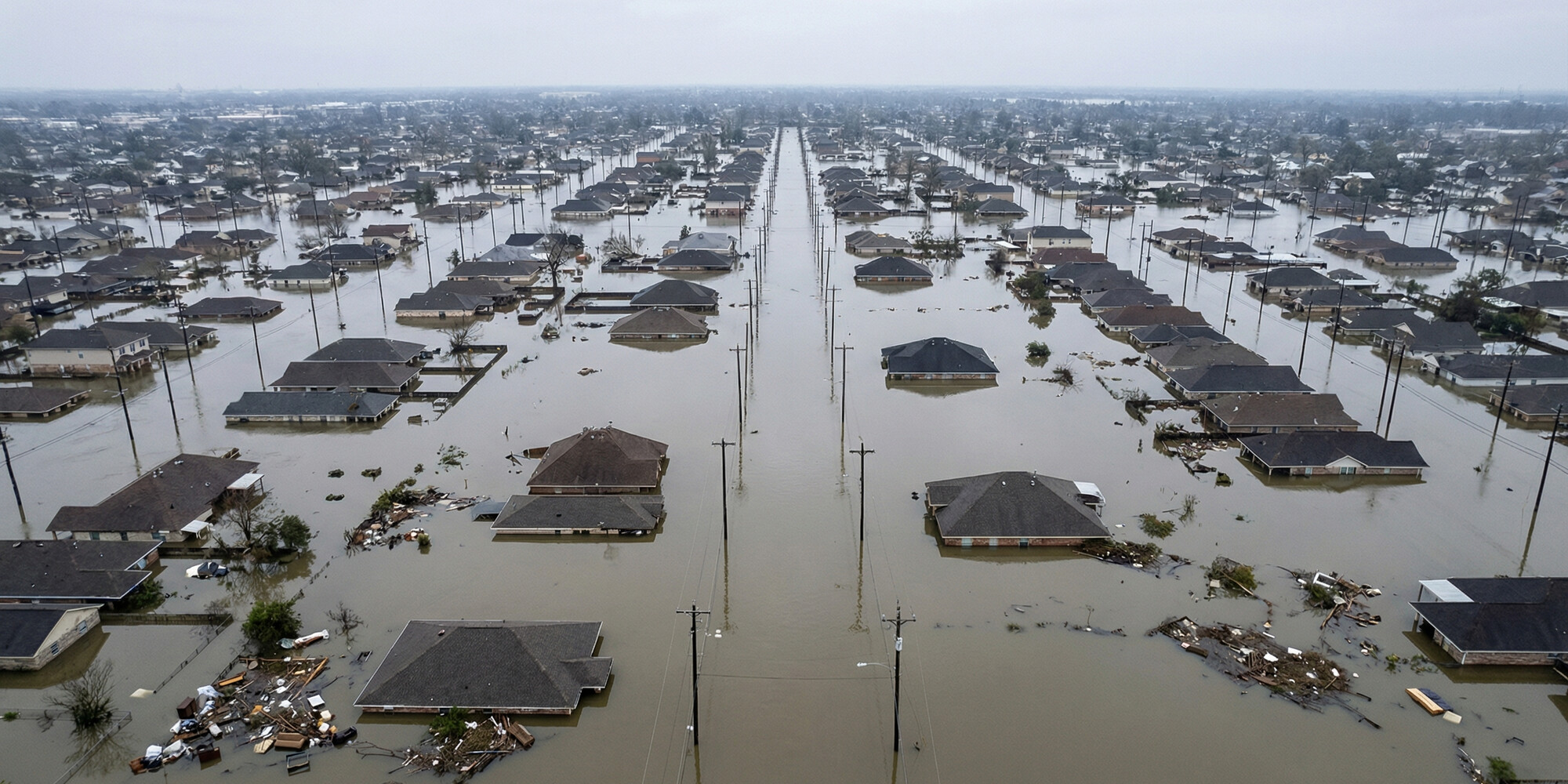
The water rose fast. By mid-morning on August 29, neighborhoods across the city were inundating. By afternoon, approximately 80 percent of New Orleans was underwater, some areas of the Lower Ninth Ward, Gentilly, and New Orleans East under ten to fifteen feet. Residents who had stayed found themselves trapped in attics, hacking through rooftops with axes to reach air. The Coast Guard launched helicopters that would ultimately conduct more than 33,000 rescues across the Gulf Coast, one of the largest search-and-rescue operations in American history. The Superdome, already sheltering between 25,000 and 30,000 people, sustained damage to its roof; rain poured through the torn membrane into the packed interior, and conditions deteriorated rapidly as water rose outside and the days passed.
At the same time, an estimated 20,000 people had gathered spontaneously at the Ernest N. Morial Convention Center along the Mississippi waterfront. They had arrived on their own initiative, seeking a large structure they believed would be a refuge. The Convention Center had not been designated as an official shelter. It had received no water, no food, no medical support, no security, no communication with emergency management. For days, as television cameras broadcast the growing crowd on every major national network (disproportionately elderly, disproportionately Black, disproportionately poor) no organized federal relief arrived. Inside, people died of dehydration, medical emergencies, and the sheer catastrophic collapse of every system that sustains human life in a modern city.
Heck of a Job: The Architecture of Federal Failure
The federal response to Hurricane Katrina did not fail because the people responsible for it were indifferent to suffering. It failed because the systems built to manage disasters had been designed for manageable disasters, emergencies in which local governments could request assistance, coordinate with state officials, and serve as the functional bedrock of organized response. Katrina had not produced a manageable emergency. It had produced the effective collapse of local government itself. New Orleans's police department hemorrhaged hundreds of officers in the hours after the storm, as some abandoned their posts and others found their own homes and families in crisis. City Hall was operating first from the Superdome, then from a hotel, then from a cruise ship in the Mississippi. The National Response Plan, the federal framework for catastrophic disaster management, assumed that functioning local governments would be making coherent requests up the chain. In New Orleans, that chain had effectively ceased to exist.
FEMA Director Michael Brown had been appointed to lead the agency despite having no significant emergency management experience; his previous position had been as commissioner of the International Arabian Horse Association. His performance during the crisis, and his congressional testimony in its aftermath, became one of the most examined episodes of institutional failure in modern American history. Brown later acknowledged under questioning that he had not learned about the 20,000 people gathered at the Convention Center, a gathering reported prominently on every national television network, until approximately two days after they had assembled. Secretary of Homeland Security Michael Chertoff did not declare Katrina an "Incident of National Significance" under the National Response Plan, the formal trigger for full federal mobilization, until August 30, the day after landfall, when the levee failures and their consequences were already catastrophically apparent to anyone watching television.
President Bush had authorized a federal emergency declaration before landfall, and the federal government had pre-staged more assets and personnel than for any previous storm. On August 31, he flew over New Orleans in Air Force One, surveying from altitude the city submerged below. The aerial photograph taken through the small oval window of the presidential jet, the face of the Commander in Chief looking down at his drowned country from a comfortable remove, became one of the defining images of the disaster. On September 2, visiting the Gulf Coast in person for the first time, he turned to Michael Brown and said: "Brownie, you're doing a heck of a job." The phrase entered American political vernacular immediately, a six-word encapsulation of the distance between official perception and the reality visible to millions on live television. Brown was removed from directing the Katrina response on September 9. He resigned from FEMA three days later.
The White House commissioned its own post-disaster review, led by homeland security adviser Frances Fragos Townsend and released in February 2006. The "Lessons Learned" report was a document remarkable for its candor. It identified seventeen critical challenges in which the federal government had fallen short, spanning unified command, communications, logistics, mass care, search and rescue, and evacuations. Its central finding was unsparing: "Our current system for homeland security does not provide the necessary framework to manage the challenges posed by 21st Century catastrophic threats." The report described four fundamental structural flaws in the national preparedness system (failures in unified management, command and control, knowledge of existing plans, and regional coordination) and characterized the federal framework as simply not built to handle "the conditions of a catastrophic event with large scale competing needs, insufficient resources, and the absence of functioning local governments."
"This Is America?": The Reckoning
At least 1,833 people died across the Gulf Coast in Hurricane Katrina and its aftermath, the deadliest natural disaster to strike the United States since the Great Okeechobee Hurricane of 1928. Louisiana accounted for the vast majority of the dead. The death toll was not distributed evenly across New Orleans's neighborhoods or demographic groups. Studies conducted in the years that followed confirmed what the images from those first days had already made visible: the dead were disproportionately elderly, disproportionately Black, disproportionately concentrated in the city's low-lying, flood-prone neighborhoods, the communities with the least mobility and the fewest options when the contraflow lanes opened and the evacuation order came. An estimated 400,000 people were displaced from New Orleans alone. Across the Gulf Coast, more than one million people were displaced, one of the largest forced migrations in American history since the Dust Bowl. The economic damage exceeded $125 billion in 2005 dollars, making Katrina the most costly natural disaster in the nation's history.
On September 2, rapper Kanye West, appearing during a nationally televised benefit concert for Katrina relief, departed from his prepared remarks to say: "George Bush doesn't care about Black people." The statement was condemned by some and echoed by many. Whatever one made of its precision as a political diagnosis, it captured something that millions of Americans watching the coverage had been struggling to articulate, that the composition of those left behind was not random, and that the assumption embedded in official evacuation planning (that residents could leave by car) had built a hidden filter into the system that sorted the city's poor and transit-dependent from its mobile and resourced. The demographics of the dead were the demographics of structural inequality made suddenly, catastrophically legible.
The long recovery that followed compounded the initial displacement. FEMA provided over $7 billion in individual and public assistance. Congress passed the Post-Katrina Emergency Management Reform Act of 2006, restructuring FEMA, establishing clearer lines of authority, and creating a more robust national response framework. The Army Corps of Engineers undertook a $14.5 billion reconstruction of New Orleans's flood protection infrastructure, completed in 2011 and described at the time as the largest civil engineering project in American history. The levees that exist today are stronger, better-designed, and more rigorously maintained than the ones that failed in 2005.
But more than 30,000 public housing units were demolished in the aftermath of Katrina and were not rebuilt at anything approaching the same scale. The neighborhoods they had occupied were redeveloped in ways that priced out their former residents. New Orleans's population, approximately 455,000 before the storm, stood at roughly 389,000 by 2010 and approximately 383,000 by 2020. Nearly two decades after the storm, the city has never recovered its pre-Katrina size. The people who did not return are as much a part of Katrina's legacy as the rebuilt levees and the restructured emergency management system, perhaps more so, because they represent not the failure that was acknowledged and corrected, but the one that was accepted.
The Mirror the Storm Held Up
What Hurricane Katrina exposed was not simply a failure of emergency management, though it was that, and not simply a failure of infrastructure investment over decades, though it was that too. It was a revelation of a particular and painful kind: a slow, live-broadcast demonstration of the distance between the America described in official documents and the America inhabited by a significant portion of its citizens. Max Mayfield had made the calls. The Hurricane Pam exercise had run the simulations. The engineers had written the reports. The warnings had been issued, in some cases for decades before August 2005. What was missing was not information or foresight. What was missing was the sustained institutional will (across multiple administrations, multiple appropriations cycles, multiple levels of government) to treat those warnings as obligations rather than estimates.
The storm lasted a matter of hours. The reckoning it produced is still ongoing. The question that Katrina forced into the open, in the wealthiest nation in the history of the world, why did it take five days to bring water to 20,000 Americans stranded in a convention center?, does not have a comfortable answer. It is a question about what kind of country America is, and for whom its institutions were built. Katrina did not answer that question. But it made it impossible, for a time, to look away.