Seventy-Three Seconds: The Space Shuttle Challenger and the Price of American Optimism
By Library of History Editorial Staff
The phone lines to NASA's Marshall Space Flight Center had been open for hours. In a conference room at the Morton Thiokol plant in Brigham City, Utah, Roger Boisjoly and a small group of engineers had spread their charts across the table and were making one last argument. It was the night of January 27, 1986. The overnight temperature forecast for Kennedy Space Center in Florida was 18 degrees Fahrenheit, the coldest in the launch pad's history. Their data was unambiguous: the rubber O-ring seals that joined the segments of the Space Shuttle's Solid Rocket Boosters lost their resiliency in cold temperatures. O-ring erosion had been documented on previous missions. Below 53 degrees, the engineers argued, no launch could be certified safe. Launch was twelve hours away.
NASA managers on the other end of the line pushed back. They challenged the engineers' methodology. One demanded to know, with undisguised impatience, when exactly Thiokol would be ready to launch, "in April?" The meeting was placed on hold. In the recess, Thiokol's senior management convened privately. When they returned, the vote had flipped. Gerald Mason, a senior vice president, turned to his chief engineer, Robert Lund, and delivered four words that would become one of the most damning lines in the history of American engineering: "Take off your engineering hat and put on your management hat." Lund complied. Joe Kilminster signed the approval form and transmitted it to NASA. The engineers had been overruled. The launch would proceed.
Boisjoly made one final appeal. He told the managers he personally felt the crew was being put at unacceptable risk. He was told the decision was final. He returned to his seat and said nothing more. The phone lines went quiet. Somewhere in Florida, seven people slept, unaware that the argument had happened at all.
A New Era in Space
To understand why that phone call ended the way it did, it is necessary to understand what the Space Shuttle program had come to mean to NASA, and to America, by the winter of 1986. The Shuttle had its origins in a 1972 decision by President Nixon to develop a reusable "space truck": not the heroic, one-off rockets of the Apollo era, but a workaday vehicle that could haul satellites into orbit and bring them back for repairs, making spaceflight as routine as airline travel. The promise was economic as much as inspirational. Reusability would make space access cheap. NASA projected, in its 1985 manifest, a flight rate of 24 missions per year by 1990, more than one launch every two weeks.
The program had delivered 24 successful missions by January 1986. Twenty-four launches without a catastrophic loss. The accumulation of those victories had done something insidious: it had quietly transformed the engineers' understanding of acceptable risk. Problems that appeared on early missions (including, critically, the observed erosion of O-rings) had not caused catastrophic failures, and so the organization had come to treat them as manageable anomalies rather than urgent warnings. The Rogers Commission would later characterize this as "normalization of deviance": the gradual process by which a culture accepts increasingly dangerous conditions as normal, simply because the danger has not yet been fatal.
Mission 51-L was positioned to be the most-watched Shuttle launch in the program's history. Among the seven crew members was S. Christa McAuliffe, a high school social studies teacher from Concord, New Hampshire, selected from more than 11,000 applicants for NASA's Teacher in Space Project. Reagan's program had been designed precisely to broadcast the Shuttle's normalcy to the American public, to demonstrate that space was no longer the exclusive province of test pilots and engineers, but was open to teachers, to civilians, to anyone. McAuliffe's presence turned classroom televisions across the country into launch monitors. An entire generation of American schoolchildren would watch what happened next.
Take Off Your Engineering Hat
The O-ring problem had a documented history stretching back years. The Solid Rocket Boosters were assembled from prefabricated segments, joined at field joints sealed by two concentric rubber rings. The seals were designed to compress against the joint walls during ignition, preventing the escape of superheated propellant gas. But the design had a flaw: under certain conditions, particularly at low temperatures when the rubber stiffened, the O-rings did not seat properly. On at least one previous mission, Shuttle 51-C, flown in January 1985 at a pad temperature of 53 degrees Fahrenheit, engineers had documented significant O-ring erosion after landing. The threshold of safe launch temperature, Boisjoly and his colleagues concluded, was somewhere above that figure. Preferably well above it.
What made the January 27 teleconference remarkable (and, afterward, historically damning) was that the warning was not ambiguous. The charts Boisjoly presented to NASA Marshall managers showed a direct correlation between cold temperatures and O-ring degradation. The overnight forecast for Cape Canaveral called for temperatures in the mid-20s Fahrenheit by launch time. The launch pad temperature on the morning of January 28 would register 36 degrees, fifteen degrees colder than any previous Shuttle mission.
The Rogers Commission, in its investigation the following spring, would find that Thiokol's management reversal was not driven by new engineering data. It was driven by institutional pressure. NASA's launch schedule had acquired a momentum of its own. The agency had already delayed Mission 51-L five times since the previous summer. There was public attention, schedule pressure, and an organizational culture that had come to treat schedule adherence as evidence of competence. "The Commission is troubled," the Rogers Report concluded, "by what appears to be a propensity of NASA to defer known safety problems." The decision to launch was flawed, the Commission found, and the engineering dissent that might have stopped it was never communicated to the Level I and Level II managers who held final authority. The people who could have grounded the flight did not know, on the morning of January 28, that anyone had argued against it.
Godspeed, Challenger
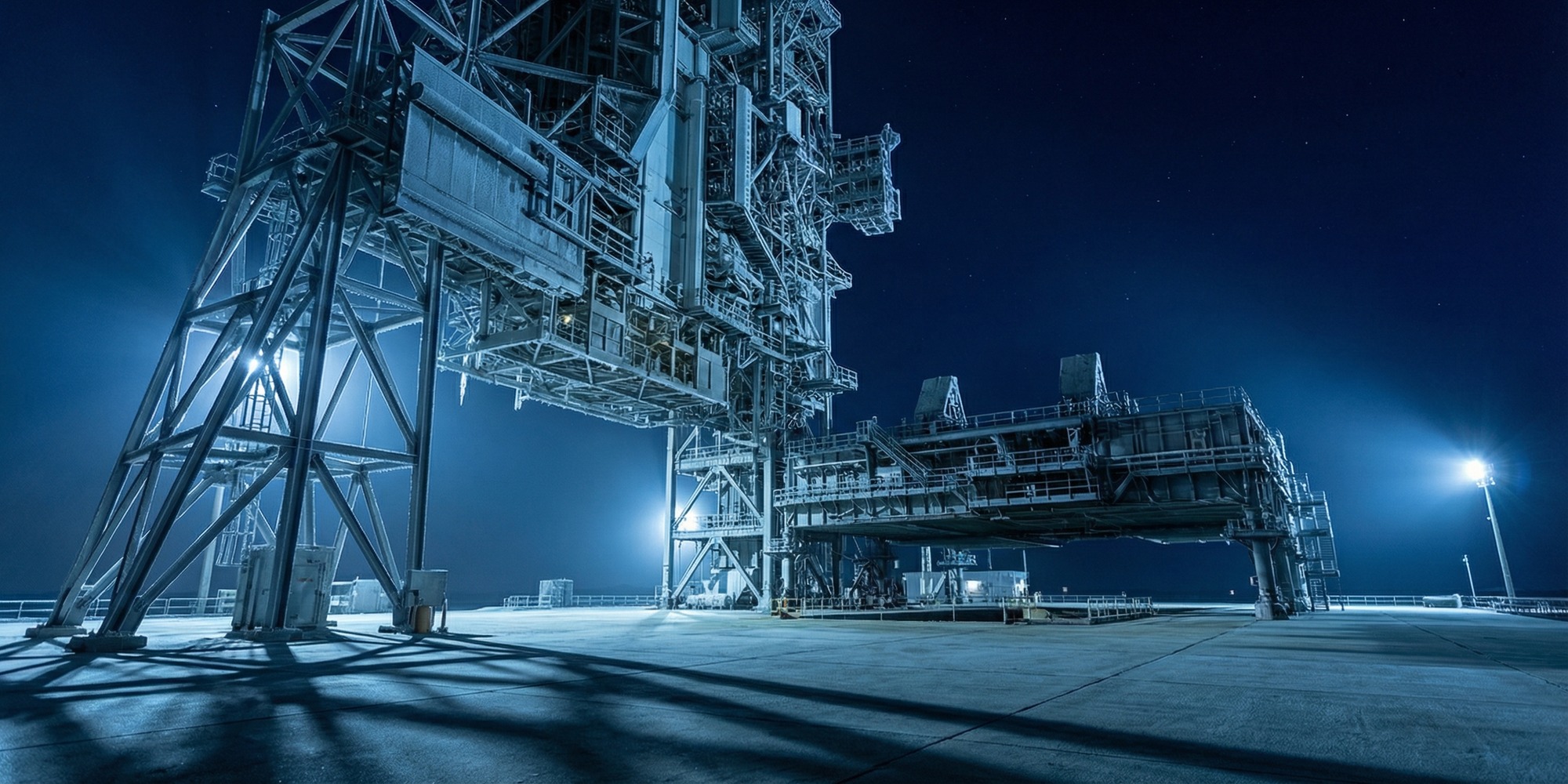
At 11:38 AM Eastern Standard Time on January 28, 1986, Space Shuttle Challenger lifted off from Kennedy Space Center's Launch Complex 39-B. In classrooms across America, children watched the launch on television, some of them looking for Mrs. McAuliffe, their teacher in space, aboard the orbiter. Challenger rose clean and straight into a cloudless Florida sky. Mission Control's voice was steady and matter-of-fact. The sequence was unfolding precisely as designed.
It was not. Photographic analysis conducted weeks later, after the wreckage had been collected from the Atlantic Ocean, would reveal that a puff of dark smoke had appeared at the aft field joint of the right Solid Rocket Booster just 0.678 seconds after ignition, invisible to ground observers, invisible on the broadcast feeds, but there in the high-speed camera footage. The O-ring had already begun to fail. For approximately the next 58 seconds, the flight appeared normal. Challenger passed through max-q, the period of maximum aerodynamic pressure. Mission Control gave the crew the go-ahead to throttle up. "Roger, go at throttle up," Commander Francis R. Scobee replied. Those were the last words from Challenger's flight deck.
At 58.788 seconds, a continuous flame plume became visible at the right booster's aft field joint, still invisible to the naked eye, detectable only in post-accident image analysis. The flame impinged on the strut connecting the booster to the External Tank, burning through the attachment point. At 72 seconds, the lower strut gave way. At 73.618 seconds, the final moment of telemetry, the lower section of the External Tank failed. Liquid hydrogen erupted. The aerodynamic forces tore the vehicle apart at 46,000 feet.
The white plume that millions of viewers saw on live television was not an explosion in the conventional sense. The Shuttle's propellant burned in a rapid, uncontrolled release, a fireball of hydrogen and oxygen that consumed the External Tank and orbiter structures in an instant. The two Solid Rocket Boosters, suddenly free, arced away from the fireball on separate trajectories, trailing their own exhaust, before range safety officers sent the destruct command fourteen seconds later. The crew compartment, structurally robust and aerodynamically blunt, was not destroyed in the breakup. It separated intact and continued on a ballistic arc, reaching approximately 65,000 feet before falling toward the ocean for two minutes and forty-five seconds. Post-accident investigation found that at least three Personal Egress Air Packs had been manually activated aboard the compartment, indicating that some of the crew were alive and conscious after the vehicle came apart. They did not survive the ocean impact.
At Kennedy Space Center, the launch director's voice came over the PA system: "Flight controllers here are looking very carefully at the situation." In classrooms across America, teachers turned off their televisions and tried to explain what their students had just seen.
Reality Must Take Precedence
President Reagan appointed the Presidential Commission on the Space Shuttle Challenger Accident on February 3, 1986. Chaired by former Secretary of State William P. Rogers, it included Neil Armstrong, Sally Ride, and Richard Feynman, the Nobel Prize-winning physicist from Caltech who would prove to be its most consequential member.
On February 11, 1986, less than two weeks after the disaster, the Commission held a televised public hearing. Feynman arrived with a small piece of O-ring material, a C-clamp, and a glass of ice water. He compressed the O-ring segment with the clamp, submerged it in the ice water, and held it there while the hearing continued around him. When he removed it and released the clamp, the material, unlike uncompressed rubber, did not spring back immediately. It remained deformed. "I believe this is a significant engineering problem," Feynman said, with the understatement of a man who had just demonstrated in sixty seconds what years of internal NASA memos had failed to resolve. The moment was broadcast live. It became one of the most famous instances of scientific communication in American history.
But Feynman's most significant contribution to the investigation was the appendix he insisted on including in the Commission's final report, Appendix F, "Personal Observations on the Reliability of the Shuttle." What he found, interviewing engineers and managers across NASA and its contractors, was a chasm between official and actual estimates of risk. NASA management had formally estimated the probability of catastrophic Shuttle failure at 1 in 100,000 per flight. Working engineers, the people who designed and maintained the components, estimated the real probability at somewhere between 1 in 50 and 1 in 200. "It would appear," Feynman wrote with characteristic precision, "that, for whatever purpose, be it for external or internal consumption, the management of NASA exaggerates the reliability of its product to the point of fantasy." He concluded with a sentence that became the Commission's epitaph for the disaster: "For a successful technology, reality must take precedence over public relations, for Nature cannot be fooled."
The Rogers Commission's final report, issued on June 6, 1986, found that the Challenger accident had two causes: a physical failure, the destruction of the O-ring seals in temperatures for which they were not certified, and an organizational failure, described in Chapter V as "a flawed decision making process." The Commission found that if managers at the highest levels of NASA had been fully informed of the engineering disagreement on the night of January 27, "it is highly unlikely that they would have decided to launch 51-L on January 28, 1986." The system had failed to surface the warning. The people with authority to stop the flight never received the argument that might have moved them to do so.
Roger Boisjoly testified before the Commission in complete detail. He described the charts he had presented, the arguments he had made, the moment Gerald Mason told Robert Lund to put on his management hat. His testimony was given in full public view, in front of the cameras. When he returned to work at Thiokol, he found himself effectively shunned, relieved of significant responsibilities, isolated from his colleagues. He eventually resigned from the company, suffered from post-traumatic stress, and spent the remainder of his career delivering lectures on engineering ethics to universities and professional organizations. He became, in the years that followed, the canonical example in engineering ethics courses of what it means to do the right thing and pay the institutional price. He died in 2012.
On the evening of January 28, 1986, President Reagan addressed the nation from the Oval Office. The speech had been prepared for him by Peggy Noonan and was among the finest presidential addresses of the twentieth century. Reagan named each of the seven crew members. He spoke to the schoolchildren who had watched. And he closed with lines from John Gillespie Magee Jr.'s poem "High Flight," which McAuliffe had planned to read to her students from orbit: the Challenger crew had "slipped the surly bonds of earth to touch the face of God." The Shuttle program was grounded for thirty-two months. When it returned to flight in September 1988, it was a changed program, restructured, with new safety oversight, new channels for dissent, new joints on the Solid Rocket Boosters.
The changes were real. They were also incomplete. In February 2003, the Space Shuttle Columbia disintegrated on reentry, killing all seven of its crew members. The Columbia Accident Investigation Board found that NASA had again allowed schedule pressure and organizational culture to suppress engineering concerns, that the same institutional pathologies documented by the Rogers Commission seventeen years earlier had never been fully excised. "NASA's organizational culture and structure," the Board concluded, "had as much to do with this accident as the foam." Challenger had given the agency the most expensive lesson in its history. Columbia demonstrated that the lesson had not been fully learned.
The Weight of Seventy-Three Seconds
The Challenger disaster endures as one of the defining events of Modern America for reasons that reach well beyond the immediate tragedy of seven lives. It arrived at a moment when American confidence in its institutions (in government, in large organizations, in the competence of experts) was already eroding. It offered, in the starkest possible terms, a portrait of how successful institutions fail: not through malice or incompetence, but through the gradual, nearly invisible process by which warning signs are normalized, dissent is filtered out, and the appearance of safety becomes indistinguishable, to those at the top, from actual safety.
Roger Boisjoly had the data. He made the argument. He was told to put on a different hat. The people who needed to hear his warning never heard it. And in the resulting silence, seventy-three seconds of what looked, to millions of watching Americans, like perfect normalcy. The lesson of Challenger is not simply that O-rings fail in cold weather. It is that institutions can be designed (unintentionally, through the accumulation of small decisions) to prevent the people who know the truth from reaching the people who need to hear it. That lesson has no expiration date.