Thirty Seconds Over Tokyo: The Doolittle Raid and America's First Strike Against Japan
By Library of History Editorial Staff
Just before eight in the morning on April 18, 1942, the Japanese patrol vessel Nitto Maru materialized out of the gray Pacific swell approximately 650 miles east of the Japanese coast. Within minutes, its radio operator transmitted a terse warning to Japanese naval headquarters: enemy carriers had been spotted. The message was intercepted almost simultaneously by American radio operators on the task force it described. On the bridge of USS Hornet, the news landed like a cold wave. The plan had called for a launch point roughly 400 miles closer to Japan. At 650 miles out, the fuel margins that Army Air Forces crews had spent months calculating evaporated in an instant. Admiral William "Bull" Halsey's orders came by signal flag within the hour: launch now, or abandon the mission entirely.
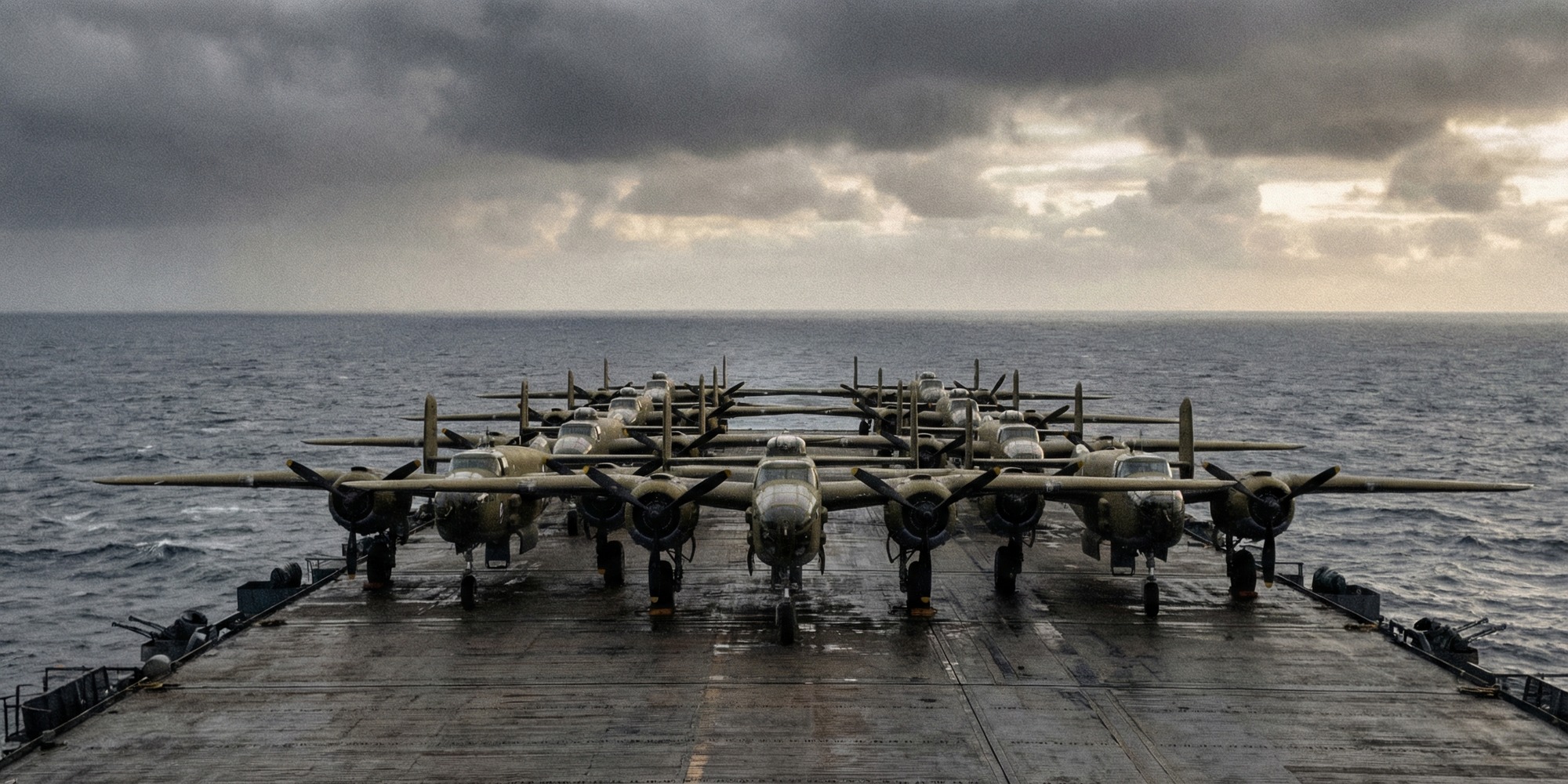
Sixteen B-25 Mitchell bombers sat lashed to the Hornet's deck, Army planes on a Navy carrier, a combination that had never been attempted in combat. In the lead plane, Lieutenant Colonel James H. "Jimmy" Doolittle absorbed the math. His men were about to take off from an aircraft carrier in rolling Pacific seas and fly to a country that had never been bombed by a foreign enemy, on barely enough fuel to reach the Chinese coast on the other side. He walked to the bow of the ship and looked out at the churning gray water. Then he climbed back into his B-25, started the engines, and prepared to go first.
A Nation in Need of a Miracle
The United States that stumbled into 1942 was a nation in shock. On December 7, 1941, Japanese carrier aircraft swept over Pearl Harbor and destroyed or damaged eighteen American warships before breakfast, killing more than 2,400 servicemen in less than two hours. In the months that followed, American and Allied forces absorbed reversal after reversal: the fall of Guam, the surrender at Bataan, the collapse of Singapore, the loss of the Philippines. President Franklin D. Roosevelt understood that a democracy asking its citizens to sustain a long and grinding war needed more than casualty lists and strategic retreats. It needed proof that the enemy could bleed.
The idea that became the Doolittle Raid was born in January 1942, in the mind of a relatively junior Navy captain named Francis S. Low. Watching Army bombers training at Norfolk Naval Air Station, Low noticed that the runway markings painted on the tarmac to simulate a carrier deck were roughly the same dimensions as an actual carrier deck. If a twin-engine Army bomber could get airborne in that distance (and the North American B-25 Mitchell, he calculated, could) then it could theoretically take off from a carrier. What happened to it afterward was a separate problem.
Low brought the idea to Admiral Ernest King, Chief of Naval Operations, who passed it to the Army Air Forces. The man selected to lead the mission was Doolittle, then 45 years old and one of the most accomplished aviators in American history. He had won the Schneider Trophy air races, pioneered the first instrument-only flight across the continent, and earned a doctorate in aeronautics from MIT. He was not a man accustomed to failure, and he was not known for understatement about danger. He accepted the assignment on the spot. His orders were simple: organize the mission, train the crews, and hit Japan.
The target list included military and industrial facilities in Tokyo, Yokohama, Nagoya, Kobe, and Osaka. The raid was understood from the beginning to be a psychological weapon as much as a military one. Sixteen medium bombers could not meaningfully alter Japan's industrial capacity. What they could do was demonstrate to a stunned American public that its country could still fight, and demonstrate to Japan's military planners that their homeland was not the sanctuary they had assumed.
The Impossible Math of an Audacious Plan
The engineering challenges alone would have defeated most planners. The B-25 was not designed for carrier operations. Its wingspan stretched 67 feet. Its fuel capacity in standard configuration was insufficient for the distances involved. At Eglin Field in the Florida panhandle, Doolittle and approximately 140 men selected from the 17th Bombardment Group spent February and March 1942 solving the problem one piece at a time, against a deadline they were not permitted to discuss.
The aircraft were stripped and rebuilt. Fuel capacity was nearly doubled through a combination of auxiliary tanks installed in the bomb bay, collapsible rubber bladders fitted into crawlways, and additional fixed tanks welded into the lower gun turret well. The Norden bombsight (America's premier precision aiming device, classified at the highest level and valued at several thousand dollars per unit) was pulled from every plane and replaced with a simple device designed by Captain C. Ross Greening at a cost of roughly twenty cents. Since the mission required low-altitude bombing, precision optics were irrelevant. The belly turret was removed to reduce weight. Radios were ripped out because strict silence was mandatory. The tail position, which lacked a functioning gun, was fitted with a pair of wooden broom handles painted black, decoys meant to give pause to any Japanese fighter pilot lining up a shot from behind.
On the Eglin tarmac, white lines were painted to reproduce the dimensions of a carrier deck. Crew after crew ran the drill: full throttle, maximum load, airborne in under 500 feet. Those who consistently failed to clear the marks were quietly reassigned. Those who succeeded found themselves boarding westbound trains without being told their destination. On April 1, 1942, a date that did not escape the crews' dark humor, sixteen modified B-25s were hoisted by crane onto the flight deck of USS Hornet at Naval Air Station Alameda, in San Francisco Bay. The ship slipped under the Golden Gate Bridge in heavy fog the following morning. Most of the carrier's own crew had never seen an Army bomber at close range. The B-25 pilots had never taken off from a moving ship. None of them were entirely sure they would land anywhere.
Launch Into the Unknown
The discovery of the task force by the Nitto Maru forced a decision that left no good options. At 650 miles from Japan rather than the planned 400, crews faced a fuel deficit they could not math their way out of. Several quietly updated their mental calculations and arrived at the same conclusion: reaching the emergency airfields in China's Zhejiang Province would require something between extraordinary luck and miracle. Halsey and Doolittle agreed: launching from this distance was nearly suicidal. Not launching meant the mission had failed before it started. They launched.
Doolittle's plane rolled down the Hornet's pitching deck at approximately 8:20 in the morning, into a forty-knot headwind. The combination of ship speed and wind gave him just enough effective airspeed to claw into the air with perhaps twenty feet of deck to spare. The crew watching from below exhaled collectively. Then the second plane went, and the third, and the fourth. All sixteen B-25s were airborne without a single abort or accident, a small miracle of training, nerve, and engineering. The task force turned back for Pearl Harbor. The bombers flew west, alone.
The raiders came in over the Japanese coast at low altitude to defeat radar detection, some of them skimming rooftops and treetops on their approach runs. Factory workers in Tokyo looked up in bewilderment at the unfamiliar silhouettes. Air raid sirens sounded across the city, but many residents assumed the planes were Japanese. Their country had absorbed no foreign attack since a Mongol fleet was destroyed in a typhoon in the thirteenth century. Bombs fell on steel works, oil storage facilities, dock facilities, and military installations in Tokyo and four other cities. No single hit was strategically decisive. But Tokyo was burning, and Americans had done it.
The flight to China became a controlled emergency. Fuel ran critically low over the Chinese coast, exactly as the worst-case scenarios had predicted. Darkness fell before most crews could locate the emergency airfield at Chuchow. One crew, low on fuel and unable to navigate the Chinese interior, diverted north to Vladivostok in the Soviet Union, where they were interned for thirteen months before eventually making their way home through Iran. The remaining fifteen crews either crash-landed along the coast or bailed out into the dark Chinese countryside. Chinese soldiers and farmers moved through the following days rescuing downed American airmen, often at tremendous personal risk, hiding them from Japanese patrols and guiding them toward friendly lines.
Of the eighty men who launched from the Hornet, three died during crash landings or bailouts. Eight were captured by Japanese forces. Three of those eight were executed. One died in captivity. The remaining four survived the war as prisoners. When Doolittle himself bailed out over China in the darkness and landed in a muddy rice paddy, he was convinced the mission had been a catastrophe. His bombers were gone, his men were scattered, and the damage to Japan, by any military measure, was minor. He fully expected to be court-martialed. Instead, he was promoted two grades to Brigadier General and awarded the Congressional Medal of Honor by President Roosevelt in a ceremony at the White House.
The Ripples of a Single Mission
The Doolittle Raid's immediate military impact was, by any conventional accounting, modest. Sixteen medium bombers carrying limited ordnance could not meaningfully wound Japan's industrial capacity or disrupt its military operations. What the raid did alter (profoundly, and with consequences that would echo for years) was the psychology of two nations at war and the strategic calculations of Japan's senior commanders.
Roosevelt announced the raid to an American public that had been absorbing bad news since December. When reporters asked where the planes had come from, the aircraft carriers were still classified, Roosevelt offered a grin and an answer that became one of the war's most remembered lines. The planes, he said, had launched from "Shangri-La," the fictional Himalayan paradise from James Hilton's novel Lost Horizon. It was a deliberate misdirection, delivered with theatrical pleasure. American newspapers put it on every front page. A nation starved for something to celebrate had a victory, audacious, slightly mysterious, undeniably American.
For Japan's military high command, the raid's consequences were far more dangerous than any of the bombs that had landed on Tokyo. Admiral Yamamoto Isoroku, already pressing the argument that Japan needed to draw the American fleet into a decisive engagement before it could reconstitute itself, used the psychological shock of the bombing to push for extending Japan's defensive perimeter to include Midway Island. His logic: if Japan occupied Midway, no American carrier force could ever again approach close enough to Japan to launch such a mission. The Japanese military council agreed. It was the right argument at exactly the wrong strategic moment.
American naval intelligence, having broken Japan's naval codes, read the plans as they took shape. The resulting Battle of Midway, fought from June 3 to June 6, 1942, became the hinge on which the Pacific War turned. Four Japanese fleet carriers, the same core striking force that had devastated Pearl Harbor six months before, were sunk in three days of combat. Japan's naval air arm, built over a decade, was gutted and never fully replaced. The road to Japan's eventual defeat ran through Midway, and the road to Midway ran through the Doolittle Raid.
There is a shadow over the story that American accounts have often moved past too quickly. In the weeks following the raid, Japanese forces launched a massive punitive campaign across the Chinese provinces of Zhejiang and Jiangxi, the regions where Doolittle's crews had come down. Code-named Operation Sei-go, the offensive was designed to destroy every airfield from which American bombers might again be staged, and to punish the Chinese communities that had sheltered and rescued the American airmen. Historians estimate that approximately 250,000 Chinese civilians perished in the reprisals. The Chinese men and women who risked their lives to pull dazed American pilots out of rice paddies and hide them from Japanese patrols paid a price that no medal ceremony could acknowledge.
The Weight of Thirty Seconds
Jimmy Doolittle's bombers were over Japanese cities for less than a minute each, dropping their ordnance and banking hard for the Chinese coast. They were never going to win the war in those seconds. They were never supposed to. What they could do, what they did, was demonstrate that the war could be won: that American ingenuity, operating under conditions that bordered on the impossible, could reach inside an empire that had declared itself beyond reach.
The Doolittle Raiders became the emblem of American resilience in the Pacific War's darkest season. Their story is one of reckless courage and careful engineering, of desperate improvisation and brutal arithmetic, where a modest strike on a distant city, launched from an aircraft carrier by men who had never done anything like it before, set in motion a chain of strategic consequences that helped determine the outcome of a world war. The raid's physical damage faded. Its psychological and strategic reverberations did not. Two months later, above the blue water near Midway Atoll, Japan's irreplaceable carriers slid beneath the surface, and the tide of the Pacific War began, slowly and inexorably, to turn.