The Day the Party Died: Black Tuesday and the Crash That Broke the World
By Library of History Editorial Staff
Before the opening bell on the morning of October 29, 1929, the queue of sell orders at the New York Stock Exchange stretched back so far that the ticker tape was already running hours behind. Brokers who had arrived before dawn found the trading floor crackling with a kind of desperate energy, not the frantic optimism of the boom years, but something rawer, more animal. Investors across the country were waiting at brokerage offices from Chicago to Los Angeles, watching stock tickers clatter out numbers that meant nothing yet, because by the time the tape printed the prices, those prices were already history. Everyone was trying to sell. Almost no one was buying.
By the time the closing bell rang on what newspapers the next morning would call "Black Tuesday," sixteen million shares had changed hands, a record that would stand for decades. Fortunes assembled over years had evaporated in hours. The Dow Jones Industrial Average, which had reached a peak of 381.17 on September 3, 1929, a number so dizzying it had seemed to confirm every prophecy of permanent prosperity, was now in freefall. In the weeks that followed, it would lose nearly half its value. Before the bottom came, three years hence, it would fall 89 percent from that peak. Twenty-five years would pass before the index returned to where it had been on that bright September afternoon.
Black Tuesday was not merely a bad day on Wall Street. It was the violent verdict on a decade of collective delusion, and the first act of the worst economic catastrophe in American history.
The Gospel of Prosperity: How the Twenties Built a Castle on Sand
To understand what shattered on October 29, 1929, you must first understand what had been constructed in the years before. The period between the Armistice of 1918 and the autumn of 1929 had transformed American life with a velocity that had no historical precedent. The automobile had moved from novelty to necessity; by 1929, one in five Americans owned a car. Radio had collapsed the distances between cities and farms, between coasts and heartland. Consumer appliances (refrigerators, washing machines, vacuum cleaners) were becoming common in middle-class households, purchased increasingly on the new gospel of installment credit: buy now, pay later, and trust that the good times would provide.
The stock market embodied and amplified this spirit. The Dow Jones Industrial Average had climbed from 63 in August 1921 to 381.17 in September 1929, a six-fold increase in eight years. And for the first time in American history, the market had been democratized. Brokerage houses, investment trusts, and a flood of popular financial advice had brought millions of ordinary Americans into the market. Margin accounts required only 10 percent down; the remaining 90 percent could be borrowed against the rising value of the stocks themselves. This seemed almost logical at the time. Why would anyone need to hold the full value of an asset that kept appreciating?
The intellectual scaffolding for this optimism came from the highest authorities. Irving Fisher, a Yale economist widely regarded as the most brilliant financial mind of his generation, declared just days before the crash that stock prices had reached "what looks like a permanently high plateau." President Herbert Hoover, sworn in just months earlier, had pledged in his inaugural address that with continued American prosperity, poverty itself might be banished from the nation. The Federal Reserve, watching speculative fever run hot, debated how to cool it without precipitating the very crisis they feared. They would not find the answer in time.
Beneath the glittering surface, however, the foundations were deeply troubled. The agricultural economy, which employed a quarter of the workforce, had been in depression throughout the decade, ground down by falling commodity prices that had never recovered their wartime highs. European economies, still burdened by war debt and reparations, were weakening. Banks had extended credit so aggressively that any significant contraction in asset prices would trigger a cascade of margin calls, loan defaults, and institutional failures. The prosperity of the Twenties was real, but it had been built, increasingly, on borrowed time and borrowed money.
The Wobble: September to Black Monday
The peak (September 3, 1929) announced itself with no particular fanfare. Trading was brisk, the Dow closed at 381.17, and the evening papers carried no prophetic warnings. Yet within days, the market began to slide. September and October saw a gradual, grinding retreat: small losses one day, partial recoveries the next, but with a persistent undertow pulling values down. Brokerage houses began issuing margin calls, demands for additional collateral from investors who had bought on credit. Those who couldn't meet the calls had to sell, which drove prices lower, which triggered more margin calls, which forced more selling.
Thursday, October 24, quickly christened "Black Thursday", offered the first glimpse of genuine panic. Nearly 12.9 million shares changed hands as investors scrambled to liquidate. The selling was so overwhelming that prices plummeted in the morning session, erasing months of gains in hours. Then came the rescue attempt. Thomas Lamont, a senior partner at J.P. Morgan, convened a meeting of the nation's leading bankers (representatives of Morgan, Chase, National City, and others) and organized a coordinated buying intervention. The pool of money they assembled was used to purchase blocks of stock, most conspicuously U.S. Steel, at above-market prices. It was the same tactic that had worked in the Panic of 1907, when J.P. Morgan himself had steadied the financial system through personal authority and coordinated action.
It worked, briefly. The market partially recovered by Thursday's close, and the weekend brought a flood of reassuring statements from officials and bankers. Treasury Secretary Andrew Mellon, whose own immense fortune was heavily invested in the market, declared that "the fundamentals of the country's business are on a sound and prosperous basis." The reassurances did not hold.
On Monday, October 28, the market dropped nearly 13 percent in a single session, one of the worst one-day losses in the exchange's history. The banker coalition convened again, but this time the losses were too vast and the panic too deep for any rescue pool to absorb. The coalition collapsed. There would be no organized defense on Tuesday.
Black Tuesday: October 29, 1929
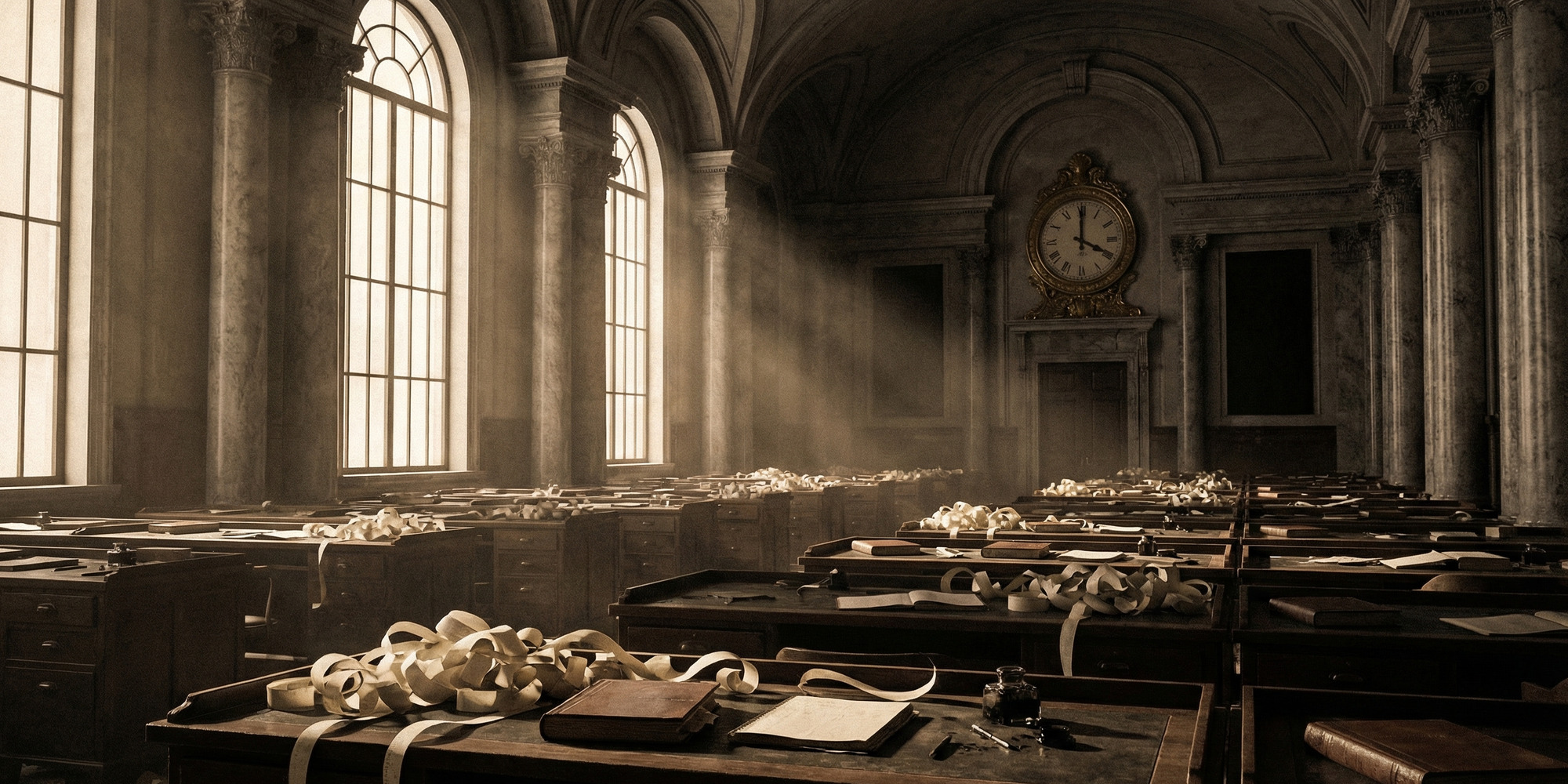
The morning of October 29 opened before the markets did, with a backlog of sell orders so deep that the exchange floor was overwhelmed from the first bell. Sixteen million shares traded hands, a figure that stunned even those living through it. The ticker tape, that thin strip of paper carrying the prices of civilization's accumulated wealth, fell hours behind; investors sitting in brokerage offices across the country watched it clatter out numbers from a morning that had already become afternoon, and they could not know what they owned or what it was worth until the day was nearly done.
Contemporary accounts describe scenes of extraordinary distress. Brokers wept openly on the exchange floor. Crowds gathered outside the NYSE on Broad Street in an eerie silence, watching the building as if waiting for some visible sign of the catastrophe occurring inside. One exchange seat (a trading license that had sold for $625,000 at the height of the boom) reportedly changed hands for $1. The story may be apocryphal, but it captured the mood precisely: that the machinery of American prosperity, which had seemed so magnificently permanent just weeks before, had in a single afternoon become nearly worthless.
The Dow fell roughly 12 percent on Black Tuesday, compounding Black Monday's 13 percent loss. Combined, the two-day decline represented a destruction of wealth that had no peacetime parallel in American experience. And the selling did not stop. By mid-November, the Dow had lost nearly half its value from the September peak. The market staged several partial recoveries over the following two years, each one followed by a worse decline, as investors who had held on hoping for a recovery finally gave up and sold into falling prices.
The true bottom came on July 8, 1932, when the Dow Jones Industrial Average closed at 41.22, 89 percent below the September 1929 peak. It was the index's lowest reading of the entire twentieth century. The market would not return to its pre-crash level until November 1954, twenty-five years after Black Tuesday. An entire generation would invest, retire, and die before the exchange recovered what it had lost in those October days.
How a Market Crash Became a Human Catastrophe
Stock market crashes do not, by themselves, cause depressions. The mechanism that transformed the 1929 crash into the Great Depression was more complex, more prolonged, and in crucial ways more avoidable, which is precisely what made the suffering that followed so devastating to comprehend in retrospect.
The immediate transmission ran through the banking system. The collapse in stock prices wiped out the collateral that had secured millions of margin loans. Banks that had extended those loans found their balance sheets suddenly impaired. Depositors, watching banks fail or fearing they might, began withdrawing their savings. By 1933, approximately 5,000 banks had failed, wiping out the deposits of millions of ordinary Americans who had never bought a single share of stock. The credit contraction that followed reduced business investment and consumer spending simultaneously, triggering layoffs, factory closures, and a spiral of deflation that made debt increasingly crushing for everyone who held it.
Congress and the Hoover administration compounded the disaster in June 1930 by signing the Smoot-Hawley Tariff Act, which raised duties on more than 20,000 imported goods to record levels. The intent was to protect American manufacturers from foreign competition. The effect was to provoke retaliatory tariffs from America's trading partners, collapsing world trade at precisely the moment when international economic cooperation was most urgently needed. Global commerce, already under strain, contracted sharply.
Most consequentially, the Federal Reserve, the institution expressly created in 1913 to prevent banking panics and stabilize the money supply, did the opposite of what the crisis required. In 1931, in order to defend the gold standard against foreign currency pressures, the Fed raised interest rates, tightening credit and deepening the contraction at the worst possible moment. Milton Friedman and Anna Jacobson Schwartz, in their landmark 1963 work A Monetary History of the United States, documented this policy failure in devastating detail: the Depression, they argued, had been transformed from a severe recession into a decade-long catastrophe largely by the Fed's decision to allow the money supply to collapse by a third between 1929 and 1933.
By 1932, the human scale of the disaster had become impossible to ignore. Unemployment had reached approximately 25 percent, one in four American workers without a job. Manufacturing output had fallen by half. Hoovervilles (shantytowns of makeshift shelters, named in bitter mockery of the president who had promised to abolish poverty) had appeared in the shadow of every major American city. That summer, thousands of World War I veterans marched on Washington, camping in the capital to demand early payment of bonuses they had been promised for their service. General Douglas MacArthur, following orders from the Hoover administration, dispersed them with cavalry, bayonets, and tear gas. The images of soldiers driving veterans from their encampment shocked the nation.
Herbert Hoover was a genuinely capable man in an impossible situation of partially his own making, committed by ideology and temperament to a response (voluntarism, local relief, fidelity to the gold standard) that the scale of the catastrophe had made insufficient. He had believed, deeply and sincerely, that direct federal relief would undermine the moral fiber of the republic. By the election of 1932, the republic was not much concerned with its moral fiber. It was concerned with eating.
Franklin Delano Roosevelt won the presidency in a landslide, carrying all but six states, on a promise that was deliberately vague but unmistakably urgent: a "New Deal for the American people." On March 4, 1933, he stood in the winter air before the Capitol and told a nation that had lost its confidence in itself that "the only thing we have to fear is fear itself." It was not a policy. It was something rarer and, in that moment, more necessary: a restoration of will.
The Long Shadow: What Black Tuesday Made
The Great Crash of 1929 and the decade of depression it helped trigger reshaped American life in ways still visible nearly a century later. The regulatory framework born from the disaster, the Securities Exchange Act of 1934, which created the Securities and Exchange Commission; the Glass-Steagall Act of 1933, which separated commercial and investment banking; the Federal Deposit Insurance Corporation, which guaranteed individual bank deposits, transformed financial markets from a largely unregulated arena into a supervised system accountable to the public interest. These institutions were imperfect and contested from the moment of their creation, but they reflected a durable national consensus: that markets powerful enough to destroy the savings of ordinary Americans could not be left entirely to their own devices.
The Depression also completed a transformation in the relationship between the federal government and its citizens that progressives had argued for since the turn of the century. Social Security, signed into law in 1935, established the principle that the federal government bore responsibility for the welfare of the elderly and the unemployed, a principle that had been not merely controversial but philosophically contested before 1929. The New Deal's public works programs, farm supports, and financial regulations created the architecture of what historians would later call the "mixed economy," in which markets operated within a framework of government rules and safety nets.
Black Tuesday was not simply a financial event. It was the verdict on a decade of believing that borrowed money, rising prices, and limitless optimism could substitute for economic fundamentals, and the opening chapter of a reckoning that forced Americans to ask, for the first time, what they owed each other when the market failed to provide. The answers they arrived at, forged in the furnace of want and fear, defined the country's political and economic landscape for generations. They are the legacy of a party that ended too suddenly, and the bill that finally came due.