Roosevelt's Tree Army: How the Civilian Conservation Corps Rebuilt Land, Labor, and Hope
By Library of History Editorial Staff
In spring 1933, the United States was not merely in recession. It was in social free fall. Banks had failed in waves. Farms had blown dry or drowned in debt. City streets held men who had once been clerks, mechanics, mill hands, and students, all waiting in lines that seemed to lead nowhere. Franklin Roosevelt entered office promising action, and one of his fastest answers looked as old as the republic itself: put people to work on the land.
The Civilian Conservation Corps, born in Roosevelt’s first hundred days, offered an extraordinary bargain to young men and their families. Enroll, leave home, live in a government camp, work in forests and parks, and send most of your pay back to parents or dependents. For households with no steady income, that remittance could keep rent paid and food on a table. For the federal government, it was relief, discipline, and infrastructure policy compressed into one program. For the country, it became one of the New Deal’s most visible signs that Washington had not run out of ideas.
Over the next decade, CCC enrollees planted trees by the millions, cut trails, built park structures, fought erosion, and helped shape the physical landscape of modern public lands. Yet the story is bigger than numbers. The CCC remade daily life for a generation of young Americans while revealing the limits of New Deal reform, including racial inequality, gender exclusion, and regional imbalance. It was a project of hope, but not an innocent one. It reflected the ambitions and blind spots of the America that built it.
Emergency in 1933: Why Washington Built a Work Army
Roosevelt and Congress moved with remarkable speed in March 1933. On March 31, emergency legislation authorized federal employment in conservation work, and on April 5, Executive Order 6101 formally organized Emergency Conservation Work, the administrative framework that quickly became known to the public as the Civilian Conservation Corps. The objective was immediate: absorb unemployed young men before despair deepened into permanent social fracture.
Eligibility rules reflected both economic triage and social assumptions of the era. Early enrollment focused on unmarried men, typically ages 18 to 25, from families on relief. Monthly pay was set at $30, and in most cases $25 was sent directly to families. In today’s terms, it was modest money. In 1933, it could be the difference between eviction and survival. In thousands of households, the CCC paycheck arrived as a lifeline with a postmark from a camp hundreds of miles away.
The program’s architecture was itself a New Deal signature. The Labor Department handled recruitment. The War Department organized transportation and camp logistics. The Departments of Agriculture and Interior directed projects on forests, parks, and public lands. This interagency design was improvised under pressure, but it worked. By combining military-style organization with civilian policy goals, Washington turned an emergency appropriation into a nationwide operating system in weeks rather than years.
Political critics saw risks. Some conservatives feared a permanent expansion of federal authority. Some civil libertarians worried about militarized discipline in camps. Others questioned whether temporary outdoor labor could solve structural unemployment. But in 1933 the greater fear was paralysis. Roosevelt’s wager was that visible action could stabilize families, communities, and public confidence at once. The CCC became proof of concept for that wager.
Inside the Camps: Pay Envelopes, Routines, and a New Kind of Citizenship
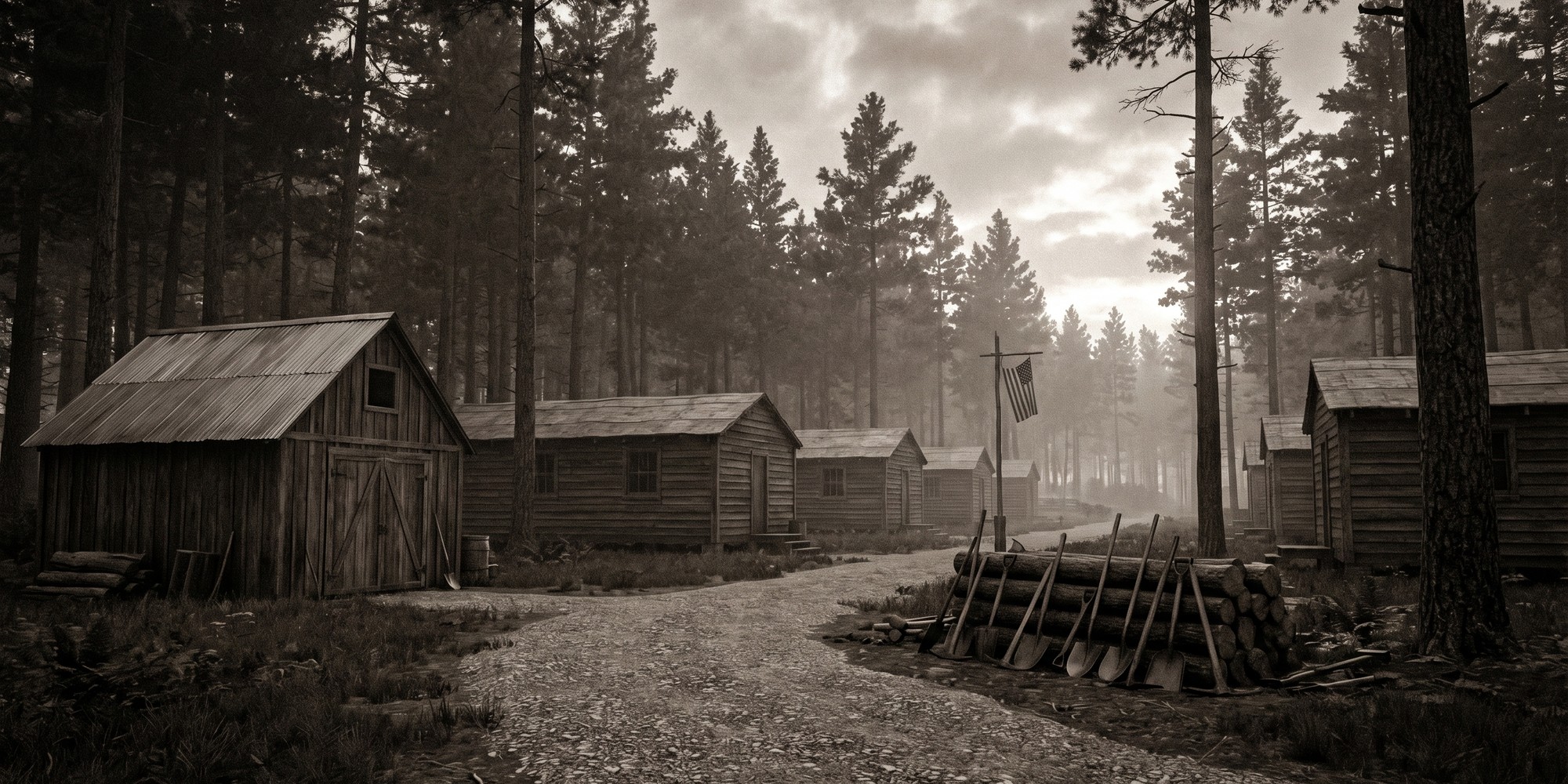
Life in a CCC camp followed routine more than romance. Men woke early, ate in mess halls, reported for assigned crews, and spent long days grading roads, clearing brush, building retaining walls, or planting seedlings. Barracks were basic. Work could be physically punishing. Weather was often unforgiving. Yet compared with breadlines and informal day labor, camp life offered structure, meals, clothing, medical attention, and predictable pay.
That predictability mattered as much as the wage itself. Families who had lived month to month with no certainty now knew a check would come. Communities hit hard by unemployment saw local stores, landlords, and farms regain a little circulation. Federal relief, in this sense, moved through kinship networks, not just through balance sheets. The CCC did not abolish poverty, but it interrupted its most desperate rhythms.
Camps were administered with military influence, and some enrollees welcomed the order while others endured it. Rules governed punctuality, hygiene, and conduct. Officers and supervisors expected compliance. For many participants, especially teenagers who had never left home, the camps functioned as a rough transition into adulthood. Some sites added classes in literacy, arithmetic, typing, or trades, and later records suggest substantial participation in educational programs where local instructors were available.
But camp life also displayed the boundaries of New Deal inclusion. The federal government authorized participation by Black enrollees, yet implementation often followed local segregation norms. Many camps were racially segregated, particularly in the South, and access to leadership positions and training opportunities was unequal. Native American enrollees participated through related conservation programs with different administrative structures, and Mexican American workers faced uneven treatment depending on region. Women were largely excluded from the CCC framework, with only limited and short-lived parallel experiments outside the main program. The CCC created opportunity, but it did not erase the hierarchies of 1930s America.
Building a New Landscape: Forests, Flood Control, and Park Infrastructure
If the camps were the social core of the CCC, the land was its public face. Crews built firebreaks in vulnerable forests, planted shelterbelts, restored watersheds, and fought soil erosion that had turned entire regions into dust and runoff. They developed campgrounds, picnic areas, trails, bridges, and ranger stations that still anchor visitor experiences in state and national parks. In many places, the first durable recreational infrastructure ordinary Americans encountered was built by CCC hands.
This was not only beautification. It was a response to ecological crisis. Decades of deforestation, overgrazing, and poor soil management had amplified flooding and land exhaustion. Conservation work offered a way to put unemployed labor to use while reducing long-term environmental risk. The logic was characteristically New Deal: treat unemployment and resource degradation as linked problems, and solve them through coordinated public works.
The scale was immense, though exact totals vary by source and method. Federal and park service records consistently describe millions of enrollees over the life of the program and thousands of projects across nearly every state and territory. Historians debate particular counts for trees planted, miles of trails built, and structures completed, but not the core conclusion. The CCC materially reshaped American public lands in ways still visible on the ground.
The program also deepened the federal government’s practical capacity. Agencies that had once operated with small professional staffs suddenly managed dispersed labor forces, supply chains, and technical projects at national scope. Knowledge gained in mapping, forestry, watershed management, and field logistics carried into later wartime and postwar administration. In that sense, the CCC was not just a relief effort. It was an institutional training ground for the modern state.
Limits, Wartime Shift, and the End of the Corps
By the late 1930s, the CCC had become popular enough to survive repeated political tests. Congress formalized it as an independent agency in 1937, giving statutory footing to what had begun as emergency improvisation. Yet the very conditions that created the corps were changing. Defense mobilization accelerated after 1940. Industrial jobs expanded. Military enlistment rose. A program designed for mass unemployment faced a labor market that no longer looked like 1933.
CCC work increasingly tilted toward defense-related and strategic projects, including tasks on military reservations and expanded forest protection tied to wartime planning. The shift made administrative sense, but it diluted the original social mission. As federal priorities moved toward war production, the political coalition sustaining the corps weakened. Congress cut funding, and appropriation acts in 1942 initiated liquidation. Wind-down activity continued into 1943 under follow-on appropriations tied to closing accounts and disposing facilities.
The end came quietly compared with the dramatic launch. There was no single closing ceremony to match the urgency of 1933. Camps were deactivated. Equipment moved or sold. Personnel transferred. For many former enrollees, the next uniform was military. For others, the next paycheck came from factory work feeding the Arsenal of Democracy. The CCC disappeared as an agency, but not as memory. Families remembered the remittance checks. Communities remembered roads and lodges. Public lands kept the marks.
By then, a generation that had entered adulthood during collapse had learned, for better and worse, to treat federal programs as part of ordinary life. The CCC did not solve every problem it touched, but it changed expectations about what democratic government could attempt in emergency and what it could leave behind when emergency passed.
Conclusion
The Civilian Conservation Corps stands at the center of Great Depression history because it fused relief, labor, and landscape into one practical experiment. It did not end unemployment, and it did not overcome the inequalities embedded in American law and custom. But it demonstrated that government could act quickly, hire at scale, and leave behind assets that outlived the crisis. In a decade defined by fear, the CCC made competence visible.
Its legacy survives in stone steps on mountain trails, in reforested hillsides, in park roads that still carry summer traffic, and in the archival records of families that lived on $25 remittances from sons far from home. It also survives in policy imagination. When Americans debate whether the state can mobilize labor for climate resilience, infrastructure renewal, or youth employment, they are often revisiting questions first answered, imperfectly but decisively, by Roosevelt’s tree army.