A Bridge Against the Odds: How the Roeblings Built America's Greatest Monument to the Gilded Age
By Library of History Editorial Staff
On a sweltering July afternoon in 1869, John Augustus Roebling stood at the edge of a Brooklyn ferry slip, notebook in hand, making surveying notes for what he believed would be the greatest bridge ever built. He was sixty-three years old, the most celebrated bridge engineer in America, and he had spent twelve years convincing skeptical politicians, nervous financiers, and contemptuous rivals that a suspension bridge could span the East River, an 1,100-foot stretch of churning tidal current that separated the island of Manhattan from the independent city of Brooklyn. The New York Bridge Company had finally been incorporated. The money had been raised. The survey was under way.
Then a docking ferryboat lurched against the timber piling where Roebling was standing, and the impact crushed the toes of his right foot. He refused conventional medical treatment. Instead, he insisted on hydrotherapy, a regimen of continuous water poured over the wound that he had championed throughout his career. Tetanus set in within days. By July 22, 1869, John Roebling was dead, fourteen days after his injury, before a single stone of the bridge had been laid.
What followed over the next fourteen years was a story almost too painful to be believed: a son crippled by mysterious underground disease, a hidden fraud in the steel supply, a fire that smoldered for weeks beneath the riverbed, and one extraordinary woman who held the whole impossible project together from her husband's sickroom window. The Brooklyn Bridge opened on May 24, 1883, not because fate was kind, but because three people refused to let it fail.
The Dreamer Who Died First
John Augustus Roebling was born on June 12, 1806, in Mühlhausen, a small city in the Thuringian heartland of Germany. He studied engineering and philosophy at the Royal Polytechnic Institute in Berlin, absorbing the idealist thought of Georg Wilhelm Friedrich Hegel alongside the practical calculus of structural loads, before emigrating to Pennsylvania in 1831 with a group of fellow Germans seeking land and opportunity in the New World. He farmed briefly and poorly, then turned to the thing he understood best: engineering.
Wire rope was his breakthrough. In the early 1840s, Roebling developed a method of spinning individual iron wires into strong, flexible cables, a manufacturing innovation that would make suspension bridge construction both practical and economical. He used it to build a series of increasingly ambitious spans: an aqueduct over the Delaware River at Delaware Aqueduct (now the oldest surviving wire suspension bridge in the United States), then a railroad bridge over Niagara Gorge in 1855, then the Cincinnati-Covington Bridge over the Ohio River, completed in 1866. Each bridge was larger and more daring than the last. The East River crossing was to be the culmination of a lifetime's work: a main span of 1,595.5 feet, nearly double anything that had come before.
He had been lobbying for the project since 1857, arguing publicly that the East River crossing was not merely possible but necessary. New York winters regularly iced over the ferry routes, stranding thousands of Brooklyn residents who depended on the boats for their livelihoods. Roebling even predicted that the bridge's elevated promenade would be, as he wrote in his prospectus, "of incalculable value" in a crowded commercial city, a public walkway above the traffic, offering citizens a view of the harbor that no building or hilltop could match. He was right about everything, and he never saw any of it.
His death transferred the entire weight of the project to his thirty-one-year-old son, Washington Augustus Roebling, an RPI-trained engineer who had served with distinction in the Union Army during the Civil War, including the crucial night at Gettysburg when he swam the Potomac River under fire to carry a message. Washington had worked alongside his father on the Cincinnati bridge and knew the wire-rope system intimately. He was, by any measure, qualified. He was also now carrying plans for a project his father had spent thirteen years developing, alone.
The Caissons Go Down
Construction began formally on January 3, 1870. The foundation work required something Americans had never seen before on this scale: pneumatic caissons, enormous pressurized wooden chambers, open at the bottom, that were sunk through the riverbed while workers excavated the mud and rock beneath them. The air pressure inside the caisson was kept higher than atmospheric pressure to keep the river water out, allowing the sandhogs, as the workers called themselves, to labor in a sealed, compressed-air environment dozens of feet below the surface of the East River.
The Brooklyn caisson measured 168 feet long by 102 feet wide, roughly the size of a city block, and descended through the riverbed beginning in the spring of 1870. Inside, it was a world unto itself: dim gaslight, candles burning with an eerie blue clarity in the dense compressed air, voices pitched strangely high. The sandhogs worked in shifts around the clock, shoveling and blasting rock, breathing air pumped down from the surface. The work paid well by the standards of the era, partly because it was so dangerous, and partly because no one yet understood quite how dangerous it truly was.
In December 1870, a candle ignited the timber ceiling of the Brooklyn caisson. The fire caught in the wood and smoldered, hidden and inaccessible, fed by the compressed air that kept the river at bay. Washington Roebling spent what witnesses described as a harrowing night inside the caisson attempting to locate and extinguish the blaze. When ordinary methods failed, he ordered the caisson partially flooded, accepting the risk of structural collapse in order to smother the flames. The gamble worked. The caisson survived. The fire had burned for weeks.
The deeper problem emerged gradually, and no one understood what it was. As the caissons sank deeper, the Manhattan caisson going down thirty-one feet below the riverbed surface, workers who ascended too quickly to normal atmospheric pressure began suffering agonizing symptoms: joint pain so severe it bent men double, paralysis, and in a handful of cases, death. Workers called it "the bends," for the contorted posture the pain forced on its victims. Physicians of the era called it caisson disease and debated its cause, was it the cold, the exertion, the foul air? In fact, it was nitrogen: gases dissolved in the bloodstream under pressure that formed bubbles in the tissues when pressure was released too rapidly. No one would understand the mechanism fully for decades.
At least three men died of caisson disease during the construction of the Brooklyn tower. Washington Roebling himself was stricken repeatedly. In the spring of 1872, after a particularly brutal inspection of the Manhattan caisson, he was carried to the surface unconscious. He survived, but only barely, and not intact. His eyesight was permanently damaged. He suffered partial paralysis and debilitating headaches that made sustained physical activity impossible. He could not return to the construction site. He could barely climb a flight of stairs. Washington Roebling, at thirty-five years old, would direct the construction of the most complex engineering project in the hemisphere from the window of his apartment at 110 Columbia Heights, Brooklyn, watching through a telescope as his bridge rose from the river below.
Emily Takes the Bridge
Emily Warren Roebling was born in 1843 in Cold Spring, New York, and educated at Georgetown Visitation Convent. Her brother, General Gouverneur K. Warren, had commanded the Union forces at Little Round Top, one of the pivotal moments of the Battle of Gettysburg, and it was at an army encampment during the Civil War that she first met Washington Roebling. They married in 1865. She was twenty-two. By all accounts, she was brilliant, socially gifted, and fiercely organized.
When her husband collapsed in 1872, Emily made a decision that was extraordinary by any standard of her era: she would learn enough engineering to serve as Washington's direct representative on the bridge. This was not a matter of relaying simple messages. The construction of the Brooklyn Bridge involved daily decisions about cable tension calculations, the properties of steel wire, the behavior of compressed-air caissons, and the structural dynamics of a span that had no precedent. Emily Roebling taught herself advanced mathematics. She studied the properties of metals, the calculus of cable loads, and the technical specifications of every component in the bridge. She worked directly with Washington, who remained mentally sharp throughout his physical ordeal, to understand what he needed her to communicate, and what she needed to understand herself before she could communicate it faithfully.
Her role expanded quickly beyond courier. She visited the construction site daily. She met with contractors, reviewed plans, negotiated with suppliers, and stood in for her husband before the bridge's board of trustees in ways that went far beyond the ceremonial. A report in the New York Times from May 1883 noted that when iron contractors came to bid on steelwork, "their surprise was great when Mrs. Roebling sat down with them, and by her knowledge of engineering helped them out with their patterns and cleared away difficulties that had for weeks been puzzling their brains."
The crisis came in 1882, when a faction of the bridge trustees moved to have Washington Roebling removed as chief engineer on grounds of incapacity. Emily met with the board directly. She argued that her husband's intellect remained undiminished, that his direction of the project had been continuous and effective, and that the disruption of replacing him at this stage, with the towers complete and the cable-spinning nearly finished, would be catastrophic. The board backed down. Washington remained chief engineer in name and, through Emily, in fact.
There was also the matter of the wire fraud. In 1878, investigators discovered that J. Lloyd Haigh, a contractor supplying steel wire for the cables, had been systematically substituting inferior wire for the approved product after testing. The wire would pass inspection, and then Haigh's men would switch it for cheaper, weaker stock before it was woven into the cables. The fraud was extensive. Rather than tear out and replace the compromised cable wraps, a catastrophic delay, Washington Roebling ordered six additional steel ropes added to each of the four main cables as a safety margin. The bridge's engineers calculated that even with the defective wire in place, the cables retained more than sufficient strength. It was a pragmatic solution to a problem born of Gilded Age corruption, and it worked: the cables have held for over 140 years.
The First Carriage Across
On the evening of May 23, 1883, the day before the official opening ceremony, Emily Warren Roebling climbed into a carriage and drove across the Brooklyn Bridge. By tradition, she carried a rooster in her lap: the symbol of victory. She was the first person to cross the finished bridge in a vehicle. Washington watched from his window through the telescope that had been his connection to the project for a decade.
The formal opening on May 24, 1883 was one of the great public spectacles of the Gilded Age. President Chester Arthur crossed on foot from the Manhattan side. Governor Grover Cleveland of New York came from Brooklyn. Fireworks erupted over the harbor. Crowds pressed against the newly opened pedestrian promenade, the elevated walkway that John Roebling had promised would be of incalculable value, and looked out over the harbor that was, that spring, becoming one of the busiest ports on earth.
Congressman Abram Hewitt delivered the formal address, and in a moment remarkable for 1883, he singled out Emily Roebling by name: "Thus it is that the name of Emily Warren Roebling will be inseparably associated with all that is admirable in human nature, and with all that is wonderful in the constructive world of art." Washington, for his part, had written of his wife: "I thought I would succumb, but I had a strong tower to lean upon, my wife, a woman of infinite tact and wisest counsel."
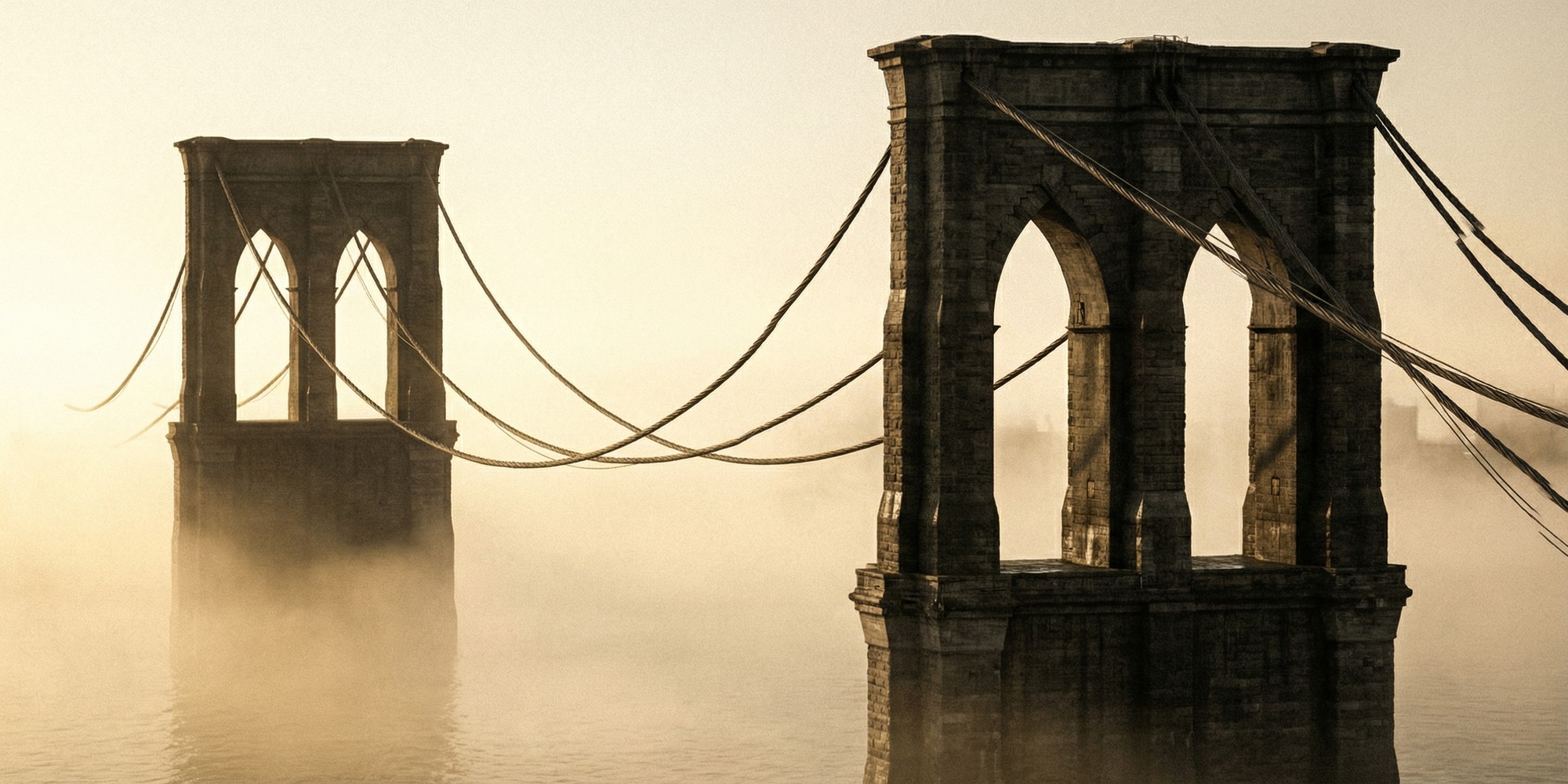
The numbers behind the bridge were staggering. Construction had taken fourteen years, from January 1870 to May 1883. At peak, six hundred workers were on site simultaneously. At least twenty men died during construction. The total cost reached approximately $15.1 million, more than double the original estimate. The main span of 1,595.5 feet was the longest suspension span in the world, a record it held until 1890. The twin Gothic towers (built of granite, limestone, and Rosendale cement) rose 276 feet above the water, visible for miles in every direction. The bridge was also the first in history to use steel wire cables rather than iron: a technological leap that would define suspension bridge construction for generations.
Within weeks of opening, 150,300 vehicles and pedestrians were crossing per day. The bridge bound Manhattan and Brooklyn together in ways the ferries never could, accelerating the commercial and residential development of Brooklyn until it became, by the 1890s, the third-largest city in the United States, before it was absorbed into the consolidated City of New York in 1898.
Emily Warren Roebling died on February 28, 1903, twenty years after the bridge she had fought to complete. Washington Roebling outlived the bridge's opening by forty-three years, dying on July 21, 1926, at the age of eighty-nine, long enough to see the structure he had never physically finished become the defining image of American industrial ambition. The bridge was designated a National Historic Landmark by the National Park Service in 1964, and a National Historic Civil Engineering Landmark in 1972.
The Brooklyn Bridge endures as the Gilded Age's clearest self-portrait: a monument to what American industry could accomplish when it chose to reach beyond what seemed possible, built by immigrant hands, designed by a German-American dreamer who died before it began, directed by a man who could not leave his bedroom, and finished by a woman who taught herself engineering in a sickroom because someone had to. It stands today because three people refused to let it fall.