The City the World Forgot: How Cahokia Became the Greatest Metropolis North of Mexico
By Library of History Editorial Staff
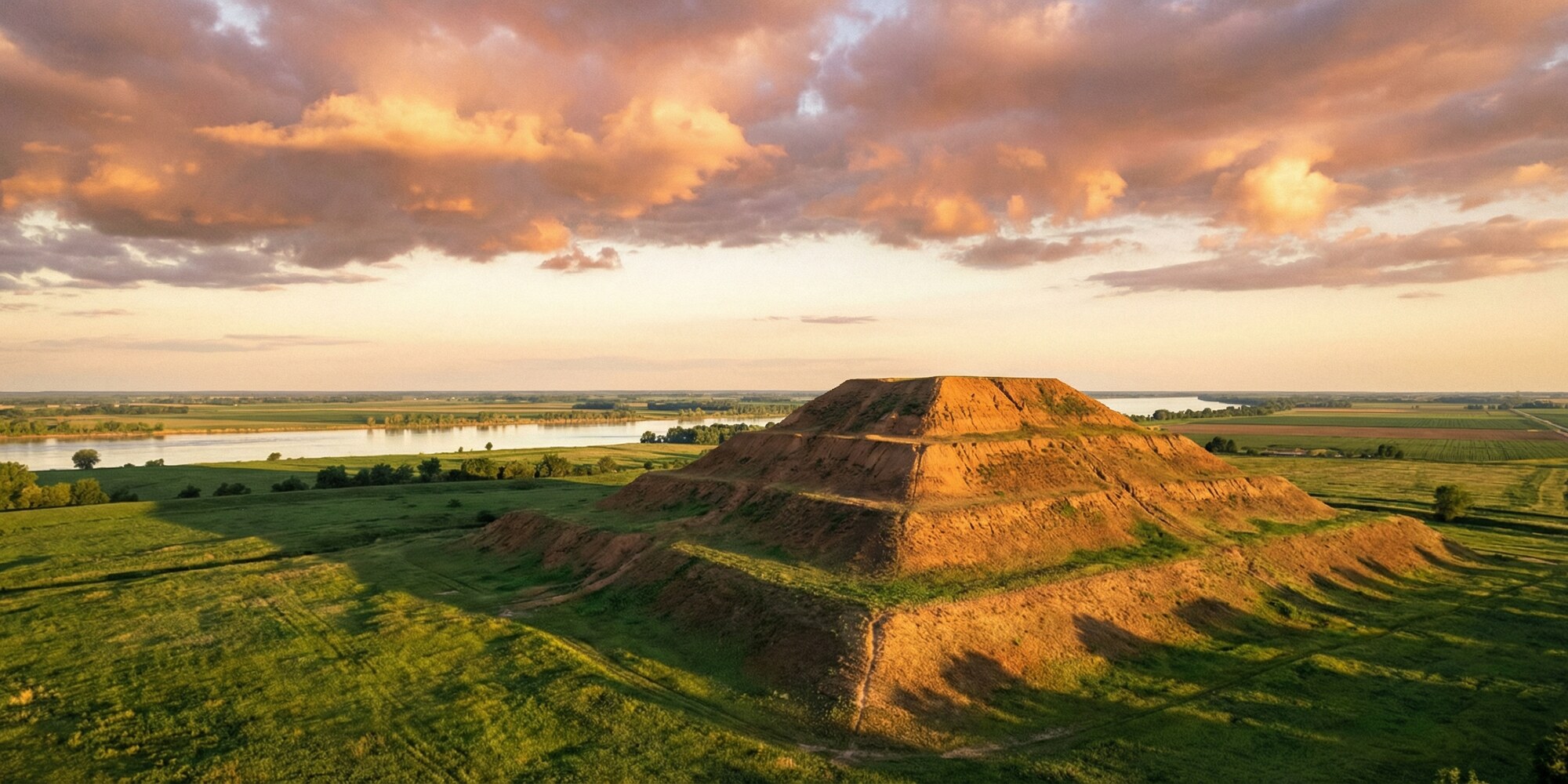
Imagine arriving by canoe from the south, rounding a great bend in the Mississippi River sometime around 1100 CE. You have traveled for days through the dense bottomland forests of what will one day become Missouri, and now, as the river widens and the horizon opens, you find yourself staring at a skyline that has no precedent in your world. Not tipis. Not a scattered village of cook-fires and reed lodges. A city. Thousands of thatched rooftops spread across a vast alluvial plain. Dozens of earthen platforms rise in stepped tiers, their flat summits crowned with great wooden buildings. And at the center of it all (so large it seems to have been grown from the earth itself, rising a hundred feet above the floodplain like a truncated mountain) is the largest man-made structure in North America north of Mexico.
This is Cahokia, at the height of its power. It is larger, at this moment, than contemporary London. Its population (by most scholarly estimates, somewhere between 10,000 and 20,000 people) makes it the most densely settled place on the continent north of the great Mesoamerican civilizations to the south. Copper from Lake Superior arrives here by canoe. Marine shells from the Gulf of Mexico are worked into ceremonial objects in its workshops. Cedar posts as tall as ships' masts stand in great circles on its plazas, aligning with the solstices and equinoxes to mark the turning of the seasons. An unknown paramount chief presides over this city from a summit building whose footprint dwarfs the great halls of European kings.
By 1350, Cahokia will be empty. Its story will be forgotten by the peoples who come after, obscured by time, buried under plows, and deliberately explained away by European colonists who needed the American continent to have been an empty wilderness before they arrived. For centuries, history treated Cahokia as a mystery, or a footnote, or a fraud. It was none of these things. It was one of the most extraordinary chapters in the entire human story on this continent, and it happened right here, in the floodplain east of the Mississippi, long before any European sail appeared on the Atlantic.
A Big Bang on the American Bottom
The geography that made Cahokia possible was extraordinary. The American Bottom, a wide alluvial flood plain on the eastern bank of the Mississippi River, roughly opposite what is now St. Louis, was among the richest agricultural zones on the continent. Soils deposited by centuries of flooding were deep and fertile. The Mississippi, Missouri, and Illinois Rivers converged nearby, creating a natural hub for water-based trade and communication. Waterfowl were abundant. Freshwater mussels crowded the river shallows. And most critically, the flat, sun-drenched fields of the Bottom were perfectly suited for the cultivation of maize, corn, whose arrival from the south as a staple crop in the centuries before 700 CE had begun transforming the population dynamics of the entire eastern half of North America.
People had lived at Cahokia since approximately 700 CE, drawn by this abundance. But for three centuries it was merely a large village, substantial by regional standards, but not dramatically different from the Late Woodland settlements scattered across the eastern woodlands. Then, around 1050 CE, something changed. Archaeologists call it the "Big Bang," and the term earns its drama: within what appears, in the archaeological record, to be a single generation, Cahokia transformed from a large village into a metropolis. The Grand Plaza (a vast, flat open space covering nearly forty acres at the city's center) was leveled and graded in an immense coordinated effort. The first great enlargement of Monks Mound began simultaneously. Neighborhoods expanded outward across the floodplain. The population surged.
What drove this transformation? The honest answer is that scholars do not know with certainty. Cahokia's people left no written records. But the evidence points toward the emergence of an extraordinarily powerful paramount chief, a leader whose political authority and, very likely, cosmological significance was sufficient to mobilize thousands of laborers in a coordinated construction effort of a scale not seen anywhere in North America north of Mexico. The Big Bang may have been the political and religious consolidation of a large surrounding region under Cahokian authority: a moment when the scattered communities of the American Bottom and its hinterlands were brought under a single organizing power, and when that power expressed itself by remaking the landscape.
Monks Mound and the Architecture of Power
To stand at the base of Monks Mound today (even in its partially eroded, twenty-first-century state) is to feel the weight of an ambition that is almost impossible to comprehend. The mound rises approximately one hundred feet from the surrounding plain. Its base covers more than fourteen acres. Within its earthen core, archaeologists estimate, lies more than twenty-five million cubic feet of soil and clay, all of it placed there by human hands, in baskets, over the course of roughly three centuries of construction beginning around 900 CE. There were no metal tools. No draft animals. No wheels. Every cubic foot of that earth was carried on someone's back, dug from borrow pits scattered across the floodplain, walked to the growing mound, and tamped into place by the feet of the people building it. It is the largest prehistoric earthen structure in the Western Hemisphere, and it was built in the middle of what European settlers would one day insist had been an empty, uncivilized wilderness.
On the mound's summit stood a large wooden building, the residence and ceremonial center of Cahokia's paramount chief. Based on the post-molds preserved in the soil, archaeologists believe this structure was approximately one hundred feet long, fifty feet wide, and perhaps fifty feet tall. Below, the Grand Plaza served as the public heart of the city: forty acres of carefully leveled, deliberately drained ground where ceremonies were held, markets operated, and the authority of the ruling elite was displayed and renewed before tens of thousands of people.
Surrounding the central precinct stood a palisaded wooden stockade wall, roughly two miles in circumference, built from an estimated fifteen thousand to twenty thousand logs. The stockade was rebuilt at least four times over the city's history, evidence of repeated reconstruction efforts, of external threats that made a defended interior necessary, and of an elite that considered its ceremonial center a space apart from the wider city around it.
Among the most remarkable features of Cahokia's central precinct were the Woodhenge post circles: a series of great rings of massive red cedar posts erected near Monks Mound. Modern archaeologists have identified at least five successive versions of these circles, each replacing the last as the city grew and the posts decayed. The largest known circle was approximately 410 feet in diameter, containing 48 posts. Key posts in each circle were aligned to mark the spring and autumn equinoxes and the winter and summer solstices, the sun rising directly over a specific post at dawn on each of these days. This was, in the most literal sense, a public demonstration of power over time itself. The paramount chief, through his command of the Woodhenge, could tell his people when to plant and when to harvest, when the world was turning in their favor and when it demanded ceremony and sacrifice. In a society whose survival depended entirely on the annual rhythm of maize cultivation, that was an extraordinary form of authority.
And the city's trade network reflected the reach of that authority across the continent. Excavations have recovered Great Lakes copper worked into ceremonial objects. Marine shells from the Gulf of Mexico fashioned into gorgets and beads. Chert from the Ozarks and Ohio Valley shaped into projectile points and tools. Cahokia was not merely a city; it was the apex of a continental exchange system, a place where the goods and ideas of a vast network of communities flowed inward and the influence of a new kind of political power flowed back outward.
Twenty Thousand Beads
Of all the revelations that decades of careful archaeology at Cahokia have produced, perhaps none is more haunting, or more illuminating of the city's true social character, than what excavators found in a low ridge-top mound in the site's southern portion, designated Mound 72.
Beneath layers of carefully deposited earth, archaeologists working in the 1960s and 1970s uncovered a burial unlike anything else in pre-Columbian North America north of Mexico. At its center lay the remains of a high-status male, a man of evident political and cosmological importance, laid out on a platform composed of approximately 20,000 marine shell beads, arranged in the shape of a great bird. The falcon, or hawk, was one of the most powerful symbols in Mississippian cosmology: the "Birdman," a warrior-priest figure who mediated between the world of the living and the world of the dead, between earth and sky, between political power and sacred authority. The shells had been brought from the Gulf of Mexico, hundreds of miles away. This man was being buried not merely as a chief but as something closer to a divine figure, a personification of the Birdman himself.
Around him lay the evidence of the cost that such power extracted from those who served it. Nearby were the remains of several other individuals, interpreted by archaeologists as retainers or sacrificial victims buried to accompany the paramount into whatever came after. Elsewhere in the mound were the interred remains of rows of young women, and "bundle burials" of men whose bones showed signs of having been processed and redeposited in a ceremonial context. Mound 72 contained, in total, the remains of at least 270 individuals, making it both a royal tomb and a testament to the scale of organized sacrifice that sustained the city's social order.
What this single mound reveals is that Cahokia was no simple chiefdom. It was a hierarchical society of the first order, one in which a small elite concentrated not only political and economic power but cosmological authority, and in which the lives of those at the bottom of the social pyramid were understood, by the society as a whole, to be appropriately subordinated to the needs of those at the top. The Mound 72 burial is the most vivid evidence archaeologists have found of how completely power was concentrated at Cahokia's apex, and of how completely that concentration of power was embedded in a shared symbolic and religious framework that made it, for most of its citizens and most of its history, seem not merely natural but sacred.
The Trees Are Gone
After approximately 1150 CE, something begins to shift in the archaeological record at Cahokia. Neighborhoods thin. The elaborate ceremonial calendar appears to be maintained with decreasing regularity. The palisade around the central precinct is rebuilt again and again, a pattern that suggests not routine maintenance but a mounting sense of external threat. By approximately 1200 CE, the city's population has begun to disperse. By 1275, the great mounds are largely empty. By 1350, Cahokia is abandoned.
The most compelling explanation for the collapse is the one that requires the least mystery: ecological unraveling. Cahokia's population placed enormous and ultimately unsustainable demands on the forests surrounding the city. Timber was needed for fuel, for the construction of buildings and palisades, for the great cedar posts of the Woodhenge. As demand outpaced the regenerative capacity of the forest, the trees upstream of the city disappeared. Without their root systems holding the soil, the watershed destabilized. Seasonal flooding became more erratic and more destructive. The rich agricultural fields of the American Bottom, the foundation on which the entire city rested, began to flood unseasonably, destroying crops. As yields declined, hunger spread. As hunger spread, faith in the ruling elite's ability to command the seasons and guarantee abundance eroded. As faith eroded, the social fabric that had bound tens of thousands of people to this place and this hierarchy began to come apart.
Scholars also point to other factors: climate deterioration associated with the end of the Medieval Warm Period, disease pressure from dense urban living, and the inherent instability of a centralized chiefdom dependent on a paramount chief's sustained authority. Together, in a society already stressed by ecological damage, they were probably fatal.
But the people of Cahokia did not vanish. They dispersed, moving south and east, joining and assimilating into other Mississippian communities across the continent. Their descendants, in various forms and lineages, are living today. The city was abandoned. The civilization was not.
Then the Europeans arrived. French explorers in the late seventeenth century encountered a group of tribes called the "Cahokia", part of the Illinois Confederacy, living near the ancient mounds, but these were not the builders of the city; the name was a geographic inheritance, not a direct cultural lineage. Encountering the great earthen mounds without any context for understanding them, European settlers generated an extraordinary array of explanatory myths: the mounds had been built by Vikings, by a lost tribe of Israel, by Aztec migrants, by a "Mound Builder" race that had preceded and been exterminated by the indigenous peoples currently living in the region. Almost any explanation was preferred over the obvious one, acknowledging the truth would have complicated the moral logic of the enterprise that was dispossessing the people still living on this land.
Archaeology, conducted with increasing rigor over the twentieth century, has demolished every one of these myths. The mounds were built by Indigenous North Americans. The city at their center was the greatest pre-Columbian urban settlement on the continent north of Mexico. It rose, flourished, and fell entirely on its own terms, centuries before any European ship touched the shores of North America. The Cahokia Mounds were designated a UNESCO World Heritage Site in 1982, one of only 24 in the United States, in recognition of their outstanding universal significance as a testament to what pre-Columbian North American civilization actually achieved.
Of the approximately 120 original mounds at Cahokia, roughly half have been destroyed by plowing, construction, and urban development. A highway interchange runs through a portion of the site. The mounds that remain (preserved within the Cahokia Mounds State Historic Site near Collinsville, Illinois) are maintained and studied, and only a tiny fraction of the site has been excavated. New findings continue to reshape and deepen the picture. The story of Cahokia is not closed. It is, in many respects, just beginning to be told.
This is what was here before the colony, before the republic, before the nation. A city. A civilization. A story that the American continent has been keeping, patiently, in the earth.