The Bureau That Built a Nation: How the Freedmen's Bureau Tried to Remake America After Slavery
By Library of History Editorial Staff
In the spring of 1865, the roads of the American South filled with people who had nowhere to go. Four million men, women, and children had just been freed from slavery, freed by gunfire and constitutional amendment, freed into a world that had never prepared a place for them. They had no land, no money, no legal standing, and no promise beyond the word of a government that had already spent four years making and breaking covenants. The roads led nowhere in particular. The fields went untended. The cities swelled with the displaced and the desperate. Freedom, it turned out, was just the beginning of the problem.
Into this chaos, on March 3, 1865, the same day President Abraham Lincoln signed the bill into law, stepped an institution unlike anything the American government had ever attempted: the Bureau of Refugees, Freedmen, and Abandoned Lands. Its mandate was staggering in ambition and skeletal in resources. In a country that had never operated a social welfare agency of any kind, Congress had just created one charged with feeding the hungry, healing the sick, adjudicating labor disputes, establishing courts, building schools, and redistributing confiscated Confederate land, all for a population of four million people spread across eleven rebellious states. The United States would not attempt anything like it again for seventy years. Whether it succeeded, failed, or was deliberately destroyed before it could do either is a question that still shapes American life today.
An Act Born in Chaos
The legislation that created the Freedmen's Bureau had been two years in the making, and its passage revealed just how profound a disagreement existed within the Union itself about what emancipation actually meant. Senator Charles Sumner of Massachusetts, the most uncompromising abolitionist in Congress, framed the debate in moral terms: "The curse of slavery is still upon them. Call it charity or duty, it is sacred as humanity." Senator James Grimes of Iowa, more skeptical of a large federal role, asked the question the whole country was quietly asking: "Are they free men, or are they not? If they are free men, why not let them stand as free men?" The very argument about what the Bureau should do reflected the nation's unresolved tension between the radical proposition of Black citizenship and the conservative instinct to return, as quickly as possible, to something resembling the old order.
Lincoln signed the bill on the last day of the congressional session, forty-two days before he would be assassinated at Ford's Theatre. The Bureau was placed under the War Department rather than Treasury, a sign that its work was understood as an extension of military occupation, not a permanent feature of American governance. That choice would haunt it. Its authority derived from the presence of Union troops in the South, and the moment those troops departed, the Bureau's power departed with them.
The act gave the Bureau authority over all matters related to refugees and freed people. In practice, this meant everything. Bureau agents were expected to negotiate labor contracts between freedmen and their former enslavers, ensure that those contracts were honored, establish schools, distribute rations to the destitute, and operate a rudimentary judicial system in areas where state courts refused to hear cases involving Black plaintiffs. It was an impossible assignment given to a handful of agents with minimal funding and a hostile white population determined to see it fail from its first day of operation.
The Christian General
The man Lincoln's successor chose to lead this impossible mission was Major General Oliver Otis Howard, a Maine-born West Pointer, a devout Christian, and a soldier whose career contained both genuine heroism and catastrophic failure. Howard had lost his right arm at the Battle of Seven Pines in June 1862 and later received the Congressional Medal of Honor. He was also the general whose Eleventh Corps was shattered by Stonewall Jackson's flanking attack at Chancellorsville in May 1863, a surprise so complete and so devastating that his troops were teased for years afterward. His men called him "Uh-oh Howard." His detractors called him worse. But President Andrew Johnson, seeking a man of unimpeachable personal piety to lead the Bureau, chose him in May 1865, and Howard accepted with the earnestness of a man who believed God had placed him there.
Howard threw himself into the work. He toured the South, met with freedmen and planters alike, and tried to build an institution from scratch in the rubble of a defeated civilization. In July 1865, he issued Circular No. 13, an order directing Bureau agents to set aside confiscated and abandoned Confederate lands for distribution to freed people in forty-acre parcels. It was the policy that would come to be remembered, in shorthand, as "forty acres and a mule," and for a brief moment it seemed possible. Hundreds of thousands of formerly enslaved people began to build lives on land they believed was theirs.
President Johnson reversed the order within weeks. The land was returned to pardoned Confederate landowners. Howard was ordered to inform the freedmen personally that the promise was withdrawn. By some accounts, he wept during those meetings. Whether he did or not, the political meaning was unmistakable: the federal government was not prepared to redistribute property, even property seized from traitors who had made war against the United States. The single intervention that might have made Black economic independence possible, land ownership, was taken off the table before Reconstruction had properly begun. What remained was everything else: the rations, the schools, the courts, the contracts, the endless, grinding work of trying to build something durable out of a promise the government had already half-broken.
Rations, Schools, and Sabotage
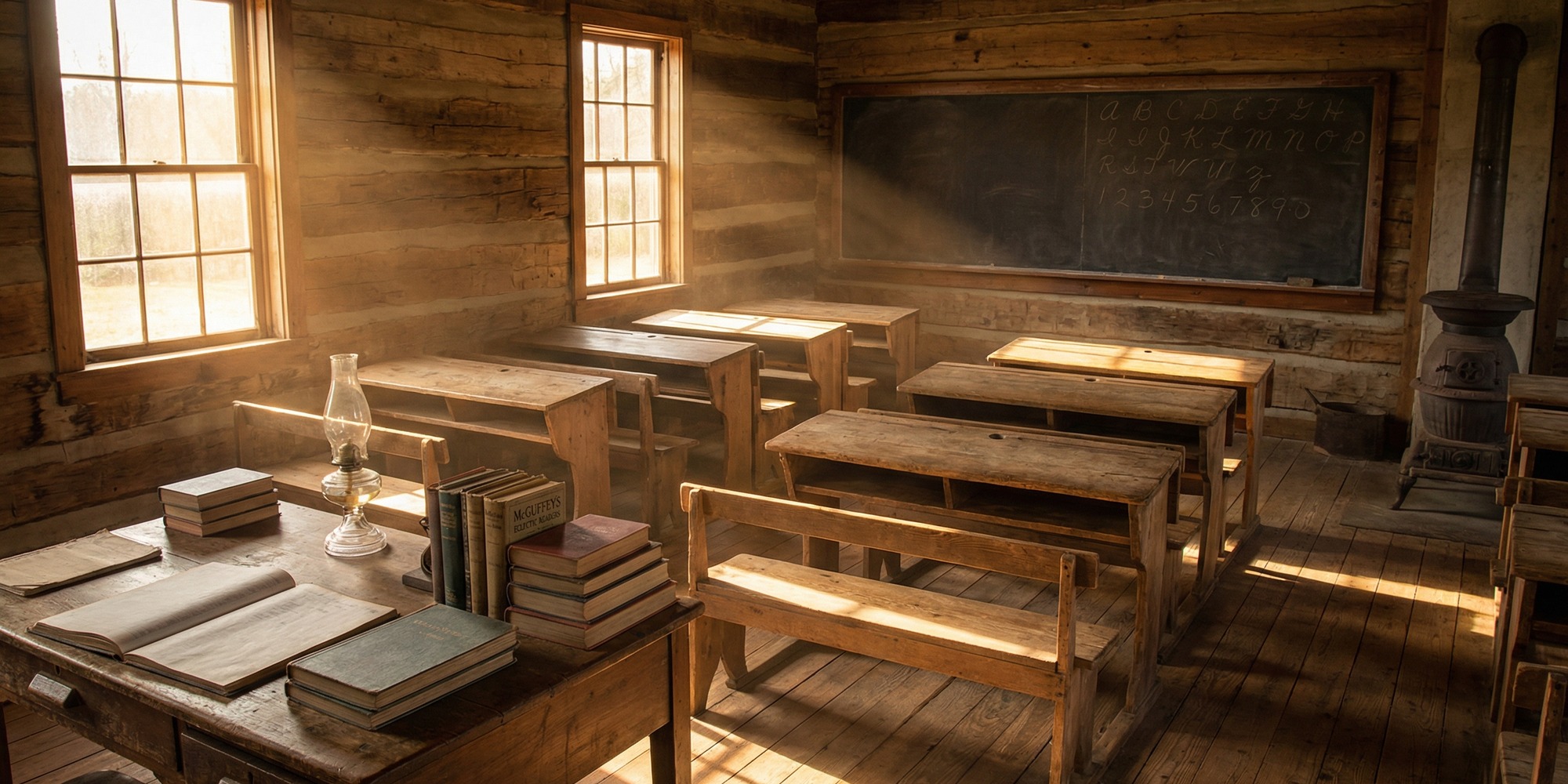
What the Bureau accomplished in the years between 1865 and its closure in 1872 was, by any honest accounting, extraordinary. More than 21 million rations were distributed to the hungry, Black and white alike, though the political enemies of Reconstruction preferred to forget the white recipients. More than one million freedmen received some form of medical assistance from Bureau physicians and hospitals. More than one thousand Black schools were established across the South, many of them in whatever buildings could be found (churches, barns, former slave quarters) and staffed by Northern teachers, many of them white women from abolitionist families who came south at considerable personal risk. Over $400,000 was invested in teacher training. The students who filed into those schoolrooms were often adults who had been legally forbidden to learn to read. They came anyway, sometimes walking miles before dawn.
The Historically Black Colleges and Universities that the Bureau helped establish are its most enduring monument. Howard University, chartered by an act of Congress in 1867 and named for the Bureau's commissioner (Howard himself served as its president beginning in 1869), became one of the nation's foremost research universities. Fisk University opened in Nashville in 1866 as the Fisk School, founded to educate freedmen; its Jubilee Singers would later tour the world, raising funds to keep the institution alive. Atlanta University opened in 1865. Morehouse College followed. These institutions, funded by a combination of Bureau resources, Northern philanthropy, and the fierce determination of their students and faculty, would produce the doctors, lawyers, teachers, and leaders who sustained Black America through a century of Jim Crow. They remain pillars of American intellectual life today.
But the Bureau operated inside a war zone. Southern states responded to emancipation by passing the Black Codes, a web of laws that required freed people to sign annual labor contracts with white employers, prohibited them from owning land in most areas, criminalized vagrancy (which was defined broadly enough to encompass any Black person not under contract), and restored, in everything but name, the conditions of bondage. Bureau agents sometimes intervened against the Black Codes; others, particularly those sympathetic to Southern planters, enforced them. The quality of Bureau operations varied enormously depending on the agent: some were idealists who risked their lives; others were opportunists or cowards. The institution was too thinly spread (never enough agents to cover the territory, never enough soldiers to enforce its rulings) to function as anything approaching a consistent system of justice.
And then there was the terror. The Ku Klux Klan, founded in Pulaski, Tennessee, in 1865, and similar organizations like the Knights of the White Camelia and the White Leagues, waged a systematic campaign of assassination, arson, and intimidation against anyone associated with Reconstruction, Black voters, Bureau agents, Northern teachers, sympathetic white Southerners, Republican officeholders. Schools were burned. Freedmen who had voted were murdered. Bureau agents found dead in their offices. The violence was not random; it was strategic, designed to prevent the political and economic empowerment of Black citizens by demonstrating that the cost of participation was death.
Congress struck back. Andrew Johnson's veto of the Bureau renewal bill in February 1866 was initially sustained, but Congress passed a new and strengthened Bureau Act in July 1866, overriding his veto. It also passed the Civil Rights Act of 1866, the 14th Amendment, and eventually the Enforcement Acts of 1870 and 1871, which gave the federal government explicit power to prosecute Klan violence. For a brief period, federal prosecution under these laws drove the Klan into retreat. But the political will to sustain that enforcement was already eroding.
The Promise Foreclosed
By 1870, the political coalition that had made Reconstruction possible was coming apart. The Radical Republicans who had driven the agenda were dying or retiring. The economic depression that followed the Panic of 1873 turned Northern voters' attention inward. The war had been over for a decade; people were tired of paying the costs of occupation and tired of the stories of Southern outrages that seemed, to a numbed public, less and less like a crisis requiring federal intervention. White Southern Democrats were recapturing state governments one by one, using fraud and violence to suppress Black voting and dismantle Republican administrations. Congress terminated the Freedmen's Bureau in July 1872, yielding not to any argument that its work was done but to the exhaustion of white Northern political will.
What replaced land redistribution and Bureau oversight was the sharecropping system, an arrangement under which freed people worked land owned by white planters in exchange for a share of the crop, with the planter controlling the accounts. It was an arrangement designed to be permanent. Sharecroppers who finished the year in debt, and the books were rarely kept in their favor, owed their debt to the planter and could not legally leave. Debt peonage replaced chattel slavery with a different set of chains. The Bureau had tried to prevent precisely this outcome. Without the Bureau, there was nothing left to try.
The final blow came with the Compromise of 1877, which resolved the disputed presidential election between Rutherford B. Hayes and Samuel Tilden by withdrawing the last federal troops from the South. With the troops went the last vestige of federal protection for Black civil rights. Within a decade, the gains of Reconstruction, the 14th and 15th Amendments on the books but unenforced, Black voters driven from the polls by violence and poll taxes, segregation becoming law, would be legislated into irrelevance by the Supreme Court's decision in Plessy v. Ferguson (1896) and the rise of Jim Crow across the former Confederacy.
The Freedmen's Bureau's story reveals something that American political culture prefers to obscure: Reconstruction's failure was not inevitable. It was chosen. The federal government had the legal authority, and at moments the military capacity, to enforce the constitutional amendments it had passed. It chose, under the pressure of white Southern resistance and Northern political fatigue, not to. The four million people whose freedom it had promised were abandoned to a century of organized terror and legal subjugation. The HBCUs survived. The constitutional amendments survived, dormant. The rest (the land, the economic independence, the courts that would hear Black testimony, the schools that would not be burned) was taken away piece by piece, and the taking was called "the end of Reconstruction," as if it were a natural conclusion rather than a deliberate act of political betrayal.
It would take another century, the Civil Rights Act of 1964, the Voting Rights Act of 1965, the long and blood-soaked arc of the movement that stretched from Montgomery to Selma to Washington, for the nation to attempt again what the Freedmen's Bureau had tried in 1865. By then, Howard University had graduated generations of leaders. Fisk had sent its singers around the world. The institutions that had survived the wreckage of Reconstruction had kept something alive that nothing, not terror or poverty or deliberate governmental indifference, had been able to extinguish: the insistence that the promise of American democracy applied to everyone, and that the work of making it true was never finished.