The Crucible of Revolution: How Valley Forge Forged a Nation's Army
By Library of History Editorial Staff
On the fourteenth of December, 1777, Dr. Albigence Waldo scratched a despairing entry into his diary. A surgeon with the Continental Army, Waldo had marched through mud and frost alongside thousands of men who were hungry, thinly clothed, and bone-weary from months of campaigning. "Poor food — hard lodging — Cold Weather — fatigue — Nasty Cloaths — nasty Cookery — Vomit half my time," he wrote. And then, the raw cry that would echo across more than two centuries: "Why are we sent here to starve and Freeze?"
The place was Valley Forge, Pennsylvania — a plateau of wooded hills roughly twenty miles northwest of Philadelphia, where George Washington had chosen to winter his army after the dismal autumn of 1777. The British had taken Philadelphia, the de facto capital of the rebellion. The Continental Congress had scattered. The campaign season had brought defeats at Brandywine and Germantown. To many observers — in London, in Paris, and even among some of Washington's own officers — the Revolution appeared to be dying by inches.
But Valley Forge was not the end. It was something stranger and more consequential: a crucible. The raw materials that marched into that frozen encampment — hungry, fractious, poorly trained, beset by disease and political treachery — emerged six months later as something new. What left Valley Forge in June 1778 was the closest thing to a professional army that America had ever fielded. The transformation was incomplete, contested, and costly. But it was real. And without it, the United States would not exist.
A March to the Edge of Endurance
Washington chose Valley Forge for reasons that were strategically sound if humanly brutal. The site sat on naturally defensible high ground, close enough to Philadelphia to monitor British movements, yet far enough to avoid surprise attack. The Schuylkill River protected the northern flank. The terrain would slow any enemy advance. Soldiers could build their own shelters and forage the surrounding countryside. On paper, it was sensible. In practice, it came close to destroying the army it was meant to preserve.
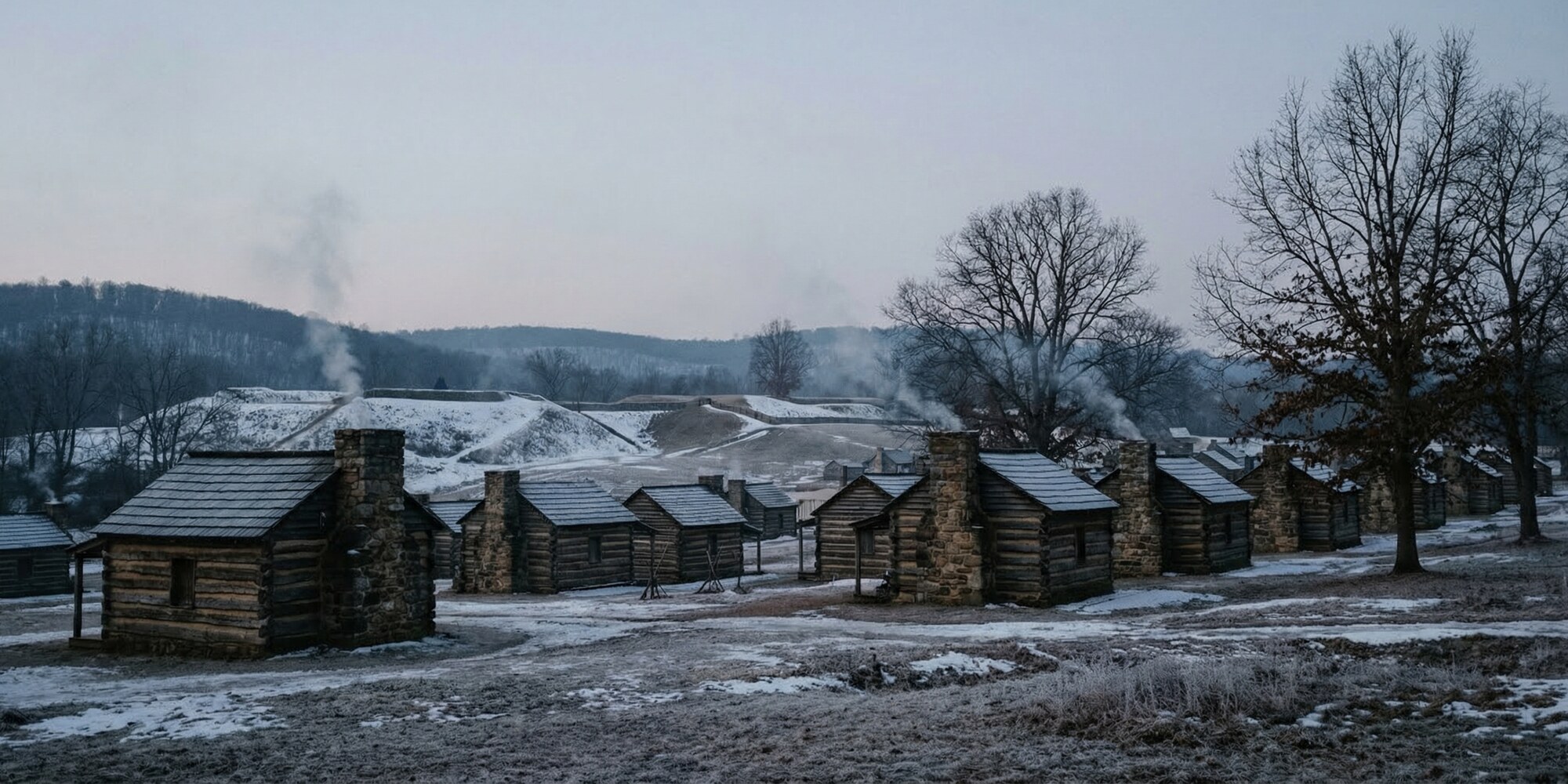
On December 19, 1777, approximately twelve thousand soldiers — plus roughly four hundred women and children who served as laundresses, nurses, and camp followers — trudged into the encampment. Washington ordered the immediate construction of log huts: each cabin fourteen by sixteen feet, housing twelve men, built to a standardized plan that would impose some order on the sprawling misery. The soldiers worked with axes and frostbitten hands, and within weeks the camp had grown into something resembling the fourth-largest city in colonial America — a city of raw timber and frozen mud, smelling of smoke and sickness.
The suffering that followed was real, though it has often been overstated in popular memory. The winter of 1777–78 was not the coldest of the Revolutionary War; that grim distinction belongs to the winter at Morristown two years later. What undid the Valley Forge encampment was not exceptional cold so much as catastrophic supply failure. The Continental Army's quartermaster and commissary systems had largely collapsed. Wagons bogged down on rutted roads. Contractors demanded hard currency the government did not have. Food and clothing sat in distant depots while men at Valley Forge went hungry and bare-footed.
By late January, Washington was writing urgent letters to Congress with barely concealed desperation. A field return from December 23, 1777, showed 2,898 men unfit for duty by reason of lacking clothing — barefoot and otherwise naked, in Washington's blunt phrase. In his letter to the New Hampshire legislature on December 29, he described men going without meat for days at a stretch. Dr. Waldo's diary records a recurring chorus from the camp: "No Meat! No Meat!" — the sound carrying, he wrote, across the valley like a lament. By the end of the encampment, approximately two thousand soldiers had died, the vast majority from disease — typhoid, dysentery, pneumonia, and influenza — rather than exposure. The dead were buried in mass graves in the frozen Pennsylvania ground.
Yet the army did not dissolve. Washington held it together through a combination of iron will, personal presence, and something harder to name — the particular authority that belongs to a commander who shares his men's privations rather than retreating to comfort. He remained in camp throughout the winter, visible and engaged. His soldiers were not all hopeless; many retained a stubborn confidence in their cause and their general. And slowly, painfully, the supply situation began to improve as Nathanael Greene took over as quartermaster general in March 1778 and began driving the logistical reforms that Washington had been demanding for months.
The Knife at Washington's Back
The physical suffering at Valley Forge was only one of the crises Washington faced that winter. Even as his men endured hunger and cold, a political conspiracy was forming in the shadows — a threat to his command that, had it succeeded, might have altered the entire course of the war.
In the autumn of 1777, Washington's military reputation had taken serious damage. His army had failed to defend Philadelphia. Meanwhile, General Horatio Gates had won a spectacular victory at Saratoga in October, capturing an entire British army under General John Burgoyne. Gates was suddenly the hero of the hour — celebrated in Congress, toasted in taverns, spoken of by some as the man who should be commanding the Continental Army rather than the Virginia planter who kept losing battles.
Into this atmosphere stepped General Thomas Conway, an Irish-born officer of the French army who had joined the American cause with a somewhat inflated sense of his own talents. Conway had written a private letter to Gates in which he disparaged Washington, and in November 1777 Washington learned of its contents through General Lord Stirling, who had heard about it secondhand. Washington's response was characteristically precise: he wrote Conway a brief, cold note making clear that he knew about the letter. The message was unmistakable. The commander-in-chief was watching.
What followed has been known to history as the Conway Cabal — a loose network of officers, delegates, and political figures who favored replacing Washington with Gates. The network was real, though historians debate how organized or dangerous it truly was. No formal motion to remove Washington was ever brought before Congress. His moral authority was too strong, his officers too loyal, and his enemies too disunited to mount a coherent challenge. Conway himself resigned from the army in early 1778; Gates eventually wrote Washington an awkward letter of explanation. By spring the threat had evaporated.
But the significance of Washington's survival of this challenge should not be underestimated. The Revolution was, at its core, not just a military enterprise but a political one — dependent on the confidence of Congress, the states, and the public. A change of command at Valley Forge, in the middle of the worst winter of the war, might well have been fatal to the cause. Washington's ability to outmaneuver his critics — not through bluster but through demonstrated loyalty and quiet political acumen — was as important as any battlefield decision he ever made.
The Drillmaster from Prussia
On February 23, 1778, a portly, magnificently self-assured Prussian officer rode into Valley Forge accompanied by a small entourage and an improbable amount of luggage. His name was Friedrich Wilhelm August Heinrich Ferdinand von Steuben. He held the honorary rank of lieutenant general in the Prussian army, had served on the staff of Frederick the Great, and had been recruited in Paris by Benjamin Franklin, who sent him to Washington with glowing letters of recommendation. He spoke no English. He would change everything.
The problem Von Steuben was asked to solve was fundamental: the Continental Army had no standardized drill, no uniform set of tactical maneuvers, no common system of command. Each regiment had evolved its own practices, some based on British manuals, some on French, some on nothing more than the improvised experience of officers who had learned soldiering in local militias. Coordinating these units in the complex maneuvers required by eighteenth-century battlefield tactics — the precise deployment of firing lines, the orderly advance and retreat, the maintenance of formation under fire — was nearly impossible. Washington's army could fight bravely. It could not maneuver professionally.
Von Steuben's solution was elegant and practical. He selected a model company of one hundred men and began drilling them personally — not from a distance, issuing orders through subordinates, but hands-on, on the parade ground, demonstrating each movement himself. He reportedly swore enthusiastically in French and German when his men made mistakes, then laughed and asked his translator to curse them in English on his behalf. The soldiers found him alternately hilarious and terrifying. They also learned.
Von Steuben understood that American soldiers were not Prussian conscripts. He could not simply replicate the brutal, mechanical discipline of Frederick's army. He had to explain the reason for each movement, appeal to his men's intelligence and pride rather than their fear of punishment. His drills simplified Prussian methods, adapted them to the realities of citizen-soldiers, and produced results within weeks. The model company became a demonstration unit; other regiments watched, then requested their own training. By spring, the entire camp was drilling in something approaching a unified system.
The results of this work were codified in Von Steuben's "Regulations for the Order and Discipline of the Troops of the United States" — commonly called the Blue Book — which became the standard American military manual and remained in use through the War of 1812. It was, in effect, the founding document of the professional American military tradition: a systematic, practicable guide to turning volunteers into soldiers.
What Valley Forge Made
On June 19, 1778, the Continental Army marched out of Valley Forge. The men who left were visibly different from those who had arrived six months earlier. They moved in disciplined columns. They executed maneuvers on command. They looked, for the first time, like soldiers rather than an armed mob.
The difference was tested almost immediately. Three weeks after leaving Valley Forge, the army confronted the British at the Battle of Monmouth in New Jersey — a chaotic, brutally hot engagement that would have devolved into a rout under the old army's command structure. Instead, Washington was able to rally his retreating forces, reform his lines, and hold the field against the best professional soldiers in the British Empire. Monmouth was not a decisive victory, but it was a demonstration: this army could stand and fight in the open, on equal terms, with something approaching European military discipline.
The Franco-American alliance, formally secured in May 1778, provided the other crucial ingredient. French money, supplies, and eventually a battle fleet transformed the strategic balance of the war. But the alliance would have meant little without an army capable of coordinating with French forces in complex joint operations. The army that Von Steuben trained at Valley Forge was the army that, three years later, would cooperate seamlessly with French troops to trap Cornwallis at Yorktown and force the surrender that effectively ended the war.
Valley Forge was simultaneously a failure and a triumph — a failure of the civilian supply system that Washington had been warning Congress about for years, and a triumph of military will, organizational genius, and political resilience. It was also a preview of something important about the American republic that would be built in the years that followed. The Continental Army at Valley Forge was a genuinely diverse institution: free and enslaved Black soldiers served alongside white colonists; European immigrants fought beside Indigenous allies; women performed essential labor that kept the camp functioning. It was, in its demographic complexity, a more accurate representation of colonial America than the political assemblies that directed it.
The lessons of Valley Forge echoed directly into the Constitutional Convention of 1787. The supply failures, the congressional dysfunction, the inability to fund or fully equip an army — all of these were cited by delegates who argued for a stronger central government with the power to tax, to raise armies, and to act with something approaching executive efficiency. The Constitution's provisions for a federal military, for congressional authority over the armed forces, for the president's role as commander-in-chief — these were drafted by men who had watched Valley Forge and understood what it had nearly cost them.
Washington himself drew a simple conclusion from the ordeal. Writing to a friend after the war, he described Valley Forge not as a tragedy but as a proof — proof that the army, and through it the cause, could survive its own worst failures. The crucible metaphor is apt: raw ore enters, impurities burn away, and what emerges is something stronger than what went in. The Continental Army that survived the winter of 1777–78 was not the army that had existed before. It was the army that won American independence — and in doing so, it became the distant ancestor of every military force this nation would ever field.