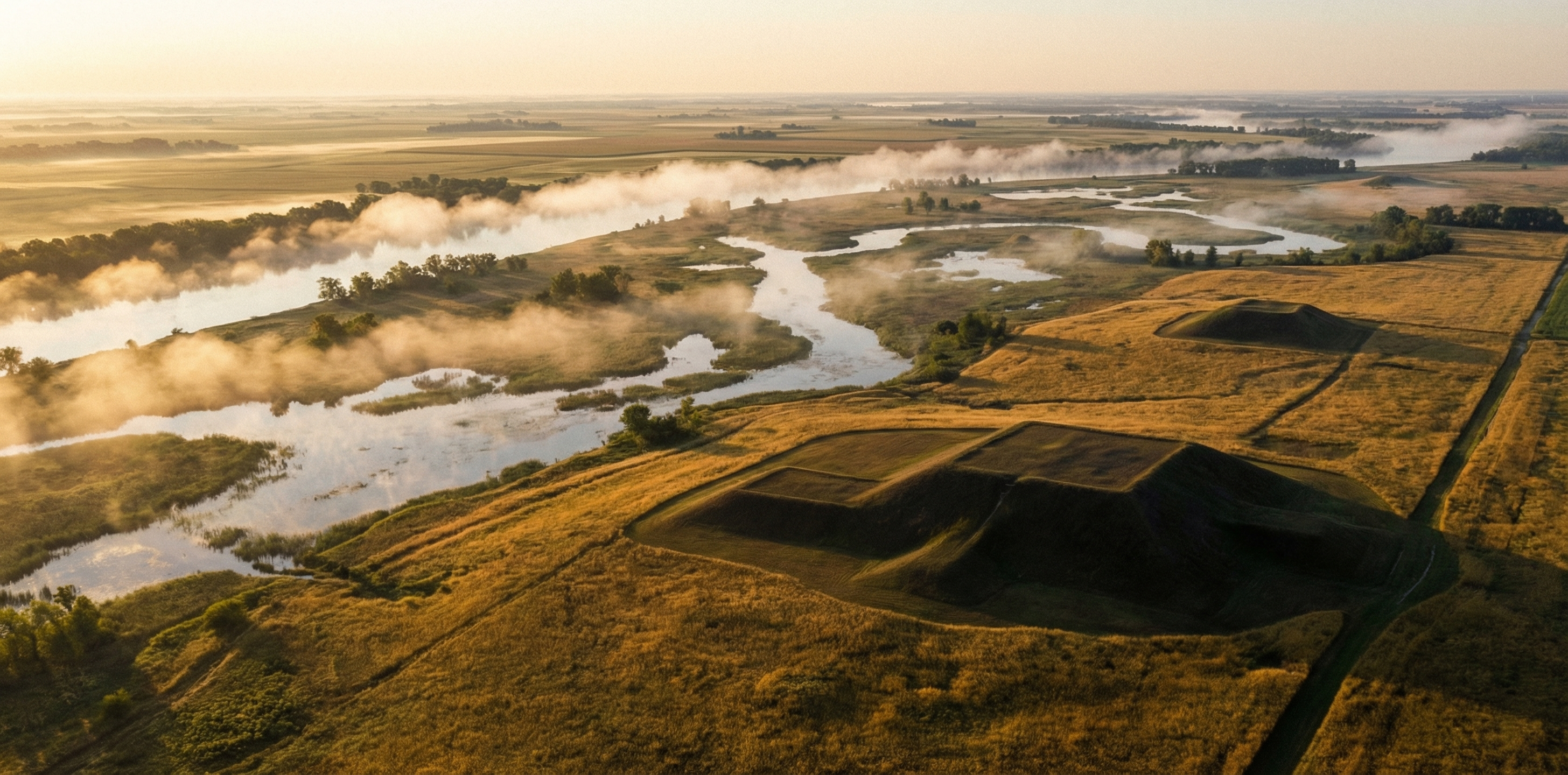
Cahokia: The Rise and Fall of North America's First Great City
By Library of History Editorial Staff
Long before a single colonist set foot on American soil, before the Mayflower or Jamestown or the broad sweep of European ambition had touched the interior of a continent, there was Cahokia. It rose from the floodplain of the Mississippi River around 1050 AD, in the rich bottomlands of present-day southwestern Illinois, and at its height it housed more people than contemporary London — a metropolis of perhaps 10,000 to 20,000 souls clustered around a stepped earthen pyramid so vast that its base covered more ground than any structure the ancient Egyptians ever built.
The Cahokians left no written records. Their language is lost, their rulers unnamed in any surviving text, their stories carried away with them when they vanished from the archaeological record sometime before 1400 AD. What they did leave behind was the earth itself — more than 120 earthen mounds arrayed across six square miles of Illinois prairie, a monument to human ambition so improbable and so immense that nineteenth-century Americans refused to believe indigenous people had built it. They invented phantom civilizations — lost Israelites, mythical Atlanteans, wandering Norse adventurers — rather than credit the ancestors of the very people they were displacing. The truth, which archaeology has spent the last century painstakingly reconstructing, is both more straightforward and more astonishing: this was the work of a skilled, organized, and highly stratified civilization that anticipated urban life in North America by centuries.
A City Risen From the Earth
What strikes any visitor to Cahokia Mounds State Historic Site today, even now, is the sheer scale of what human beings accomplished without metal tools, draft animals, or wheeled vehicles. Monks Mound — named for a community of Trappist monks who farmed its terraces in the early nineteenth century, long after the civilization that built it had vanished — rises roughly 100 feet from the flat Illinois plain. Its four terraced platforms cover 14 acres at the base. To build it, Cahokian laborers carried an estimated 22 million cubic feet of earth in woven baskets, load by load, over the course of more than two centuries. The pyramid grew because human beings willed it upward, season after season, generation after generation.
At the base of Monks Mound lay the Grand Plaza — a deliberately leveled open space of roughly 50 acres, cleared and flattened to permit large-scale public gatherings, ceremonies, and the playing of chunkey, a competitive game in which participants rolled stone discs and hurled long lances to mark where the discs would stop. The chunkey stone has become one of the most distinctive artifacts of Mississippian culture, appearing across a geographic range that stretches from Wisconsin to the Gulf Coast — a material signature of a shared cultural world that Cahokia sat at the center of, and may well have largely created.
The city itself was organized with a clear sense of purpose and hierarchy. Monks Mound and its surrounding ceremonial district occupied the urban core. Residential neighborhoods fanned outward in orderly arrangements of thatched-roof structures. Around 1175 AD, workers erected a substantial palisade wall of hewn logs encircling the central district — a defensive measure whose repeated reconstruction over succeeding decades tells archaeologists that something significant had shifted in the city's political temperature. Beyond the palisade lay the broader residential sprawl, and beyond that the agricultural fields whose intensive maize cultivation fed an urban population that would have been impossible to sustain on hunting and gathering alone.
Among the most remarkable features of Cahokia's design were five large circles of red cedar posts arranged to the west of Monks Mound. Archaeologists dubbed these structures "Woodhenge," and the name fits: certain posts aligned precisely with the rising sun at the spring and fall equinoxes and the summer and winter solstices, suggesting a solar calendar of considerable sophistication. The Cahokians were not merely building a city. They were reading the heavens, calibrating their urban landscape to the rhythms of the cosmos, aligning their earthly power with the movements of the sun itself.
A World of Trade, Power, and Ceremony
No city arises in isolation, and Cahokia was the hub of a trading network that continues to astonish researchers. Archaeological excavations have recovered artifacts originating from the Great Lakes, the Rocky Mountains, the Gulf of Mexico, and the Appalachian highlands — copper from the Lake Superior region, marine shells from the Gulf Coast, mica from the Carolina mountains, distinctive flint from quarries in Ohio and Arkansas. These were not random accidental imports. They were the material consequences of deliberate, sustained exchange relationships that Cahokia cultivated and in many cases dominated at the peak of its power, roughly 1050 to 1200 AD.
At the heart of that power was a ruling elite whose authority was simultaneously political and religious. Excavations of Mound 72, a small ridge-shaped mound located south of Monks Mound, revealed one of the most arresting burials ever uncovered in North America. Lying on a platform constructed from more than 20,000 marine shell beads arranged in the shape of a large bird — almost certainly a falcon or thunderbird, a central figure in Mississippian cosmology — was the skeleton of a man estimated to be in his mid-thirties. Surrounding him were the remains of more than 270 other individuals, many of them young women, who appear to have been sacrificed to accompany him into death. This was not the burial of an ordinary man. This was the interment of what many archaeologists believe was an early paramount chief, a figure who fused religious authority with political power in ways that defined the Mississippian world.
The Mississippian culture that Cahokia both exemplified and likely amplified was defined by several interlocking traits: intensive maize agriculture, hierarchical chiefdom governance, elaborate ceremonial life centered on the sun and cosmic forces, and a characteristic artistic tradition featuring falcon warriors, severed hands, weeping eyes, and other potent symbolic images that appear on pottery, engraved shells, and beaten copper plates across the Southeast. Scholars call this complex the Southeastern Ceremonial Complex — a network of shared religious ideas and artistic styles that bound disparate communities together across enormous distances. Cahokia was not merely a participant in this network. At its height, it was its beating heart.
Around 1100 AD, the city was likely the seat of a paramount chiefdom that exercised political influence or at least profound cultural dominance over communities for hundreds of miles in every direction. New towns and villages emerged across the Midwest bearing the unmistakable hallmarks of the Cahokian model — planned plazas, platform mounds, chunkey courts. Whatever Cahokia was preaching, communities across the heartland of North America were listening, and the message was spreading far beyond any boundary that could be drawn on a map.
The Long Unraveling
The mystery of Cahokia is not its rise. It is its disappearance.
By 1200 AD, roughly a century and a half after the city reached its peak, the signs of strain were everywhere. The population had begun to fall. The construction of new mounds slowed and eventually ceased. The great log palisade around the ceremonial core was rebuilt multiple times in the years that followed, each iteration suggesting a social environment of deepening tension. By 1350 AD, the city that had once rivaled any urban center in the medieval world was essentially empty — its plazas overgrown, its buildings decayed, its remaining residents departed for communities scattered across the wider Mississippian world.
Archaeologists and historians have proposed a range of explanations, and the honest answer is that no single cause has achieved consensus. Climate is a compelling candidate. The Medieval Warm Period that had blessed the Mississippi valley with reliable rainfall and agricultural abundance for generations began to deteriorate around 1200 AD, giving way to a cooler, drier, and far more variable climate that would have severely stressed the intensive maize agriculture on which Cahokia's dense population depended. Flooding posed a persistent threat in the low-lying floodplain; researchers have identified evidence of catastrophic flood deposits in the archaeological record at and around the site.
Environmental degradation almost certainly compounded the crisis. Feeding a city of 10,000 to 20,000 people required an agricultural infrastructure of enormous scale, and maintaining that infrastructure required wood — for building, for fuel, for the palisade walls that circled the city's core, for the great cedar posts of Woodhenge. Pollen core studies from lakes near the site document a dramatic decline in forest cover beginning in Cahokia's own heyday, suggesting that the surrounding landscape was stripped to satisfy the city's growing appetite. A deforested floodplain is more vulnerable to flooding, more susceptible to soil erosion, and far less resilient when the climate turns hostile.
Social and political fractures likely played their part as well. Elite authority structures that demand enormous labor investments from a subject population are inherently fragile when the returns on that labor begin to diminish. A succession of failed harvests, an episode of catastrophic flooding, or simply a generation of rulers who could no longer sustain the religious legitimacy that justified their dominance might have been enough to trigger a cascading collapse of social trust. People left. They scattered into smaller communities, carrying fragments of the Cahokian cultural tradition with them. By the time the first European explorers pushed into the interior of the continent more than two centuries later, the greatest city in pre-Columbian North America had become a silent field of grass-covered mounds, remembered by no surviving oral tradition, recorded in no surviving document.
What the Mounds Remember
The rediscovery of Cahokia was slow and reluctant. The earthworks rising from the Illinois floodplain were remarked upon by French missionaries and fur traders as early as the seventeenth century, but the civilization that built them had vanished so completely that early American settlers could not bring themselves to associate the mounds with the living indigenous peoples around them. A mythology of "lost races" flourished in popular imagination — a convenient fiction that the land had been empty before Europeans arrived, or at most occupied by mysterious vanished peoples who bore no relation to the "savages" being displaced and dispossessed. Erasure, in other words, was not merely a physical act. It was also an intellectual project.
It was not until systematic archaeological work began in the late nineteenth and especially the twentieth century that the truth came into focus. Excavations at Cahokia expanded dramatically in the 1960s and 1970s, as researchers from Washington University, the University of Illinois, and the Illinois State Museum worked to document the scale and complexity of what lay beneath the mounds. Their findings were transformative. In 1982, the United Nations Educational, Scientific and Cultural Organization designated Cahokia Mounds a UNESCO World Heritage Site — placing it alongside the Pyramids of Giza, Stonehenge, and the Great Wall of China as a monument of exceptional universal significance. It is among the very few such designations in the United States.
Today, Cahokia Mounds State Historic Site preserves 80 of the original mounds across 2,200 acres in Collinsville, Illinois. The Interpretive Center at the site presents decades of archaeological findings to the public. Monks Mound is open to visitors who can climb its terraced flanks and look out across the flat Illinois plain, trying to imagine the city that once spread to every horizon — the plazas filled with people, the sound of chunkey stones rolling across packed earth, the cedar posts of Woodhenge aligned to greet the morning sun.
What Cahokia demands of us, above all else, is an honest reckoning with the depth and complexity of human civilization in North America before 1492. The people who built Monks Mound were not primitive. They were urban planners and agricultural engineers, astronomers and long-distance traders, political theorists and artists of formidable skill. They built a city that their descendants had entirely forgotten by the time European sails appeared on the Atlantic horizon. That forgetting was not only their tragedy. It became ours as well — a gap in the American story that archaeology has only begun to fill, and that the grass-covered mounds of the Illinois floodplain stand ready, in their patient silence, to help us understand.